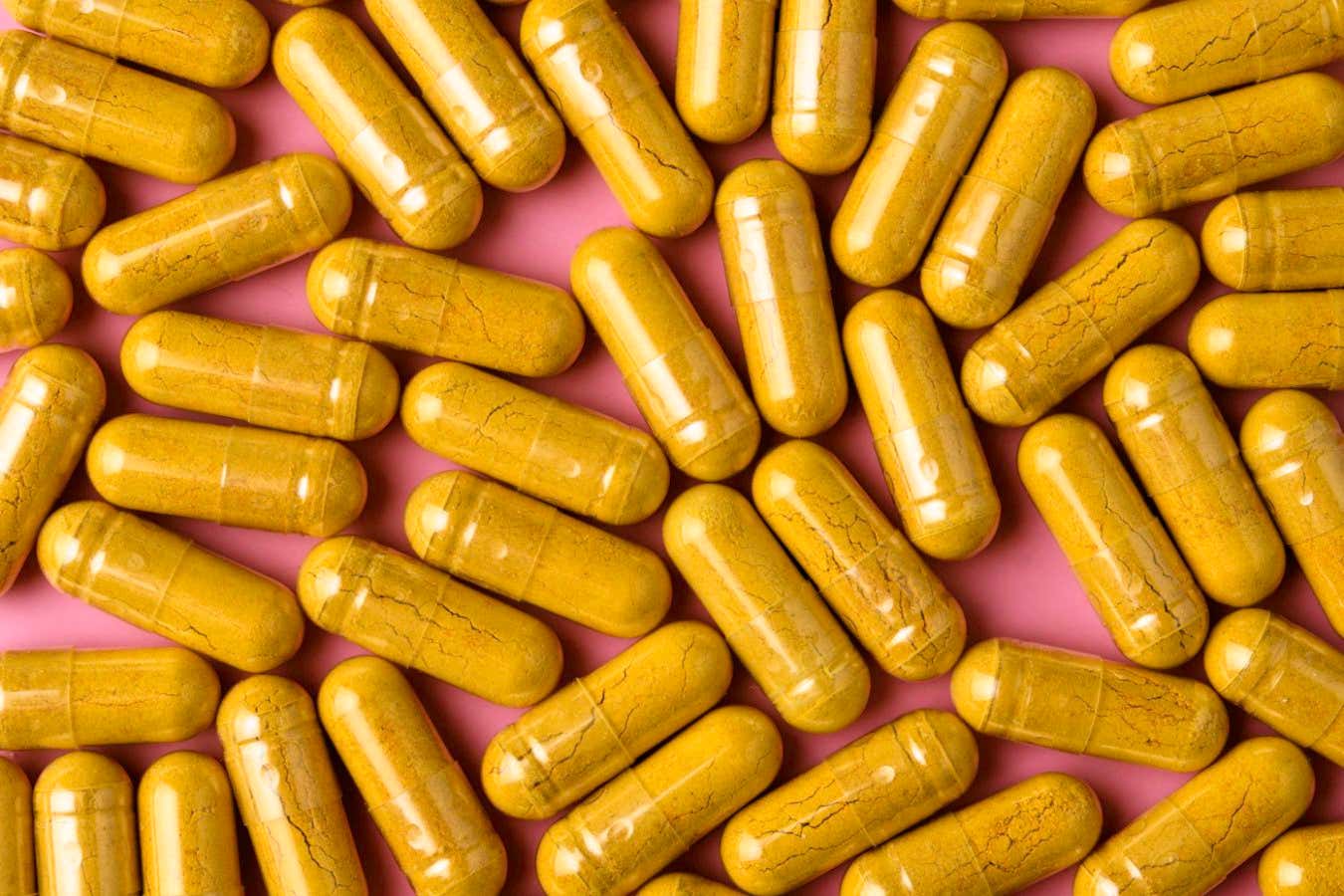

A compound in turmeric called curcumin is sold in supplement form, but what are its benefits?
SOLDATOOFF/Shutterstock
As the temperature drops in Australia, I’ve been seeing recipes on social media for “golden milk”, a mix of turmeric, other spices and honey in warm milk. In addition to being delicious, it is meant to have medicinal qualities, thanks to a compound in turmeric called curcumin, which gives it its distinct yellow colour. Curcumin is said to have anti-inflammatory properties that are protective against cancer, arthritis, hay fever, Alzheimer’s disease, menopause symptoms and many other ailments. But is this based on solid evidence?
Turmeric has been used in South Asian cooking and medicine for thousands of years, but has been exalted as a “superfood” in the West over the past couple of decades. This is largely thanks to the research of Bharat Aggarwal, a biochemist formerly at the University of Texas MD Anderson Cancer Center. Starting in the early 2000s, he published over 100 papers showing that curcumin reduces inflammation and kills “almost all types” of tumour cells. This sparked the popularity of the turmeric latte and curcumin supplements, and inspired a bevy of other studies. US health agencies have spent more than $275 million on curcumin research since 1990, with a large uptick following Aggarwal’s early work.
The idea that a tasty, vibrant-coloured spice rooted in traditional Ayurvedic medicine might be a modern medical panacea has appeal. But a large question mark now hangs over the validity of Aggarwal’s research findings. In 2012, the Office of Research Integrity at the US Department of Health and Human Services notified MD Anderson Cancer Center about allegations by academic whistleblowers of potentially fraudulent results in at least 65 of Aggarwal’s papers (although that does not mean that the results are in fact fraudulent). Aggarwal left the cancer centre after an internal investigation and 30 of his papers have now been retracted from scientific journals based on concerns about the authenticity of the results. Aggarwal’s papers, of which there are several hundred, are still regularly cited. New Scientist was unable to reach him for comment.
Personally, I find it surprising that curcumin has managed to attract so much research attention because a quick look at its chemistry tells you it is unlikely to be much good as a drug. Years ago, when I did a PhD in cancer drug development, one of my lab colleagues experimented with curcumin, but found it almost impossible to work with because of its poor solubility and tendency to degrade. A 2017 review in the Journal of Medicinal Chemistry, led by Kathryn Nelson at the University of Minnesota, concluded that “curcumin is an unstable, reactive, nonbioavailable compound and, therefore, a highly improbable lead” for therapeutic use.
Because very little curcumin dissolves in water, it isn’t easily absorbed into the blood following ingestion. Instead, most of it stays in the gut and is excreted in faeces. A study published by Dutch researchers last year found that curcumin was barely detectable in the bloodstreams of men who took curcumin supplements, even high doses of “enhanced” formulations meant to boost absorption with piperidine from black pepper or nanoparticle delivery systems. The concentrations detected in the volunteers’ blood were more than 100 times lower than those that have shown activity against cancer cells in a dish.
This probably explains why curcumin has failed to show convincing benefits in any rigorous clinical trials of people with cancer, arthritis or other conditions. According to Nelson and her colleagues, curcumin is “a missile that continually blows up on the launch pad, never reaching the atmosphere or its intended target(s).”
Too much of a good thing

Scanning electron micrograph of a hepatic stellate cell, which forms scar tissue in response to liver damage
STEVE GSCHMEISSNER/SCIENCE PHOTO LIBRARY
Concerns have also been raised about the safety of turmeric and curcumin supplements. Turmeric is safe to eat in curries and other meals because small amounts are mixed with other ingredients. Moreover, only around 5 per cent of the dry weight of turmeric is curcumin. But supplements containing concentrated curcumin, especially enhanced formulations, are digested differently and can cause liver problems in some individuals. According to the US National Institute of Diabetes and Digestive and Kidney Diseases, “turmeric appears to have become the most common cause of clinically apparent, herbal-related liver injury in the United States”, with most cases “attributed to highly bioavailable forms of curcumin” like the enhanced formulations the Dutch researchers studied.
Symptoms of these liver injuries include yellowing of the skin, dark urine and nausea. They usually resolve once a person stops taking the supplement, but a small number of people have died of liver failure.
Another concern is that turmeric products are sometimes adulterated with harmful substances. In the US, for instance, more than a dozen brands of ground turmeric spice were voluntarily recalled between 2011 and 2016 after they were found to contain lead chromate, which was added to enhance the spice’s yellow colour. Some children who regularly ate food spiced with these products were found to have dangerously high lead levels in their blood. In Norway and Sweden, meanwhile, a turmeric supplement that caused liver problems and some deaths was found to be adulterated with a pain medication called nimesulide.
I had a go at brewing up some golden milk, hoping the turmeric in my cupboard was lead-free, and can confirm that it is deeply comforting to the soul, if nothing else. I think I will make it a winter staple, but with the recognition that its magic lies in turmeric’s unique flavour, rather than in any miracle health benefits. Aggarwal and his colleagues once wrote in the journal of the American Association of Pharmaceutical Scientists that curcumin’s efficacy may seem “too good to be true”. He was certainly right about that.
Topics: