



Able-bodied people need to step up and do their bit to counter Ireland’s ‘dysfunctional’ public transport system, a prominent disability advocate said this week.
Gary Kearney, an acquired brain injury survivor and a spokesperson for the Disability Federation of Ireland, said transport networks are ‘moving forward’ in relation to accessibility.
But he said able-bodied people in the National Transport Authority (NTA) are ‘telling disabled people what’s right and what’s wrong for them’ regarding how they fund accessibility upgrades.
He also revealed how ‘selfish’ able-bodied passengers can make life very difficult on board public transport services.
Mr Kearney told the Irish Mail on Sunday: ‘[Other passengers] take their space. If you’re slow moving, they push you out of the way.
‘I’ve seen people do that – there’s somebody in a wheelchair, and they just push the wheelchair out of the way.’

John Fulham, who is public engagement manager at the Irish Wheelchair Association, described the Irish public transport system as ‘dysfunctional’ in terms of accessibility
The advocate continued: ‘A lot of the problems on the DART are caused by abled people taking disabled spaces.
‘You’ll see bikes chained up in the wheelchair space, and people walk away.
‘A friend of mine is a wheelchair user who gets the bus home to Clontarf, and people stand in front of her literally with their crotch in her ear.’
Wheelchair-using Dublin Bus passengers must hope the one space dedicated to them is vacant – and the ramp is working – when a bus pulls up, but these spaces are often occupied by buggies, Mr Kearney said.
‘The amount of times I’ve literally yelled at people to get out of the wheelchair space.
‘The amount of times people with buggies refused to fold them for a person in a wheelchair.
‘That’s not Dublin Bus’s fault. That’s people’s fault.’
Mr Kearney, who is a member of the Dublin City Council public participation network for disability and has spoken at Oireachtas committee meetings, called on the public to intervene if they witness this – bus drivers are not obliged to and don’t always get involved.
While he said Ireland has progressed hugely in recent decades, there are still significant issues faced daily by disabled passengers.
Most train stations in Ireland are unmanned, and wheelchair users have to call four hours in advance to make sure someone is there to set a ramp up for them.
The lifts at train stations ‘are getting better’, but breakdowns are not uncommon.
And Bus Éireann passengers have to compete for just one space on its accessible busses, while the lift to bring them aboard has been known to break down while operating, with wheelchair users stuck outside until maintenance arrives.
John Fulham, who is public engagement manager at the Irish Wheelchair Association, described the Irish public transport system as ‘dysfunctional’ in terms of accessibility.

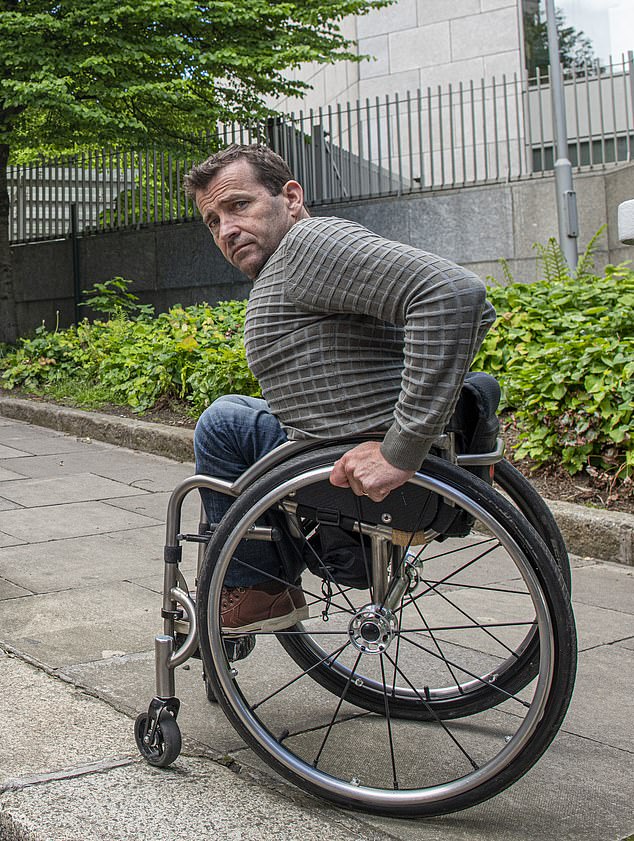
Gary Kearney: ‘Selfish, able-bodied passengers can make life very difficult on board public transport services’
He compared decisions made on accessibility to a well-known budget airline’s cost-cutting measures, whose CEO ‘doesn’t want disabled people on these airlines because they slow down his turnaround’, according to Mr Fulham.
Leaving stations unmanned ‘was a decision purely based on finance’, the four-time Paralympian said. ‘As somebody who uses a wheelchair, [having to give advanced notice of travelling] is s***.
‘The lads can’t ring me up and say, “Johnny, coming into town for a pint?” I’m kind of going, “I’d love to, but sorry. I can’t. I’ve got to give four hours notice.”’
‘They’ve made a decision that has impacted people, and they’ve tried to put in a process that will negate that or mitigate that, but it doesn’t.
‘The term I often use is that people with disabilities are the acceptable collateral damage in trying to get a system that will work for everyone. And I don’t think that’s fair anymore.’
Some but not all train drivers will get out and put the ramp up for disabled passengers.
‘I’m sure there are demarcation disputes and union disputes and about job responsibility,’ Mr Fulham continued.
‘I’m not going to argue for or against that. I’m arguing for the fact that people with disabilities need to be able to use the train.’
The advocate said stories recounted to the MoS of disabled people being stuck out in the rain after a bus ramp wouldn’t work are ‘not the worst case scenarios – they’re very real.’
‘There are people who are missing medical appointments. There are people who can’t get from A to B. They’re being left isolated at home.
‘ Unless you can guarantee you’re going to get there, any employer is not going to tolerate you being late, unless they’re really, really accommodating.’
Mr Fulham said there has been a ‘cultural attitude over the years’ that people with disabilities ‘weren’t considered as part of anything’ in Ireland.
‘We were regarded as people who were to be looked after and cared for, and not as equal participants in the community, in the world we live in.
‘That’s now changing, but we’re constantly having to fight for the changes to be made.’
In response, Bus Éireann said all vehicles on its ‘public service obligation routes and Expressway services are wheelchair accessible, and our city and town fleets are 100 per cent low floor accessible’.
A spokesperson said: ‘Our regional and Expressway coach fleets are also wheelchair accessible, though the availability of fully accessible routes depends on local bus stop infrastructure.
‘We continue to work with the NTA and local authorities to expand fully accessible routes.’
Dublin Bus said its ‘entire fleet’ is ‘fully accessible’, adding: ‘Low floors, ramps, and priority seating support those with mobility needs, while audio-visual announcements assist passengers with sensory impairments.’
A spokesperson agreed if there is a wheelchair user already on the space on the bus, that person will have to wait for the next bus. ‘Dublin Bus drivers may request that customers fold and stow buggies, but they cannot enforce this.’
Irish Rail said a new DART fleet operational next year will have an automated retractable step at every door to cover the gap between train and platform.
A spokesperson said notice for accessibility assistance has been reduced from 12 hours to one hour at most major stations.