


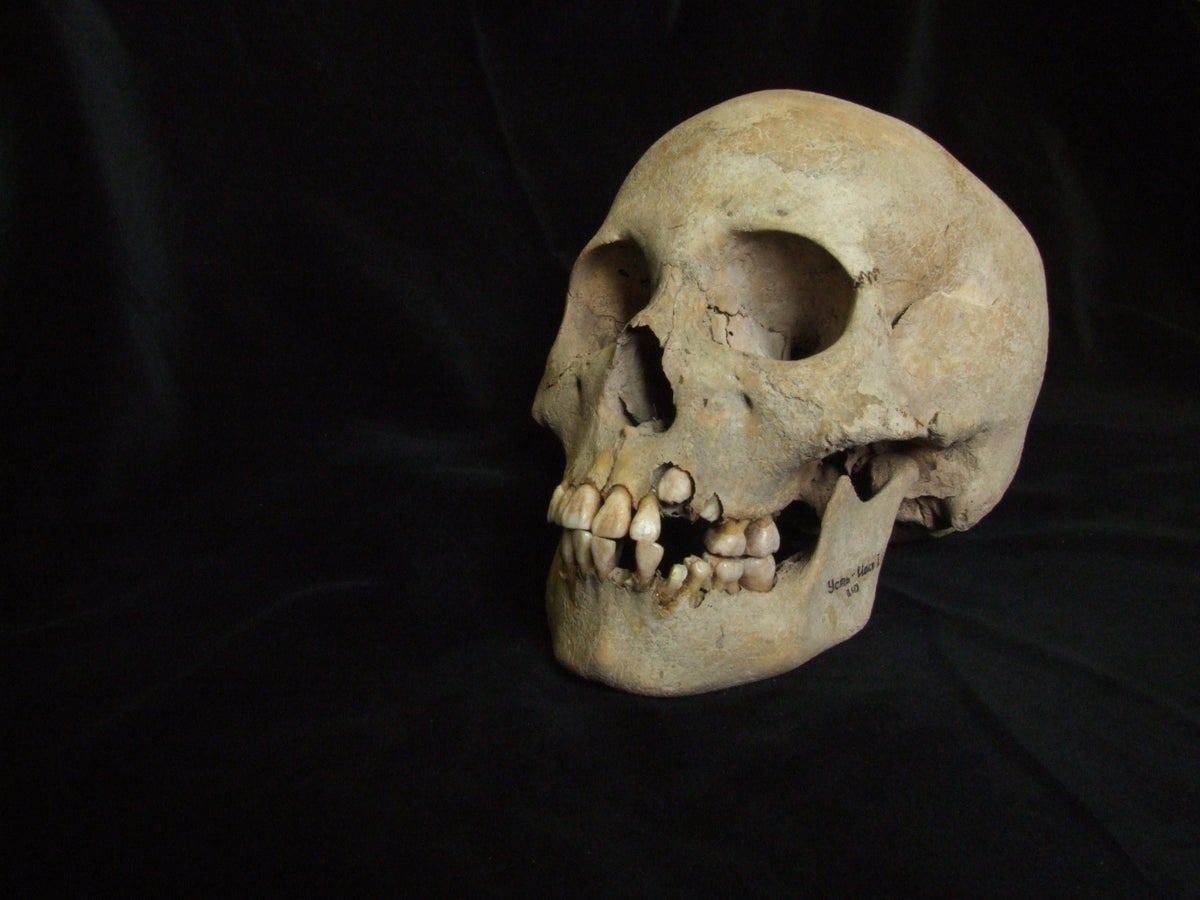
Plague has terrorized humans for millennia: In the 1300s the Black Death sparked the deadliest pandemic in human history, killing as many as half of all the people in Europe. Long before that, around C.E. 540, plague destabilized the Roman Empire, and some scholars argue this may have precipitated the empire’s collapse. But when and where plague actually first arose has long been a mystery. Now a new study published today in Nature claims to have identified deadly cases of plague in hunter-gatherers dating back some 5,500 years ago. The outbreak marks the earliest known cases of plague in human history.
The findings reveal a new characteristic of ancient plague outbreaks: they didn’t need densely populated communities to occur, says Roman Woelfel, director of the Bundeswehr Institute of Microbiology in Germany, who was not involved in the new study.
“This study is exciting because it pushes lethal plague outbreaks further back in time and into a very different social setting than we often imagine,” he says. “The striking point is that these were not dense urban or farming populations but small hunter-gatherer communities, yet plague still appears to have caused severe, clustered mortality.”
On supporting science journalism
If you’re enjoying this article, consider supporting our award-winning journalism by subscribing. By purchasing a subscription you are helping to ensure the future of impactful stories about the discoveries and ideas shaping our world today.
The researchers analyzed the remains of dozens of hunter-gatherers buried in cemeteries near Lake Baikal in Siberia during the mid-Holocene—a period that spanned from about 7,000 to 5,000 years ago. Genetic data revealed many of the individuals were infected with Yersinia pestis, the bacterium that causes plague. They found that many members of the same family were infected, suggesting human-to-human transmission. Children between the ages of eight and 11 were especially vulnerable.

This shared grave contained a boy (aged 12-15 years old) and a girl (aged 13-16 years old) who were found to not be closely related, and plague DNA was obtained from their remains.
“This is the first time that we’ve seen direct evidence for mass lethality and outbreaks of plague in prehistoric hunter-gatherer societies,” said Ruairidh Macleod, lead author of the paper and a postdoctoral research fellow at the University of Oxford, at a press briefing on Tuesday.
Y. pestis has been detected in ancient graves before, including in farming communities that existed some 5,000 years ago. But until now, there was no clear evidence of how deadly the oldest strains would have been.
The findings shed new light on the evolution of Y. pestis, a pathogen that “played an extremely important part of human history” and is still circulating today, noted environmental geneticist Eske Willerslev, senior author of the paper and a professor at the University of Copenhagen and the University of Cambridge, at the same press conference. Today the bacterium isn’t nearly as deadly as it once was—in large part thanks to antibiotics but also because of changes to its genome.
“Ancient bacterial genomes are a kind of evolutionary archive. They show us when pathogens acquired traits that made them more transmissible, more virulent, or better adapted to particular hosts or vectors,” Woelfel says.
“For plague, this matters today because Yersinia pestis is not only a historical pathogen. It still persists in animal reservoirs and can spill over into humans,” he adds. “Understanding how plague moved between animals and humans in the past helps us think about zoonotic risk in the present.”
Understanding how this bacterium evolved could help scientists better prepare for future outbreaks, Willerslev said. Part of what made Y. pestis so deadly during Black Death, for instance, was a mutation in the bacterium that allowed it to survive in fleas—and jump to humans via flea-infested rats.
Y. pestis samples older than about 3,800 years don’t have that mutation, suggesting 5,000-year-old strains likely weren’t spread by fleas. In the new study, the researchers hypothesize the bacterium may have jumped to humans from marmots, a kind of ground squirrel, remains of which were also found at the Siberian burial sites.
What remains unclear is how widespread these ancient animal reservoirs of plague might have been, Woelfel says. “For future work, the big question is not only when plague emerged but how it moved between animals, landscapes and people,” he adds.
Ultimately, the paper is another point of information in understanding how dangerous bacteria emerge, evolve and spread over time, he says.
“Plague is often treated as a disease of the past, but this paper shows why its evolutionary history remains relevant for public health and biosecurity today,” Woelfel says. “It is still an ecological disease, maintained in animal reservoirs, and that makes its past directly relevant to how we assess risks today.”
It’s Time to Stand Up for Science
If you enjoyed this article, I’d like to ask for your support. Scientific American has served as an advocate for science and industry for 180 years, and right now may be the most critical moment in that two-century history.
I’ve been a Scientific American subscriber since I was 12 years old, and it helped shape the way I look at the world. SciAm always educates and delights me, and inspires a sense of awe for our vast, beautiful universe. I hope it does that for you, too.
If you subscribe to Scientific American, you help ensure that our coverage is centered on meaningful research and discovery; that we have the resources to report on the decisions that threaten labs across the U.S.; and that we support both budding and working scientists at a time when the value of science itself too often goes unrecognized.
In return, you get essential news, captivating podcasts, brilliant infographics, can’t-miss newsletters, must-watch videos, challenging games, and the science world’s best writing and reporting. You can even gift someone a subscription.
There has never been a more important time for us to stand up and show why science matters. I hope you’ll support us in that mission.