


Dean Robbins is a journalist and children’s author. He contributed this article to Space.com’s Expert Voices: Op-Ed & Insights.
The pioneering computer scientist Margaret Hamilton, who died on Sept. 30 at age 90, played a key role in putting astronauts on the moon. She was a problem-solver extraordinaire, and it all started in early childhood.
Considering the name “daddy longlegs” unfair to female arachnids, young Margaret decided to call half of them “mommy longlegs.” Wondering why the neighborhood baseball players were all boys, she determined to join the team herself.
As she grew up in the 1940s and ’50s, Margaret noticed a similar problem with various professions. Why were doctors, judges and scientists almost always men? The solution: she would study hard in school and prepare herself for any job she might care to do.
It’s no surprise that a born problem-solver would gravitate to computers. In the late 1950s, the new technology offered mind-bending possibilities, and this college math major saw a chance to put her skills to use on a cosmic scale.
Hamilton had long been a stargazer, thanks to a philosophical father who taught her to love the night sky. In 1965, after stints in meteorology and satellite tracking, she became interested in a Massachusetts Institute of Technology project that designed in-flight computers for NASA’s moon mission.
The team, of course, consisted solely of men. But, just as with her neighborhood baseball team, Hamilton refused to accept limitations for herself or anybody else. She kicked open the door and quickly rose to director of software engineering.
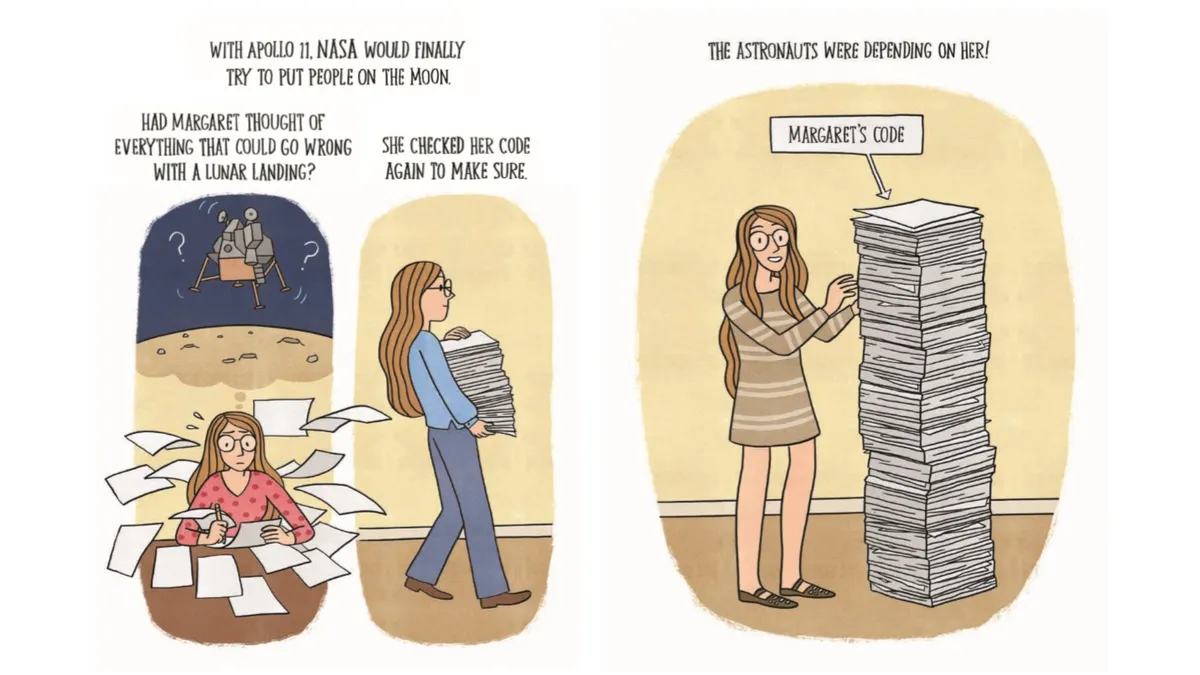
With her knack for devising novel solutions to seemingly insoluble problems, no one was better suited for the job. Working with the era’s primitive technology, Margaret thought through the various mishaps that could occur on a spaceflight and designed the software to handle every contingency.
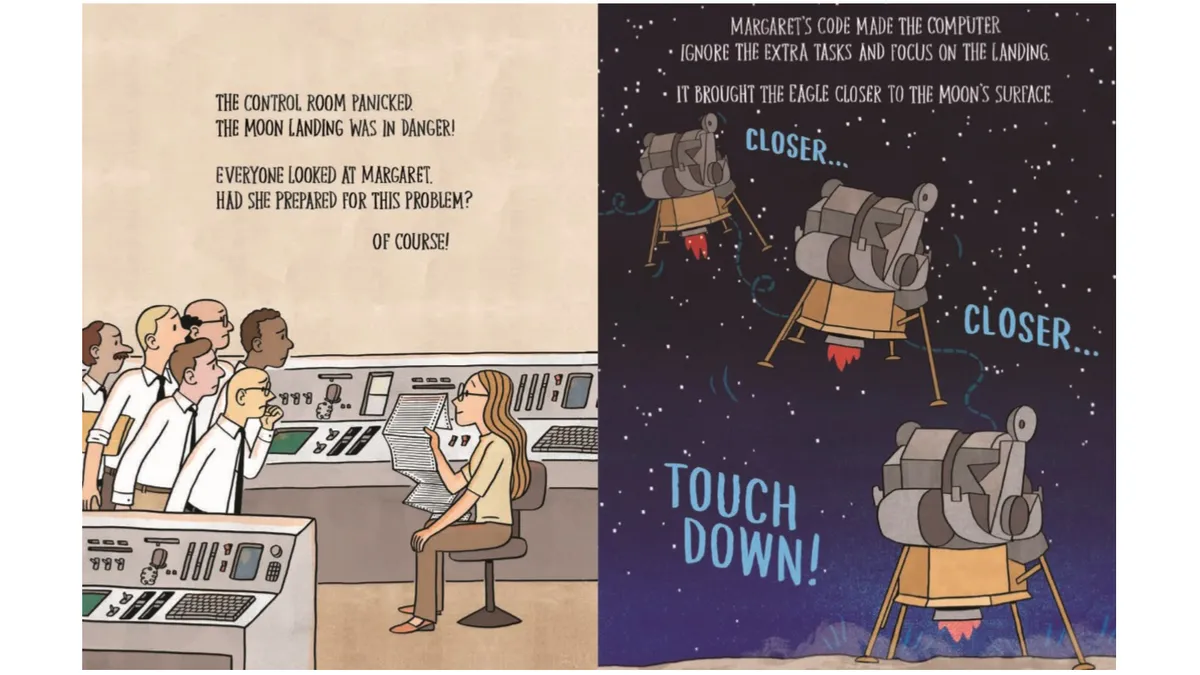
The epochal Apollo 11 moon mission of 1969 put her planning to the test. As astronauts Neil Armstrong and Buzz Aldrin neared the moon’s surface in their lunar module, an error overloaded the onboard computer’s processing unit. Mission Control faced the prospect of aborting the landing, but Margaret’s ingenious programming allowed the system to prioritize essential tasks while canceling the inessential ones. The lunar module touched down without a hitch, and Armstrong and Aldrin became famous.
Sadly, Margaret Hamilton did not. She continued to work behind the scenes, contributing to the five additional lunar landings as well as Skylab and the space shuttle. In 1976, she struck off on her own to start a software company. She might have lived the rest of her life in obscurity if not for a fateful black-and-white photograph from 1969.
This image began to attract attention on the internet in the 2010s. It showed Margaret wedged between a coatrack and a blackboard at MIT, standing beside a towering stack of her printed code from the Apollo missions. Bespectacled and smiling, she radiates the confidence of a scientist who had stormed the boys’ club and conquered the universe.
I was one of those fascinated by the photograph, and I contacted Margaret about the possibility of profiling her in a children’s book. She initially resisted, uncomfortable with being the center of attention. But she came to see the appeal of a book about herself that she could read to her great-grandchildren, so that they might be inspired to break barriers themselves one day. She warmed to the task of telling her life story and even sent me examples of her Apollo code, which Lucy Knisley incorporated in the illustrations for “Margaret and the Moon: How Margaret Hamilton Saved the First Lunar Landing.”
With the 2016 book and movie “Hidden Figures” calling attention to women’s overlooked contributions to the space program, Hamilton soon had to get used to being the center of attention. She received a Presidential Medal of Freedom and achieved LEGO immortality in the “Women of NASA” set. In 2019, to mark the 50th anniversary of the first moon landing, Google used reflected moonlight to create a massive portrait of Margaret in the Mojave Desert. Rarely has so humble a soul received so grand a tribute.
The world will miss Margaret Hamilton, but, just like her great-grandchildren, we will always have her example to inspire us. She showed that, no matter how daunting the obstacles, there are few problems we can’t solve.

