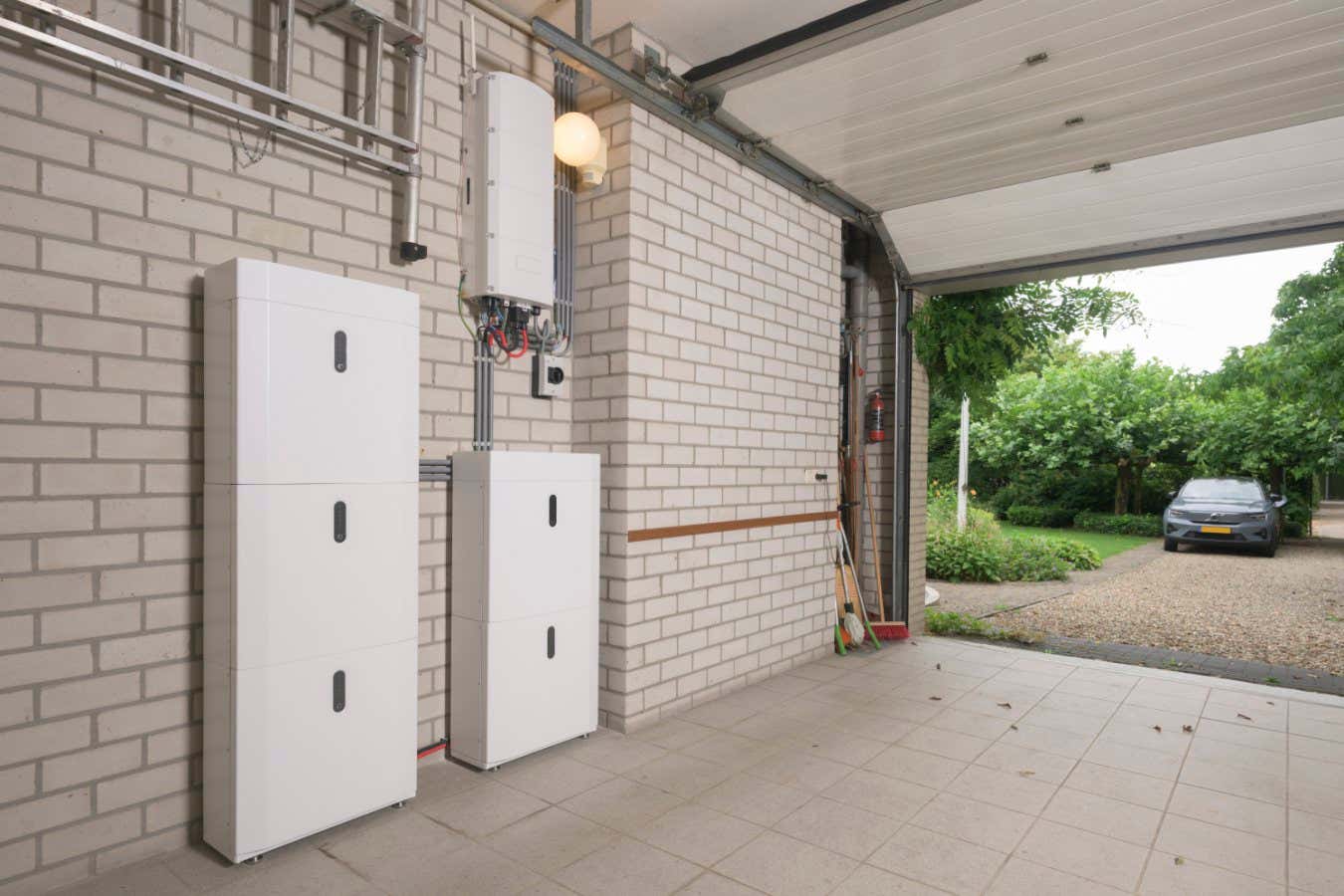

Home batteries can charge up when electricity is cheap and sell energy back to the grid at peak times
Mischa Keijser/Westend61/Getty Images
Think of climate solutions in homes and you will probably think of solar panels on the roof. But a suitcase-sized battery in the closet can be a cheaper way to save money and the environment.
Although rooftop solar has been expanding, battery storage is now the world’s fastest-growing power technology, according to the International Energy Agency, including home batteries that can power the house and sell leftover energy to the grid. Most of these are paired with rooftop solar, but as energy prices rise, more and more homeowners have been buying just the battery.
Now, countries are starting to allow home batteries that can simply be plugged in, rather than professionally installed.
“That could be the game changer… that I think suddenly opens it up to a lot more people,” says Iain Staffell at Imperial College London. “Low-cost plug-in batteries could be the next rooftop solar.”
More than 40,000 homes and small businesses installed battery systems in the UK last year with or without solar, nearly doubling the record from 2024. Installations of both home solar and battery systems by Octopus Energy doubled from February to March after the Iran war began disrupting energy supplies, and they have remained higher than pre-war levels as Britain’s energy regulator announced it would raise the state cap on energy prices.
In the US, home battery installations were up 75 per cent in 2025, even as rooftop solar growth slowed. The technology is also expanding rapidly in places like China and Australia, while in Germany, 1 in 6 homeowners have a home battery, making more than 2 million in total.
On a variable tariff, a battery can charge up in the early afternoon or at night, when electricity costs as little as 5 pence per kilowatt-hour in Britain. Then it can power the home when demand peaks from 4 to 7 pm, and a kilowatt-hour can cost 40 pence. Air conditioning and fan use during the current heatwave has driven that price up to nearly 50 pence.
While homeowners in the UK currently spend an average of £9400 on a battery system, Octopus’s forthcoming plug-in option will cost less than £300. The size of a shoebox, it will only store 2 kilowatt-hours, enough to run a fridge for one to two days, but it will allow renters to get in on the game once approved for consumer use, which is expected to be in 2027.
“You’re going to get return on investment in two to three years,” says Phil Steele at Octopus. “That should make it a no-brainer.”
Home batteries also cut greenhouse gas emissions by reducing consumption during peak times, so power companies don’t need to burn as much gas to supplement low-carbon sources of energy. On those windy, sunny, low-demand days when Britain’s grid briefly runs on almost 100 per cent zero-carbon sources, storing energy in a home battery can help the climate even more than generating unneeded energy with home solar.
Last year, the UK paid wind farms £379 million to shut down when the grid couldn’t handle that energy, a surplus that could have been partly stored in batteries. If half the homes in Britain had a 5-kilowatt-hour home battery, that would meet the government’s 2030 goal for battery storage, most of which is expected to be delivered by grid-scale batteries.
As the average share of solar and wind in the energy generation mix increases, home batteries will be even more crucial to balance the grid and even better for the climate, according to Staffell.
“Probably solar is better at the moment, but fast-forward five years, the batteries would be more important then,” he says.
However, the manufacturing process could lessen home batteries’ climate benefit, according to Aritra Ghosh at the University of Exeter, UK. There’s also currently no infrastructure to recycle millions of home batteries at the end of their lifespan, which Octopus expects to be at least 12 years.
A recent study found that producing a lithium-ion battery emitted about 150 to 200 kilograms of carbon dioxide equivalent per kilowatt-hour of capacity, about as much as driving a petrol car 1 kilometre. This could be greatly decreased if hubs like China were able to decarbonise heavy industry, but “currently we are not even close to that scenario”, says Ghosh.
Topics: