


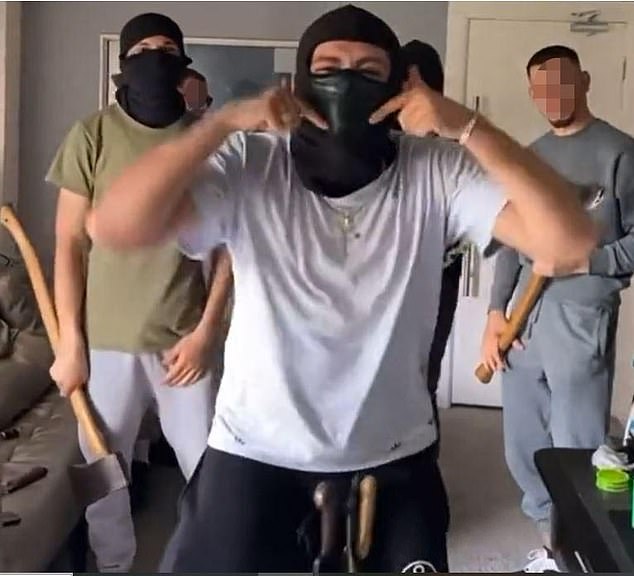
Sweeping across the country at pace, Albanian gangs have rapidly taken over the UK’s drug market – and all the crime that comes with it.
Picking off local groups one by one, Balkan kingpins have built up a near insurmountable dominance over the criminal underworld by using links to Colombian cartels to secure the best value cocaine and violently exacting revenge on those who dare oppose them.
But now they have competition.
As the UK’s demographics change rapidly, emerging gangs have been viewing the Albanian success story from afar – and they want a piece of it.
While rivals boldly muscle into established territory in the big cities, eastern European bosses are responding by branching out into untapped criminal markets, including your favourite seaside resort or country town.
Ministry of Defence (MoD) prisoner stats obtained by the Daily Mail via Freedom of Information request reveal jails across the south coast are now filled with Albanian inmates, from Dorset and Devon to Hampshire and Sussex, following an invasion of Balkan gangs terrorising local communities.
Meanwhile, idyllic Oxfordshire – home to vast swathes of the well-heeled Cotswolds – holds more Albanians in its jails than anywhere outside of London and Kent, data from all prisons in England and Wales reveals.
It reflects a dramatic changing of the guard as new arrivals – often asylum seekers from Africa and the Middle East – look to make their mark on Britain’s often lucrative crime circuit.
But in some areas the traditional ring leaders are holding firm after decades of dominance.
Old crime families are still feared in parts of London despite a wave of new competitors, including African and Caribbean gangs in Tottenham and Peckham, experts say.
Meanwhile, Turkish families are clinging on to power across the north of the capital, while the Tamil community continue to terrorise Croydon decades after they first established control.
Similarly Indian and Pakistani gangs formed in the mid-20th century patrol the streets of Birmingham with few real rivals.
And other cities, such as Liverpool and Glasgow, remain immune to foreign groups invading their turf and are still governed by British gangsters.
What’s certain is that the UK’s crime map is being ripped apart and redrawn with dozens of nationalities now making their mark.

Sweeping across the country at a terrifying pace, Albanian gangs have rapidly taken over the UK’s drug market – and all the crime that comes with it

Two gangsters pose with large wads of banknotes in an image posted to Instagram

Other nationalities are also making their mark. Algerian phone thief Aouidj Abderaouf is pictured walking past a rucksack, bottom left, that he later made off with
Rampant Albanian gangs in Essex and Kent
The Daily Mail’s analysis of MoD prisoner stats has revealed the Albanian chokehold on the UK’s criminal activity is far from overstated, with 1,053 of 7,590 foreign prisoners hailing from the Balkan nation.
First making an impact in east London, they quickly gained a foothold even further east and now have 139 compatriots behind bars in Kent’s prisons – HMP Maidstone, HMP Rochester, HMP Cookham Wood, HMP East Sutton Park and the Sheppey Cluster jails.
Hi, I’m Alex Matthews, Editor of The Crime Desk.

It was over 30 years ago that Fred and Rose West’s ‘house of horrors’ was found – but have you ever wondered what happened to their children? Some live in fear, others have happy lives. Sign up here to get our exclusive piece for free.
A Daily Mail investigation in December found an Albanian based in the area was running a network helping crooks flee for £2,500.
The criminal, named Alfons, who should be behind bars himself, told an undercover reporter he used four drivers – all Kosovan-Albanians.
He later sent our reporter a link to the meeting spot on the Maidstone M20 Services, in Kent, the last refuel and rest stop before the Eurotunnel terminal connecting to the Continent.
Meanwhile, more than a third (28) of the non-British inmates in Essex’s HMP Chelmsford prison are Albanian, proving their influence in the South East.
Albanian drug dealer Valentin Roci, who sneaked back into Britain on a dinghy after being deported, discovered in August he is set to be kicked out again for selling cocaine.
His latest arrest came when police pulled over a Ford Mondeo with a broken brake light in Southend, Essex, only to discover Roci behind the wheel without insurance. Officers searched him and uncovered £1,195 in cash, eight wraps of cocaine and one wrap of cannabis.
Albanians also make up three-quarters (28) of the foreign prisoners in Durham, a third (18) in Bedfordshire, and one in three in Sussex (26).
They also make up sizeable proportions of the inmates in Hampshire, Suffolk, Devon, Cornwall and Lincolnshire.
Join the discussion
What do you think needs to happen to take back control from powerful organised crime gangs in the UK?


Albanians continue to hold sway in Kent and Essex (Pictured, left, Kent-based Alfons who helps crook flee the UK for £2,500; and, right, Essex drug dealer Valentin Roci)

A social media photo of an Albanian gangster holding a gun at the wheel of a car. Our map shows that Balkan gangs have been forced to spread to new parts of the country

In this photo, a fearsome looking weapon lies on a table next to a luxury watch and a large amount of cannabis
Newcomers fighting for control of the capital
But some regions have held strong in the face of Albanian gangs, often thanks to the persistent dominance of their home-grown crime networks.
Take the capital. A troupe of 138 Albanian inmates prowl London’s jails, including 45 in HMP Wandsworth and 26 in Wormwood Scrubs, but more notable are the groups soaring up the crime stakes.
Algerian phone theft gangs now dominate the City, targeting wealthy employees enjoying a post-work drink.
This phenomenon means more than half of the UK’s prison population from the north African country (92) are now locked up in London.
The top four jails for Algerian inmate numbers are all in the capital – Wandsworth, Wormwood Scrubs, Thameside and Pentonville.
Video footage showed the moment Algerian thief, Enzo Conticello, swiped a whisky executive’s Givenchy handbag from a Soho pub – not realising it contained a £2million Fabergé egg and watch.
He targeted Rosie Dawson, director of premium brands at Craft Irish Whiskey, as she greeted a friend outside the Dog and Duck pub in Bateman Street.
Conticello was jailed for two years and three months with both the egg and watch remaining missing after the theft.
One trio – Adam Zawi, Oussama Fadage, and Aouidj Abderaouf – were jailed after being caught on camera swiping rucksacks filled with £4,000 worth of laptops, tablets and headphones.
And Algerian migrant Munir Ghilas, 28, targeted 16 separate City workers at bars in central London between August and September last year – stealing some £31,000 of goods. He was jailed for 18 months.
Emerging migrant groups are also competing in the capital’s crime scene, adding to the melting pot of nationalities causing police problems in the city.
Some 60 Afghans, 27 Eritreans and 27 Syrians are now locked up in London’s jails – again particularly in Wormwood Scrubs and Wandsworth – reflecting their increased presence on the capital’s streets.
One Afghan, Samiullah Ahmadzai, has been boasting about his life behind bars at Wormwood Scrubs in Hammersmith, west London in brazen posts on TikTok.
Videos show Ahmadzai perched on the top bunk of his bed filming Afghan flags he has drawn on the wall before panning to his well-stocked selection of snacks – including chocolate bars, fruit, fizzy drinks and sausages.
The Afghan is being held at the jail for his alleged role in a ‘dangerous’ trafficking gang and is currently undergoing extradition proceedings over a return to Belgium at Westminster Magistrates’ Court.
Meanwhile, Eritrean migrant Aron Hadsh was last year handed a 14-month prison sentence after he sexually assaulted an ‘extremely vulnerable’ teenage girl who has learning difficulties in a park in broad daylight.
He was living at a taxpayer-funded Holiday Inn near Heathrow when he attacked the 19-year-old in June last year after she had been sent by her mother to pick up fruit from a food bank.
London also hosts every single Libyan inmate in the country amid a wave of recent migration, across Wandsworth, HMP Pentonville, HMP Thameside and Wormwood Scrubs.
In some parts of the capital the historic old guard is actually clinging on, experts revealed.
Turkish crime families still rule the roost in parts of north London with 47 inmates from the country in the city’s jails in total.
African and Caribbean groups dominate Tottenham and Peckham, and the Tamil community is still feared across Croydon – and the numbers support these long-accepted orthodoxies.
Dr Simon Harding, of the National Centre for Gang Research, told the Daily Mail: ‘We have street gangs reflecting the neighbourhoods they come from.
‘If that neighbourhood is white they will be white, if south Asian they will be south Asian, if black then black, and so on so forth.’

Alleged migrant trafficker Samiullah Ahmadzai, pictured, is one of a wave of Afghan criminals who have called London home in recent years

Eritrean migrant Aron Hadsh, pictured, attacked a 19-year-old in West Drayton in June last year after she had been sent by her mother to pick up fruit from a food bank
Homegrown strongholds
Mr Harding also revealed that Liverpool and Glasgow – though the latter is excluded from the MoD’s England and Wales-only prison statistics – are run by predominantly British or Irish gangs.
Around 91 per cent of prisoners in Liverpool’s HMP Altcourse and HMP Liverpool jails are British with just 19 Albanian inmates in total.
Indeed, most of these gang members are Scouse themselves, born and raised into one of the city’s main crime families.
‘There hasn’t been the opportunity of breaking into the criminal networks in those areas,’ he said.
‘For example, the cocaine trade has been very much taken over by Albanians but the one place they can’t break into is Liverpool because the Liverpool gangs are strong – the same half dozen big key families for many years – that’s not going to alter.
‘Digging into history you find original migrant groups in Glasgow and Liverpool were Irish,’ the crime expert said. ‘They have become settled and integrated but they also still hold a lot of power and sway over the fraternities in those cities.
‘The groups are so tight they don’t let the Albanians take hold.’
Expert witness Gary Carroll added: ‘Cities further north have a lesser multicultural split when compared to the likes of Birmingham and London.
‘These do include Liverpool, Newcastle. And in Scotland above urban street gang level, most upper criminal groups are still for now a white majority, especially in Glasgow, Edinburgh and Aberdeen.’
Liverpool is carved up among several powerful and historic gangs and prison sentences have not been enough to stop bosses running their criminal operations from the inside.
Particularly infamous in the Liverpool crime scene is the Huyton Firm, which since its founding in the late 1990s has risen to become one of Merseyside’s most feared criminal outfits.
The mobsters, who worked with Thomas Cashman – murderer of nine-year-old Olivia Pratt-Korbel – ruled Merseyside with an iron fist for around 20 years.
But cryptic Encrochat text exchanges revealed in court chronicled crime boss Vincent Coggins’s plans for revenge against a rival gang for a drug raid led to Coggins’ arrest and conviction.
Following a trial, he was jailed for 28 years for drug trafficking and blackmail.
Several members of the Huyton Firm lived in Spain, where they developed relationships with major international crime groups including the Kinahan cartel.
Despite Coggins and his senior associates now being in jail, sources have told Daily Mail the Huyton Firm is still active in importing drugs into the UK.
Meanwhile one particular gang which formed in the early 2000s appears to still wield significant influence on the miles of dockland, scrap yards and backstreet boozers to the north of Liverpool city centre.
The group, which has no particular name, was responsible for a wave of car bombings between 2003 and 2004 that targeted police stations, nightclubs and homes.
Elsewhere, Curtis ‘Cocky’ Warren, arguably one of the world’s best known drug dealers thanks to publicity surrounding his life, made the transition from being a low-level street crook to setting up as major importer.
He was later jailed in the UK for drug dealing offences before being released in November 2022 after a 13-year spell.
While Warren now claims to be poor, prosecutors have told courts he is linked to a network of criminal assets and is worth in the region of £200m. He is said to own countless shops and apartments in Liverpool city centre that are not in his name.
While Warren served out his prison sentence in Holland, his associate Colin Smith presided over Warren’s firm back in Liverpool before he was murdered while leaving a gym in 2007.
Smith’s death led to a fracturing of the old criminal order that once ruled the estates of Netherley and Speke.
Through time a former boxer known as the Bird of Prey began to emerge as the new titular figure to control the south of Liverpool.
The Bird of Prey – who cannot be named for legal reasons because he does not have a criminal record – had established his own reputation as a gangland enforcer, and was feared by many, before an assassination attempt in 2010.

Liverpool continues to be run by homegrown gangsters, including Vincent Coggins, pictured, who helped form the Huyton Firm


Albanian gangs have struggled to topple Liverpool’s British and Irish groups (Pictured: Paul Woodford, left, was an enforcer for a gang, while Thomas Cashman was used as a hitman)
Manchester’s thriving African gangs
The same cannot be said of Manchester, where more than one in 10 prisoners (35) are Albanian including 26 in HMP Forest Bank – but the economically thriving city in the north-west is also experiencing problems at the hands of other nationalities.
Its prisons hold 20 per cent (17) of the Eritrean inmates across the UK including 12 in HMP Risley, despite accommodating just four per cent of Britain’s foreign prisoners.
Last year a group from the African country were allowed to set up a camp in Manchester city centre hours after being evicted by the authorities from their previous tent village.
Eritrean asylum seekers admitted to the Daily Mail it was ‘madness’ they had been allowed to move from one site to the next without any intervention from the authorities.
Meanwhile, the city has seen an influx of Nigerian and Sudanese migration which has translated into the growing prisoner statistics with 18 and 19 in Manchester’s jails respectively.
Just last month, Nigerian migrant Gift Oladele, who was living in Manchester, was convicted of carrying out a terrifying rape on a young woman walking home from a night out – as it emerged he tried to attack another female victim a few years earlier.
And Sudanese asylum seeker Edris Abdelrazig, who was staying in a three-star government hotel in Stockport, Greater Manchester, was in August charged with attempting to kidnap a 10-year-old girl in front of her father.
Some parts of the UK meanwhile have witnessed curiously large proportions of crime at the hands of one particular nationality.
Despite only containing around four per cent of the nation’s inmates, Lincolnshire’s HMP Morton Hall and HMP Lincoln jails hold 11 of the 37 Gambians currently behind bars.
Slovaks and Vietnamese criminals also make up a far greater chunk of the foreign prisoners in Yorkshire than they do for the rest of the country. Thirty-six and 23 per cent of their inmates are locked up in the area’s prisons.

Nigerian migrant Gift Oladele, who was living in Manchester, was convicted of carrying out a terrifying rape on a young woman walking home from a night out
Albanians spreading to the seaside
This surge in competition has driven Albanian gangs to pastures new, with previously genteel parts of the UK slowly being consumed by the Albanian crime machine.
Perhaps the scariest development in recent years has seen once idyllic seaside havens on the south coast becoming hotspots as crooks search for untapped mines of crime.
Sex crime has soared in Devon and Cornwall, Hampshire, Dorset and Sussex in the past four years, according to ONS stats, while violent crime has increased in Devon and Cornwall and Sussex.
The surge in criminal activity has been fuelled mainly by eastern European groups, according to prisoner figures, with more than 40 per cent of the non-British inmates across Dorset, Devon and Cornwall prisons either Albanian or Romanian.
Seventeen of 75 prisoners in these jails are Romanian while 15 are Albanian.
Some 24 of the 88 foreign prisoners in Hampshire are Albanian – all at HMP Winchester, as well as 26 of the 78 in Sussex jails, including 23 in HMP Lewes.
The south coast is a key entry point for migrants and contains some of the most populated asylum seeker hotels including three in Bournemouth alone.
Some arrivals attempt to land in the UK as far west as Cornwall, with one Albanian migrant, Romeo Zani, caught trying to enter the UK through various means – including via a yacht in Falmouth – told he would be deported for a fifth time in January.
And they are expanding their dominant drug operations to the south too. Earlier this year, a reporter in Brighton was able to purchase a gram of highly pure cocaine normally peddled by Albanians in the wealthy Cotswolds.
Last year it was revealed two Albanian ‘asylum seeker’ brothers, Klevis and Artur Hoxhosmani, launched their £335m cocaine empire from a car wash in Bournemouth eventually leading to their arrest by investigators in their homeland.
Romanian crime gangs, meanwhile, have been gaining a foothold in the organised shoplifting world in recent years and the south coast has not been spared, with prolific thief Claudia Rostas, 33, caught swiping a £6k diamond ring from Hamilton’s jewellers in Dorset last year. She was spared jail because her son is being treated for cancer.

Some arrivals attempt to land in the UK as far west as Cornwall, with Albanian migrant Romeo Zani, caught trying to enter the UK through various means – including via a yacht in Falmouth
Birmingham and West Midlands’ traditional gangs
The arrival of waves of criminals from new countries combined with the growing spread of Albanian gangs has created a chaotic and constantly evolving crime map – but in some areas, the old guard holds strong.
Indian and Pakistani arrivals to Birmingham made up a large proportion of the post-war Commonwealth migration surge, and there are still a large number of families from these countries in the city.
Indeed, some 21 per cent of the foreign criminals in HMP Birmingham are Indian and 12 per cent Pakistani.
Meanwhile, the wider West Midlands area experienced a greater share of Caribbean migration in the mid 20th Century and crime is still largely governed by these groups with eight per cent (27) of the foreign prisoners from Jamaica in the region, including 14 at HMP Oakwood.
As expert Mr Harding points out, these changes in demographic led to rising criminal networks, and their ability to hold on to their power has shown their resilience.
He said: ‘Wolverhampton might be more black African or Caribbean whereas other areas like Aston might be more south Asian or Pakistani.
‘Indian crime groups are more family orientated and less organised crimes. It’s a bit of a complex picture and mainly relates to the fact this is where these communities have come to live.
‘The golden rule is that the makeup of the neighbourhood dictates the makeup of the street gangs.’
Their range of criminal activity is broad, with one Indian national arrested in December in connection with the advertising of people smuggling services on social media.
And a Pakistani national who tried to smuggle 72 firearms parts in a car shipped from Pakistan to the United Kingdom was last year jailed for eight years after being arrested in Birmingham’s Jewellery Quarter.
In the West Midlands, some high-profile cases involve Jamaican criminals including the mother of a killer who stabbed an aspiring footballer trying to help him flee the country to a safe house in the Caribbean country following the murder.

Indian and Pakistani groups still dominate Birmingham and the West Midlands (Pictured: Mehakdeep Singh, left, and Sehajpal Singh, right, who murdered a DPD driver last year)

Pictured is the moment just before DPD driver Aurman Singh was ambushed and murdered by his assailants
For all the trends, crime is becoming increasingly mobile with social media allowing different nationality groups in different regions to join forces and dominate.
Mr Harding said: ‘Where it does not involve families, [gangs] are established around networks of people who have come out of prison and come together. This can be almost anywhere.
‘Social media connections mean people can connect and affiliate to these groups in different ways and you can now find young people who may affiliate to a gang in Croydon but are not in that part of London.
‘You find blendings in these gangs – not the pure ethnic gangs they have in Central America or the USA. Even a Somali gang from Woolwich might have some eastern Europeans tagged along.’
This has resulted in new cities, such as Ipswich, Milton Keynes, Coventry, Derby and Sheffield, ‘developing a gang culture that wasn’t there in the past’, according to Mr Harding.
‘In these cities it is a mix of groups,’ he added. ‘Even seven to 10 years ago they wouldn’t have been referenced as having gang issues.’