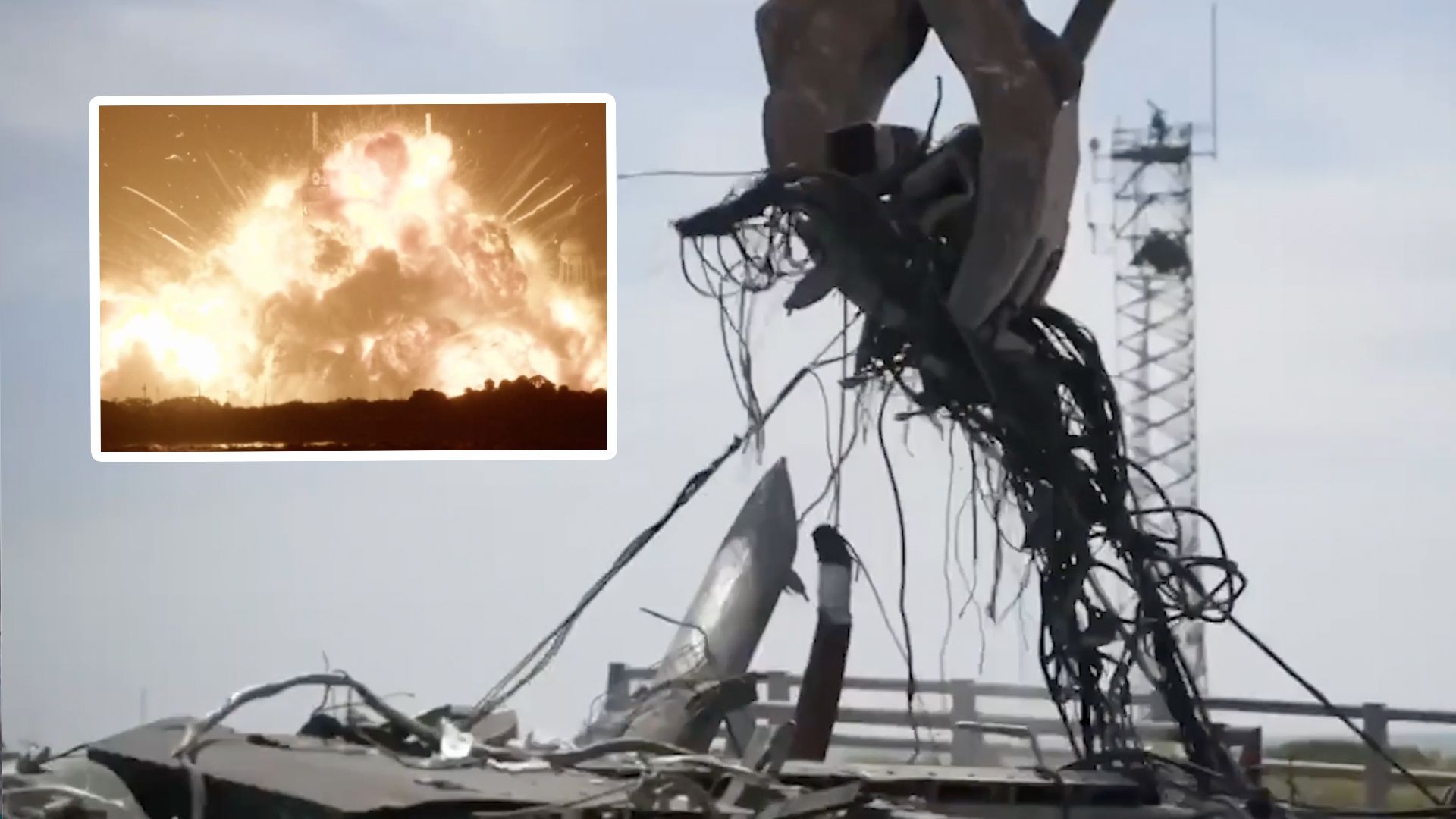
Blue Origin is hard at work at its Cape Canaveral launch pad, collecting debris and repairing the damage after an explosive accident last month.
The company’s New Glenn rocket exploded during a fueling test last month at Launch Complex-36 (LC-36). The resulting fireball laid waste to the surrounding facility, and erupted in a burst with a glow visible more than 100 miles (160 kilometers) away. In the aftermath, Blue Origin CEO Dave Limp voiced confidence that, despite the setback, the company would bring New Glenn back to the pad for a launch before the end of the year.
He doubled down on that assessment in an X post on Thursday (June 25), which featured a timelapse video of the work done at LC-36 over the past few weeks. “Huge shoutout to the team who have been working 7×24” Limp said. “We have started reconstruction and still plan to fly again this year.”
Quite a sight to see the progress this team has made since May 28. Wreckage recovery from start to finish was completed in 9 days, and all debris has been cleared from Launch Complex 36. Huge shoutout to the team who have been working 7×24. We have started reconstruction and… pic.twitter.com/2plAi8fb22June 25, 2026
In his post, Limp said that all the debris has now been cleared from LC-36, and that all the wreckage from New Glenn and the surrounding facilities was collected within nine days of the explosion.
The speedy cleanup is a positive step toward Blue Origin’s goal of launching New Glenn again by the end of 2026, but it’s still an ambitious undertaking. Similar incidents, like the explosion of SpaceX’s Falcon 9 at LC-40 in 2016, have taken up to twice as long to recover from. For Blue Origin, though, there’s a lot on the line.
NASA has contracted the company’s Blue Moon spacecraft as one of the agency’s crewed Artemis lunar landers, and Blue Moon has been designed to launch on New Glenn. NASA is targeting late 2027 for the launch of Artemis 3, which depends on astronauts aboard an Orion capsule rendezvousing with Blue Moon in low Earth orbit to demonstrate docking maneuvers and spacecraft interoperability ahead of future missions to land astronauts on the lunar surface.
Orion will also dock with SpaceX’s Starship during Artemis 3, if all goes to plan. NASA initially selected Starship as the lunar lander for Artemis 4 and 5, but delays in the development of the huge vehicle prompted NASA to reopen its considerations about which lander would fly the landing missions ahead. Should either Starship or Blue Moon not be ready in time to launch for Artemis 3, their builders risk losing out on the chance to return American astronauts to the moon.