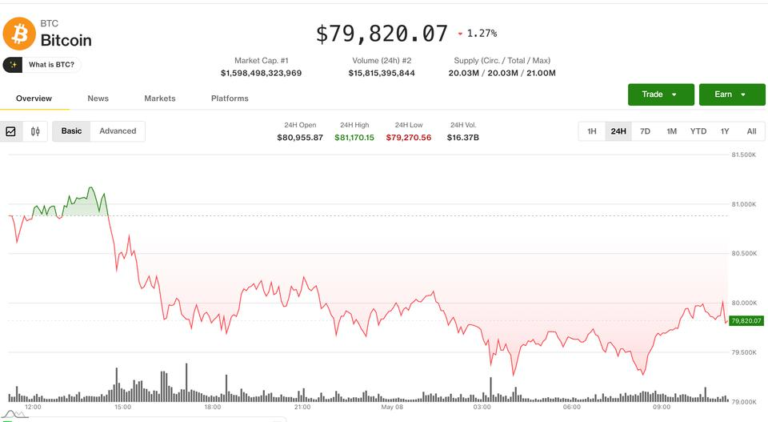




Some Revolut users saw bitcoin briefly display far below market prices on Friday, with app charts showing a sudden plunge before snapping back near prevailing levels, in what appeared to be either a pricing display issue or a liquidity-related dislocation.
Revolut’s official bitcoin page shows BTC briefly marked around £29,414 on Revolut’s one-day chart before returning near £58,600. Other social media posts claimed the app showed even lower prints, including near-zero prices as low as 2-cents, though CoinDesk could not independently verify those levels or confirm whether any trades were actually executed there.

The issue seemed isolated as no exchange on lists tracked by CoinGecko and CoinMarketCap showed any bitcoin price anomaly. It trades just over $79,000 as of Asian afternoon hours Friday.
Revolut had not responded to a CoinDesk request for comment by publication time.
Some users on X claimed buy orders executed during the disruption, but those reports remain unconfirmed. If trades were filled, Revolut would likely have to determine whether the prints reflected legitimate liquidity, stale quotes, a routing issue or a platform-side pricing error.
Flash moves in crypto apps can happen for several reasons. A display glitch can show an incorrect price without actual market execution. Thin liquidity on a specific venue or internal pricing rail can also produce sharp wicks if an order sweeps through a shallow book.
“Revolut operates with limited liquidity depth compared to a full exchange, and if a large enough sell order hit a thin book at the wrong moment, it could exhaust all available bids down to that level before the price recovered,” Ranveer Arora, co-founder and CEO of Altura, told CoinDesk in message as a possible explanation.
In other cases, market makers briefly pull quotes, spreads widen, and apps relying on aggregated feeds may display prices that do not match deeper global markets.
Crypto has seen similar isolated dislocations before. Bitcoin briefly printed far below market on Binance’s USD1 pair in December in a move tied to a thinly traded pair rather than broader selling. South Korean exchanges also saw sharp local wicks during the country’s martial-law shock in 2024 as activity surged and local order books briefly broke from global prices.