Jan Bartek – AncientPages.com – A new study challenges established views on human skull evolution. Researchers suggest that brain growth and the reduction of the face and jaw may be less influenced by directed natural selection than previously thought.
Findings from the University of Tennessee-Knoxville and the Senckenberg Centre for Human Evolution and Palaeoenvironment (SHEP) at the University of Tübingen indicate a slower and more limited evolutionary process than traditional accounts suggest.

The genus Homo, now represented only by modern humans, emerged about 2.5 million years ago. “With few exceptions, the evolution of the various Homo species was characterized by an increase in brain size as well as a decrease in the size and robustness of the face and jaws,” explains Prof. Dr. Katerina Harvati of the Senckenberg Centre for Human Evolution and Palaeoenvironment (SHEP) at the University of Tübingen.
“At the same time, significant behavioral changes occurred: stone tools were used more intensively, food was obtained and processed in increasingly diverse ways, populations spread across significantly larger geographic areas, and more complex social structures presumably emerged.”
For decades, researchers assumed these changes resulted from sustained, directed natural selection. Larger brains were thought to enhance cognitive abilities, while smaller faces offered energetic benefits as tools replaced the need to chew.
In their new study, Professor Mark Hubbe of the University of Tennessee-Knoxville and Harvati evaluated how morphological changes in the genus Homo align with different evolutionary models. Their findings suggest the data support a different explanation.
“While our analyses confirm the well-known evolutionary trends of cranial growth and facial reduction, they show that the differences within our genus can be explained much more effectively by neutral evolutionary processes and long periods of evolutionary stasis,” explains Hubbe.
This suggests that gradual brain enlargement and facial reduction were not the result of a steady, progressive path toward the modern human form. Instead, random genetic mutations, stabilizing selection, and biological and ecological constraints likely played a much greater role than previously thought.
Hubbe and Harvati analyzed three-dimensional skull measurements from 87 Homo fossils, spanning early species such as Homo habilis and Homo rudolfensis, through Homo erectus and Homo heidelbergensis, to Neanderthals and both early and modern Homo sapiens. This dataset includes most well-preserved hominin fossils from the past two million years, making it one of the most comprehensive studies of evolutionary changes in our genus.
“We compared this exceptional dataset with six different evolutionary models using statistical analyses to assess which model most accurately explains the observed changes in head and facial morphology within the genus Homo,” says Harvati.
The models examined included natural selection, neutral evolution, prolonged periods of minimal change, and the “punctuated equilibrium” model, which suggests species remain stable for long periods before experiencing rapid evolutionary shifts.
The results indicate that both neutral and limited evolutionary processes influenced the evolution of the Homo lineage. This finding enables more detailed analysis of key periods when significant changes occurred.
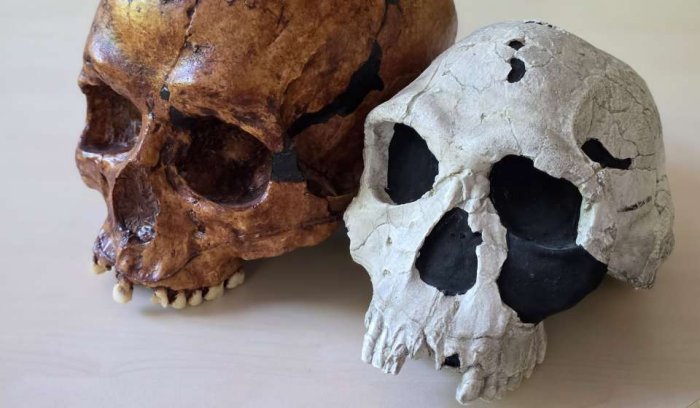
Replicas of a Homo habilis skull (right) and an early Homo sapiens skull (left) illustrate two major evolutionary trends in our genus: a significant increase in brain size and a reduction in facial size. Credit: Katerina Harvati
Major phases of brain enlargement – such as in Homo heidelbergensis and, later, in Homo sapiens and Neanderthals – likely occurred during periods when these evolutionary constraints were temporarily less severe. The researchers point to a combination of possible factors, including developmental biology, metabolic and energetic conditions, and – most importantly – cultural innovation.
“In many ways, culture acts as a buffer: It enables us to utilize new habitats and access more resources. This reduces the pressure on certain physical structures because they need to be less strictly adapted to environmental conditions,” explains Hubbe, and he continues, “In this way, periods of intensified technological and cultural innovation can trigger rapid evolutionary changes. Such changes were clearly of great significance for the evolution of the genus Homo, as they enabled our ancestors to meet the nutritional demands of larger brains and to fully exploit the benefits of higher cognitive abilities.”
Similar mechanisms could also explain the evolutionary changes that distinguish modern humans from earlier Homo species, according to the research team. For example, Neanderthal facial morphology appears to have remained more restricted over long periods, while the faces of modern humans are significantly smaller than those of other genetic lineages.
“It is possible that these later changes were also linked to particularly profound behavioral shifts that accompanied the emergence of our species,” adds Harvati.
See also: More Archaeology News
The study does not suggest that natural selection has played an insignificant role in human evolution. Instead, it emphasizes the importance of identifying the most relevant research questions. “Our findings shift the focus,” Harvati concludes.
“Instead of asking why humans have continuously evolved toward larger brains and smaller faces, it would make more sense to investigate under what conditions human populations were able to break free from existing constraints and develop new traits. This approach could be particularly well-suited toward better understanding the evolution of our genus.”
The study was published in the journal Nature Communications
Written by Jan Bartek – AncientPages.com Staff Writer