


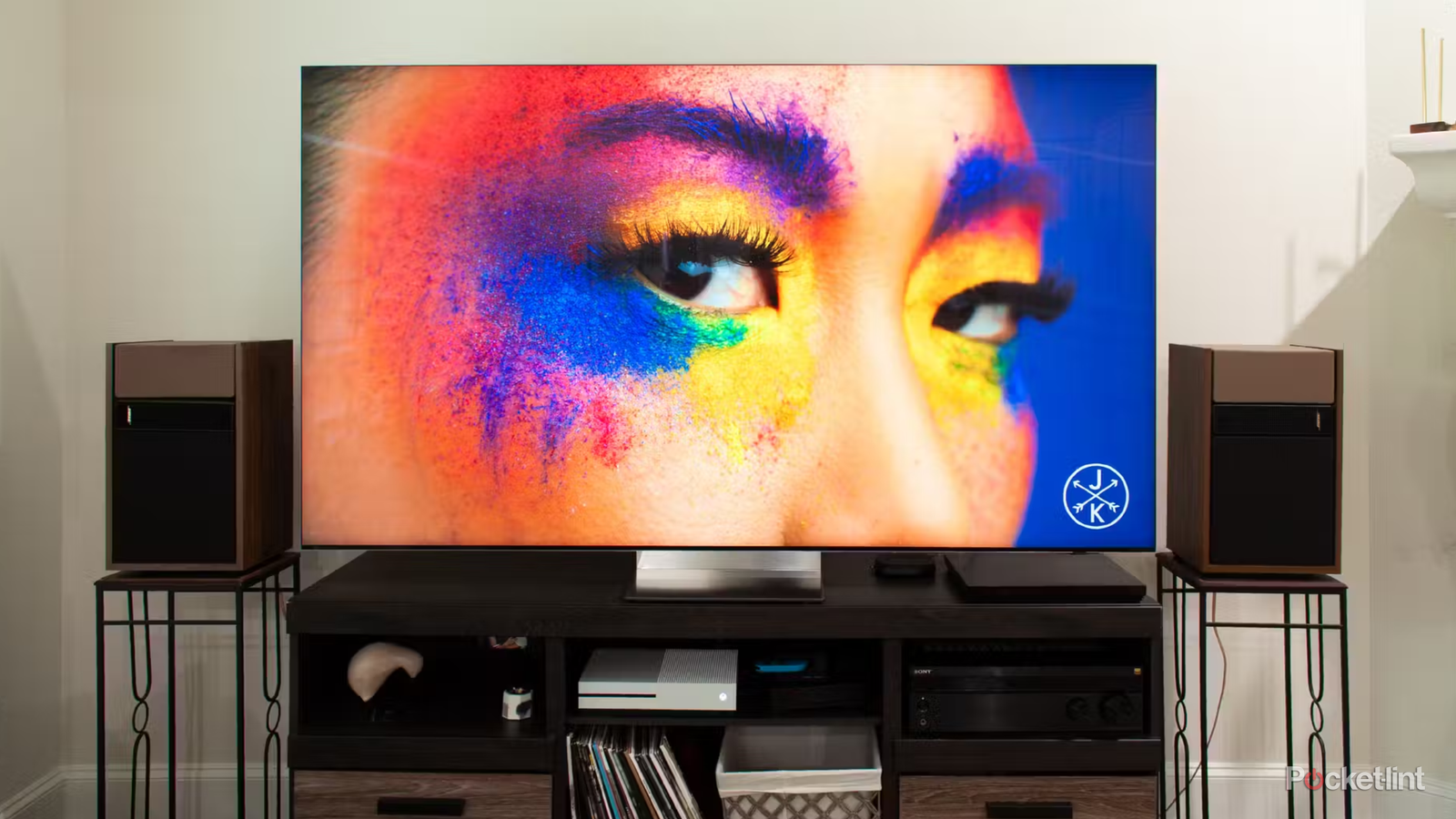
There’s no ceiling on how much you can spend on a new TV. In the course of writing for Pocket-lint, I’ve discovered a surprising number of models in the six-digit realm, and some that might cost even more, except that I’ve had no reason to investigate them further. Usually their pricetags stem from cutting-edge panel technologies like MicroLED, or screen sizes that make a 100-inch Super Bowl splurge look tiny. These are sets built for either for commercial applications, or for millionaire shoppers who might as easily pick up a Ferrari on a whim.
Some of the things that add to a TV’s cost are truly superfluous, though, in that they don’t add much if anything to the real-world viewing experience. Even if I were rich, I wouldn’t bother hunting for TVs with these features, because I always care about value for my money. To keep the auto references coming, I’d much rather own a 300-mile EV with low maintenance demands than a gas car with leather seats and an overpowered speaker system.
8K resolution
Too far ahead of its time

If you don’t follow the TV industry as closely as us journalists do, you might be surprised. In the past three decades, higher resolutions have repeatedly defined each generation. First it was the jump to DVD quality (480p), then 720p and 1080p. Consumer 4K has been around for over a decade, so you might reasonably assume 8K would be ready for the limelight.
Quite the opposite, actually. Despite a rush of models a few years ago, TV makers are pulling back from 8K. The only major supporter at the moment is Samsung, and I wouldn’t be surprised if it pulls out too, at least for a few years.
What gives? An 8K TV might give you bragging rights, but it’s useless in practice. None of the major streaming services offer 8K except for YouTube, and there, most channels are liable to be in 1080p or 4K, since 8K production is expensive. You also won’t find 8K Blu-ray discs, and studios aren’t producing up-rezzed masters for the most part, except perhaps for archival purposes. On an 8K TV, 99.9% of what you watch is going to be upscaled 1080p or 4K.
As if that weren’t bad enough, 8K is unnecessarily sharp for the limits of human vision and the average living room. At a distance of 5 feet (about 1.5 meters), you need at least a 75-inch screen to tell the difference versus 4K. At a more reasonable 10 feet (3 meters), you might need a display well over 100 inches — which could be totally impractical in a New York City penthouse, never the spaces most of us plebes live in.
8K will presumably return once economies of scale make it trivial. Until then, think of it like buying a Porsche 911 to drive a road full of potholes.
Art/lifestyle TVs
A Trojan horse for accessories and subscriptions

In the abstract, an “art” or “lifestyle” TV has a lot of appeal. These are sets designed to blend into your decor, taking on the look of a framed photo or painting. To achieve this, they use matte screens, decorative bezels, lightweight form factors, and specialized apps that rotate artwork.
Th thing is, a lot of compromises are required. Keeping weight down means you’re not going to get a large display, at least not without paying through the nose for advanced technologies. Also, most photos and paintings are hung high on a wall so they can be seen while you’re walking by. When you’re relaxing on the couch, that creates a terrible viewing angle that strains your neck.
The killer for me is that you’re often making spec sacrifices. While a matte texture does kill reflections, it also softens sharpness and contrast, which is bound to be disappointing if you’re in this for the movies and games rather than the fashion angle. OLED art TVs are particularly rare, thanks to an obvious concern: burn-in. While there are technologies that mitigate the threat, OLED is distinctly unsuited to showing static images for hours at a time. Expect to pick up a mini-LED or QLED model instead.
A dirty secret is that a lot of art TVs are meant to rope you into additional purchases. Even if a model ships with a decorative bezel, you may be forced to buy another one anyway if you want it to match your room aesthetics. And some companies ask for subscription fees to display more than a limited selection of images, which is downright insulting.
Motorized cabinets and folding screens
Your TV is never in the way

Somehow, a recurring theme with luxury TVs is a screen that tucks away into a cabinet. The best-known example might be LG’s Signature OLED R, pictured above, but it’s not hard to find others, whether for sale online or displayed as concept hardware at the annual Consumer Electronics Show in Las Vegas. The OLED R is/was based on a rollable panel; others use more conventional mechanisms.
On paper, the draw is having a stylish, minimalist room most of the time, while keeping ability to watch a movie in a matter of moments. Some models might have enough space to respect objects on top.
It’s not difficult to break down how silly this is in practice. For one, most people are just fine with their screen sitting out in the open, and might even consider it a status symbol. You’re also needlessly inconveniencing yourself, for that reason. Though it might only take a few seconds for the TV to be unfolded, a normal set would already have Netflix or the news on.
Moreover, you’re not really clawing any space back. The cabinet has to be big enough to hold the screen, and you’re probably not going to place anything on top, because you’d just have to remove it anytime you wanted to watch something. A motorized screen is just a rich man’s flex.
Premium materials
Remember the gold Apple Watch?

Unlike the other items on this list, there’s some practical value to buying a TV with expensive construction. Tougher metals and wood are going to be less prone to cracking or denting than conventional aluminum or plastic. Keep in mind that you’re not going to find a TV made entirely out of one material or another — rather, specific components may use elements like steel, leather, fabric, or oak.
The core problem is that all TVs have a finite usefulness. The panel will eventually break or burn out, and its specs may become outdated before then. You’re probably going to want to replace it in a decade or less, and you’ll be lucky if anyone wants to take it off your hands, no matter how much you paid for it.
I’m reminded of the first-generation Apple Watch, which had special gold Edition models costing over $10,000 apiece. Apple discontinued gold options the next year, and by the time the Series 5 rolled around, those “Series 0” watches felt ancient, with no way to upgrade them.
A lesser issue is weight. Tougher often means heavier, so you may run into obstacles with wall mounts or your entertainment center. It’s safer to bury any pretense and buy a TV built like any other.