


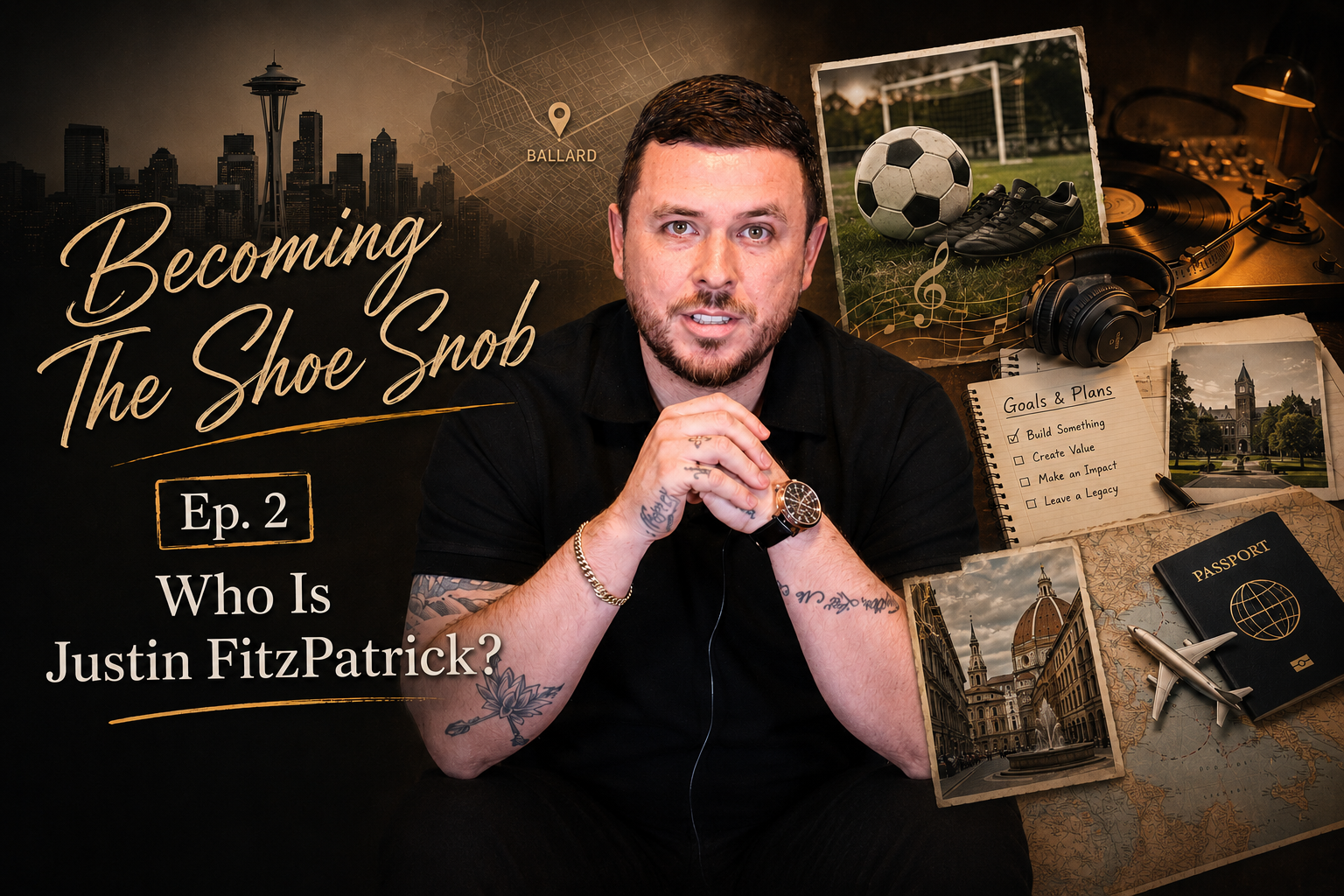
The first episode of this series was about shoes. Or at least the earliest memories I have of shoes, the way they entered my life, and how they slowly became something more than just something I wore. This episode is a bit different. This one is less about shoes and more about me.
That might sound strange in a series called Becoming The Shoe Snob, but the truth is that shoes were not my first dream. They were not my first plan. They were not the first thing I imagined building my life around.
In fact, shoes came after several other paths had already started and failed, or perhaps better said, taught me what I needed to learn.
I have never liked the word failure. I use it sometimes because everyone understands what it means, but I do not really believe in it. Failure, to me, is just an experience that teaches you what not to do next time. It is feedback. It is redirection. It is sometimes painful, but it is rarely the end.
And in my life, the things that felt like failures at the time were often the very things that pushed me closer to where I was supposed to go.
So before I became The Shoe Snob, before the blog, before the shoe brand, before London, before Italy, before any of that, I was just Justin FitzPatrick from Seattle. More specifically, from Ballard.
Seattle, Ballard, and Moving Around
I was born and raised in Seattle, Washington.
Technically, I was born around the Lake City area, in the northeast part of Seattle. But I do not really identify with that part of the city because it was not where my strongest memories or bonds were formed.
I moved around a lot as a kid. By the time I left Seattle at twenty-four, I must have moved around fifteen times. Maybe more. Moving became such a normal part of my life that I almost stopped thinking about it as unusual. That’s not to say that I enjoy it, though.
Eventually, around eleven or twelve, I moved from the northeast side of the city to the northwest side, across I-5. For those who do not know Seattle, I-5 basically runs through the whole city and splits the east from the west. Downtown splits north from south, and then you have West Seattle, which is almost its own country.
The northwest side is where I feel I truly grew up.
Ballard is the place I identify with. I went to high school there. I played for the city teams there. My formative years were there. When I think of where I am from, I think of Ballard.
That is the part of Seattle that feels like mine.
The Accent Question
One question I have been asked my entire life is: “Where is your accent from?”
That has always made me laugh because even when I lived in Seattle, people asked me that. I have had this strange accent, or whatever people want to call it, for as long as I can remember. I think the origin of it probably comes from my mother.
My mother is from Mexico City. My parents separated when I was very young. They were both in my life, but I was raised more full-time by my mother. I saw my father every other weekend, on holidays, and at other times, but the day-to-day was mostly with my mom.
So while my English was obviously formed in school and in Seattle, it was also shaped by hearing my mother speak English every day with her Mexican accent. Her accent is softer now, but when I was younger, it was somewhat stronger. Certain sounds and words were different. And I think that naturally affected the way I spoke.
My father is American. His ancestry is Irish, Ecuadorian, and Costa Rican. So there is quite a mix in me. I have Latino blood, Irish blood, and a background that people often cannot quite place. I am proud of that, I like being mysterious, so to speak.
I very much identify as American, but I love that people often cannot pinpoint where I am from. And the accent has probably only become more confusing over time. I moved to Italy. Then London. Then New York. I was surrounded by South London accents, which can leave a mark. All of those influences layered themselves on top of whatever was already there.
So if you have ever wondered why I sound the way I do, that is the best explanation I can give.
A Mexican mother, an American father with mixed ancestry, Seattle, Italy, London, New York, New Jersey and probably a bit of stubborn refusal to sound like anyone else.
My First Dream Was Soccer
Before shoes, before business, before anything else, my first dream was to become a professional soccer player.
I loved soccer from the moment I could kick a ball. My earliest memories of playing are probably from around four or five years old, just kicking a ball around in the front yard. By six or seven, I was already playing competitively.
I had talent. Or at least I like to think I did.
How much talent, I will never really know. Enough to become a professional? Maybe not. Enough to be a very good player? Yes, absolutely. I made varsity as a freshman. I was all-state. I was captain of the team. I played select soccer. I was, by most normal measures, a strong player.
But there is a big difference between being good locally and being good enough to become a professional.
At the time, of course, I thought I had a chance. Most young athletes who are good enough to stand out in their world believe that. And maybe you need to believe it. Otherwise, why even try?
Still, I was not blind. There were players around me who were better. One friend from elementary school, who I eventually played against, was probably the best player in the state. He had real raw talent. And even he did not go pro, unfortunately, likely because of injury.
So the dream was there. The ambition was there. But the reality had not yet fully revealed itself. My father saw it earlier than I did.
My Father’s Advice
My father is a unique person.
He is from the Richland area of Washington, about three hours from Seattle. Fiercely independent. Highly intelligent. Completely unafraid. A true Rolling Stone type. He dropped out of high school at seventeen, took his parents’ car, and left for Seattle.
That gives you a small idea of the kind of person he was.
When I was younger, he worked for Red Robin. He was almost like Tom Cruise in the movie Cocktail, doing bar tricks, throwing drinks and pitchers across the bar, opening new locations, putting on a show. He had that gift of the gab, the ability to talk to anyone, anywhere, at any time.
Both of my parents were like that. They could talk to strangers in grocery stores for ten minutes while I stood there thinking, “Come on, let’s go.”
My father was, and still is, one of the smartest people I have ever known. And when I was getting to the age where I had to start thinking seriously about my future, he gave me two pieces of advice.
The first was about university. He told me, “Justin, if you want to go to college, you are going to have to pay for it, because I do not believe in it. So you better get straight A’s and get a scholarship, otherwise you will enter the workforce like I did.” Remember, this is coming from a man who dropped out of high school and eventually made a huge success.
The second piece of advice was about soccer and becoming a professional. He said, “If you want to become a professional soccer player, you better run five miles a day and take five hundred shots on goal every single day. If you do not do that, you might as well stop thinking you are going to become a professional.”
At the time, I thought he was exaggerating. I played a lot. I practiced all the time. I played high school soccer and select soccer at the same time. Soccer was a major part of my life.
But I did not live it the way true professionals live it.
I did not eat, sleep, and breathe it. Not fully. I still cared about girls, being cool, being popular, having fun, and living the teenage life. I loved the game, but I was not sacrificing everything else for it.
And if I am honest, deep down I probably knew that. I was not lazy, but I was not obsessed enough.
That is a hard thing for most to admit, but it is the truth. I learned that more profoundly by building The Shoe Snob Blog and what I did to get it to where it is today.
Europe and the End of the Soccer Dream
When I was around fifteen or sixteen, I was invited to play in Europe with a traveling soccer team. We were going to compete in a tournament in Holland called the Haarlem Cup, with training beforehand in Hamburg, Germany.
It was an incredible opportunity. It also cost money. I went to my father and asked him to help. I did not ask him for a lot growing up, but when it came to big things that I felt could move my life forward, I would ask. This trip was one of those things.
He agreed to pay for it. So I went to Europe for the first time. Germany. Holland. A real international tournament. At that age, it felt massive. And we got destroyed. Not just beaten. Destroyed. We were wiped off the field, easily. It was not even close.
And the most important part was not simply that we lost. It was realizing that the kids destroying us were probably not going to become professionals either. That was the moment. If those kids were not going pro, and they were beating us that badly, then what did that say about me?
The dream did not die in a dramatic movie scene. There was no single whistle, no slow walk off the pitch, no grand heartbreak. It was more like reality quietly walked up, put a hand on my shoulder, and said, “Now you know.”
When I came home, my father took me to lunch. He asked if I had enjoyed the trip. I said yes. Then he asked, “Did you learn anything?” I laughed because I knew exactly what he meant. He had not paid for that trip only for me to have fun. He had paid for it so I could see the truth for myself. He knew I would not believe him if he simply told me. I had to experience it.
That was my father’s way. From that point on, I let go of the idea of becoming a professional soccer player.
I kept playing, of course. I still love playing. It is probably my favorite thing in the world to do. Funny enough, I do not really watch much soccer. I enjoy it, but I do not make much time for it. Free time, when I have it, usually goes to my family, movies/series or work.
But playing soccer has always remained with me. The professional dream, however, ended in Holland. And when one dream dies, you move on to the next one.
Music
My next great passion was music.
I loved music deeply. I was the kind of kid who had headphones on everywhere I went. In the car. Walking around. At home. Going to sleep. I used to make playlists on old-school stereos and fall asleep with music playing. I probably listened to music eighty percent of my waking day.
To this day, I still love it. Music has an ability to move something in you that is hard to explain. It can change your mood, shift your energy, and sometimes even feel like it affects your health. Certain sounds, frequencies, melodies, and rhythms can take you somewhere else.
I am not the type of person who is primarily moved by lyrics. I know some people connect with songs through the words first. For me, it is the melody. The feeling. The sound. The movement. I listen to music from all over the world. Latin music, Italian music, Chinese music, Indian music, Pakistani music, and everything in between. Music feels like a language that does not need translation.
And because I also had this fierce desire for independence, the dream became clear. I wanted my own record label.
I was not a musician. I played violin briefly when I was young, and I learned a little bit of piano, but I was never a musician in the proper sense. I loved music, but my brain was always business-oriented. I wanted to build something.
I wanted my own company.
Some of that came from watching my father. I inherited his independence, his refusal to be controlled, and probably, if I am honest, his problem with authority. I do not do particularly well when people tell me what to do.
Sales jobs suited me because they offered freedom. If you make money, keep customers happy, and produce results, the boss usually leaves you alone. In that kind of environment, you are almost your own boss even while working for someone else.
Other types of jobs were harder for me. I almost always clashed with managers in some way. So I knew early on that I wanted my own company. I wanted to do things my way. I wanted the freedom to build something according to my own vision.
At that stage, the vision was a record label.
University and the Music Industry Plan
I followed my father’s advice on school. I got the grades. I earned a full scholarship to the University of Washington, where I studied entrepreneurship with a minor in marketing. The plan was clear in my mind.
I wanted to get into the music industry, ideally as an A&R representative. For those who do not know, A&R stands for artists and repertoire. These are the people who find talent. They go to small clubs, hear local bands, recognize potential, and sign them. In a way, they are like scouts in sports.
That was the entry point I wanted. I figured I would become an A&R rep, learn everything I could about the music industry, and then eventually start my own record label. I have always made goals and plans. That was the plan.
But getting into a record label in that era was not easy.
This was before the music industry had fully collapsed into the digital world we know now. It was before Spotify. Around the time when downloading music was beginning to change everything, but record labels still had power. Working at a record company was still considered one of the coolest jobs you could have.
Everyone wanted in. The labels were mostly in New York and Los Angeles, and internships were extremely competitive.
Then I came across a company called the University of Dreams. The premise was simple: they would get you the internship of your dreams, or you would get your money back.
They had connections with companies in New York and Los Angeles and placed students from universities into internships. For someone like me, trying to get into the music industry from Seattle, it sounded like the perfect bridge.
There was only one problem. It cost six thousand dollars. I did not have six thousand dollars.
The Internship
Like I had done with the soccer trip, I went to my father. I explained the program. I explained the opportunity. I explained that it cost six thousand dollars.
My father was not the type to buy me everything I wanted. But if he believed something could help me move forward in life, he would often find a way. Sometimes he helped. Sometimes he made me work for it.
This time, he made a deal. He told me that if I paid half, he would pay the other half. So I had to find three thousand dollars.
I went back to the manager of the internship program and explained the situation. He told me I could work for him selling internships to other students and earn commissions. If I sold enough, I could make my half.
So that is what I did. I sold internships.
Eventually, I earned the three thousand dollars I needed. I went back to the manager and told him I had my half. My father was good for the other half. Now I wanted the internship.
The problem was that the specific companies I wanted were not part of their normal list. I wanted one of the top record labels. I wanted a serious A&R opportunity.
To his credit, the manager went above and beyond. He found a way to get me an interview with one of the companies I wanted. I believe it was BMI, or at least that is how I remember it. The exact name matters less than the opportunity itself.
This was the dream. I did the interview. I nailed it. They offered me the internship.
Everything had worked. I had earned my three thousand dollars. I had gotten the interview. I had been offered the position. All that remained was calling my father for the other half. So I called him. And he told me he could not do it. Business was not going well. He simply did not have the money to send.
I remember that conversation vividly. I was gutted.
Not angry, really. I knew he had his own business and his own circumstances. But something about that moment crushed me in a way I still cannot fully explain. I had done everything I was supposed to do. I had worked for my half. I had gotten the opportunity. I had landed the position. And still, at the final step, it fell apart.
I went back to the manager and told him I could not do it.
He tried to help. He was a good guy. He wanted to find a way to make it work. But I was done. Something in me shut off. I told him no. I thanked him for everything he had done, but I walked away. Then I told the record company that something had come up and I could not accept the internship.
That was one of the only times in my life I truly felt like a failure. Which is strange, because I had not failed. I had done everything right. But it felt like failure, or at least a gut-call to just walk away.
The Lesson
That moment changed me. It was painful, but it created something important. I told myself that would be the last time I did not achieve something I had truly put my mind to. The next thing I chose, I would get. No matter what.
It also taught me a hard lesson about reliance.
I learned that I could accept help, but I could not build my future on someone else’s promise. Not because people are bad. Not because my father did anything malicious. Life happens. Circumstances change. People may want to help and still be unable to help when the moment comes.
So from that point forward, I decided that anything I achieved had to be achieved by me. Help was welcome. Reliance was dangerous.
Looking back now, I believe that whole experience was divine intervention. Or fate. Or God. Or whatever word someone wants to use for the unseen hand that redirects your life.
As much as I loved music, I do not think I was meant for the music industry. From everything I have seen, heard, and understood about it, I do not know that I would have survived that world well. Maybe I would have. Maybe I would not. But deep down, I believe that path closed for a reason.
And after it closed, shoes became serious.
That is when I began moving more fully into the shoe world, which I touched on in the first episode. Nordstrom. Men’s shoes. Learning the business. Selling. Understanding customers. Seeing how shoes affected men and their confidence.
The music dream died, but it gave me the mindset I needed for the next path. When I made up my mind about shoes, I was not going to take no for an answer.
What I Lost Along The Way
Because I moved so much in my life, I lost a lot along the way. Shoes, clothes, things — none of that bothers me much.
What hurts are the memories. Old photos. School yearbooks. Photo albums. Things from the pre-digital era when you took pictures on Kodak cameras, printed them, and physically placed them into albums.
I miss that.
There was something beautiful about that process. Taking a photo meant something because you did not take hundreds. You captured a moment, waited for it to be developed, and then held it in your hands. Those are the things I wish I still had.
Objects can be replaced. Memories cannot.
Simple Pleasures
Despite everything I do and all the work that comes with it, I am a fairly simple person.
I work a lot. I spend time with my family. I stay home most of the time. I do not go out much. When I do, it is usually to smoke a cigar once or twice a month. My great loves outside of shoes are music and cinema.
I have always loved the movie theater. Going to the cinema is probably my favorite childhood pastime. I am perfectly happy going to the movies by myself. Sometimes I actually prefer it.
I do not think Hollywood is what it used to be, which is sad because I love film. These days, many of the better stories seem to live in TV series, but watching something from your couch does not feel the same as sitting in a theater.
The theater has always felt special to me.
Music is the same. It moves me. It changes my mood. It connects me to places, cultures, and feelings that I cannot always put into words.
Beyond that, I like talking nonsense with friends, spending time with family, and now, hopefully, playing soccer with my son.
My oldest son is more into basketball. My younger son likes soccer. I recently played basketball with my eldest in Rome, and I found myself giving him a version of my father’s old speech. If you want to get better, take five hundred shots.
It is the ten-thousand-hour rule in another form. Whether the exact number is accurate or not does not matter. The principle is true. If you want to become good at something, you have to put in the time.
That lesson came from my father. And now I hear myself passing it on.
Who Is Justin FitzPatrick?
So who am I?
I am a Seattle boy from Ballard.
I am the son of a Mexican mother and an American father with Irish, Ecuadorian, and Costa Rican roots.
I am someone who moved too many times and lost too many old photos.
I am someone who wanted to become a professional soccer player and got humbled in Europe.
I am someone who loved music so much that I wanted to build a record label.
I am someone who landed the dream internship and still had to walk away.
I am someone who learned that failure is not failure unless you decide to stop there.
I am someone who does not like authority, does not like being told what to do, and probably was always destined to build something of his own.
And eventually, through all of those experiences, I became a shoe guy.
Not because it was the first dream.
Because it was the one that stayed.
The dreams that came before it were not wasted. Soccer taught me discipline, humility, and competition. Music taught me feeling, rhythm, and the power of something that moves people without needing explanation. Business taught me planning, independence, and the desire to build. The failed internship taught me not to rely on promises and to take ownership of my future.
All of that became part of The Shoe Snob.
All of that became part of me.
And that is why I do not believe in failure.
I believe in redirection.
I believe in learning experiences.
I believe that sometimes the thing you think you lost is the thing that clears the way for what you were meant to find.
This episode was not about shoes in the obvious sense.
But it is absolutely part of the shoe story.
Because before The Shoe Snob could exist, Justin FitzPatrick had to become the kind of person who could build it.
—Justin FitzPatrick, The Shoe Snob
Shop · Marketplace · Patreon