
There is a short version of every story.
Mine usually goes something like this: I started The Shoe Snob because I wanted to see men wearing better shoes.
That statement is true. It has always been true. But like most short answers, it barely scratches the surface. It does not explain where the obsession came from, why shoes mattered to me in the first place, or how a kid from Seattle eventually built a life around something most people still treat as an afterthought.
Over the years, I have done plenty of interviews. And interviews, by their nature, tend to pull out the same answers. You get asked the same questions, you give the same polished responses, and everything gets condensed into neat little talking points. That is fine for an interview, but it is not the full story.
This series is my attempt to tell the longer version.
Not the overly romanticized version. Not the perfect origin story. Just the real one, as best as I can remember it.
I have always loved stories, especially stories about people who came from very little and built something through stubbornness, persistence, risk, and a fair amount of delusion. I would not sit here and claim to be wildly successful by some grand external measure. But by my own standards, I feel fortunate. I have a family I love, a roof over my head, bills that somehow keep getting paid, and a life connected to something I genuinely care about.
That, to me, is success.
So this is where I begin.
Shoes Before The Shoe Snob
People often ask where my love of shoes came from. The honest answer is that I do not know if there was one clear beginning. I cannot point to a single moment and say, “That was it.”
What I can say is that I grew up in the early 1990s, and in that world, shoes mattered.
Maybe they still do today, but back then, especially as a kid, your shoes said something about you. They told people whether you were cool, whether you fit in, whether you had the right things. It sounds ridiculous now, but any kid who grew up in that era knows exactly what I mean.
There were shoes that were acceptable and shoes that were not. There were brands that gave you status and brands that made you hope no one noticed. Payless ShoeSource, for example, was not something you proudly announced at school. That was not how you won points with the cool kids. In fact, you might get bullied by admitting your shoes came from there.
And at that time, I cared.
I would love to pretend that my love of shoes was born out of some refined appreciation for craftsmanship, leather quality, lasting, pattern making, and all the things I talk about today. But that came much later. At 10 years old, you do not know anything about craftsmanship. Nor do you care about it. In the beginning, shoes were about identity. They were about wanting to belong. They were about wanting to be seen in the right way.
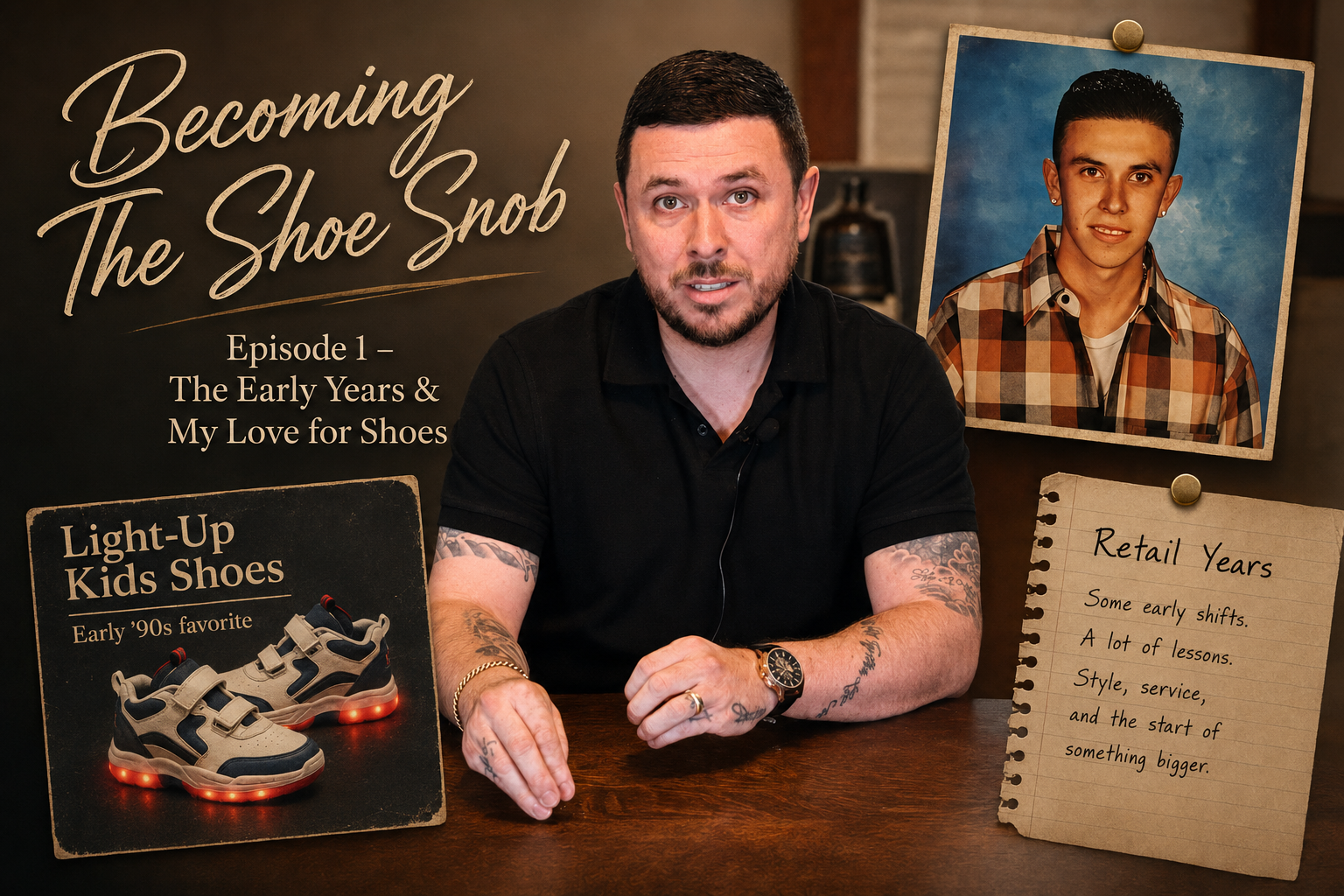
My earliest real memory of desperately wanting a pair of shoes was around the age of nine or ten. They were LA Gear shoes with lights that flashed on the bottom.
That was the thing. Flashing lights in the sole.
I cannot remember if they were actually cool or if I only thought they were cool. I cannot remember if anyone else cared. But I remember wanting them. I remember getting them. And I remember loving them.
Funny enough, my son now has a pair of Crocs with lights in the bottom, and every time I see them flash, I think, “Here we are again.” The brands change. The shapes change. The materials change. But the emotion is the same. A kid gets a pair of shoes that feels special, and suddenly those shoes become more than shoes.
That was probably the first time I remember feeling that.
The Early Need To Fit In
Around ten, eleven, twelve years old, something changes in a child. You are no longer just running around without a thought in the world. You start becoming aware of yourself. You start noticing girls. You start noticing who is popular, who is not, who gets attention, and who gets ignored.
You start caring about things you probably should not care about, but at that age, they feel like everything.
I was vain as a kid. I cared far too much about my hair. People sometimes joke now that I have a Lego haircut, but that is precisely because I do not want to deal with it. I wash it, move it into place, and I am done. As a kid, though, I spent way too much time trying to make it perfect. Just look at the photo of my teenage years. I must have been 15/16 there.
I cared what people thought. And shoes were part of that.
After LA Gear, it became Reebok, Adidas, Nike, and whatever else had status at the time. I played soccer, so Adidas always had a place in my life, but Nike was the one that captured me. Nike felt like the cool shoes. Nike was what I wanted for everything outside of soccer. Nike is what Michael Jordan wore, and Michael was my hero.
Middle school made this worse. Sixth, seventh, eighth grade — that was when the pressure to fit in became very real. In that world, cool shoes were not optional. You needed them. No cool shoes, no cool kid.
That was how it felt.
I did not have a giant shoe collection back then. It was nothing like today. But shoes were the thing I asked for. Birthdays, Christmas, rewards, whatever the occasion was, I wanted shoes.
And my mother knew it.
My Mother’s Bargain
My mother was smart. She knew I loved shoes, and she also knew I needed to read more.
So she made a deal with me. If I read the books she gave me, she would buy me the shoes I wanted.
Naturally, I took the deal.
At the time, I probably thought I had won. I was getting the shoes. That was all I cared about. But looking back, I realize she was the one playing the long game. She used the one thing I wanted most to push me toward something that would actually help me.
And that says a lot about her.
She did not have a lot of money. I knew that. Yet I always wanted the expensive shoes, because of course I did. Kids do not think practically. They want what they want. But she was willing to make that trade because she wanted me to better myself. My mom was my real hero.
I still remember some of the books she had me read. They were probably advanced for my age, but they stayed with me. The shoes may have been the reward, but the reading was the real gift.
So even then, shoes were woven into my life in a strange way. They were not just something I wore. They were motivation. They were currency. They were part of how I maneuvered through the world and through my interactions with people.
From Sneakers To Dressing Like A Man
As I got older, the love of shoes stayed with me, but it began to shift.
I still loved sneakers. I still do. Not big, clunky basketball shoes so much anymore, but classic, streamlined sneakers. Nike Cortez. Reebok Classics. Those types of shoes still appeal to me because they represent a different era and a different kind of cool.
But somewhere around my senior year of high school, I started thinking differently.
I was preparing to go to university. I was going to business school. In my mind, that meant I needed to start looking like a man.
Looking back at old photos, I can say with confidence that I did not always dress well. In fact, some of it was horrendous. But we all go through that. Teenagers are supposed to make mistakes. That is almost the point.
Still, I began wanting to dress smarter. I started buying polos, chinos, trousers with creases, and what I thought were proper dress shoes.
Unfortunately, this was the era of Steve Madden, Kenneth Cole, and the great square-toe disaster. Everything was blunt, clunky, and trying far too hard to be fashionable. I was never fully drawn to the worst of it, but I was still operating within that world because that was what was available.
One memory that sticks with me is a pair of black dress shoes I bought in Las Vegas. My father used to do business there, and on one trip, he gave me some money to buy a few things. I went into some fancy Italian clothing shop in Caesar’s Palace and bought a pair of dress shoes that I thought were incredible.
They were not incredible. They were probably terrible.
They were also some of the most uncomfortable shoes I have ever owned. I am fairly sure they gave me my first experience with plantar fasciitis. But at the time, I thought I had made a sophisticated purchase. I must have been eighteen or nineteen, walking into this shop as if I knew something.
I often wonder what the salesmen thought of me and if they had ever encountered another 19-year-old so happy to be getting a pair of dress shoes.
But that was part of the process. I was trying to become something. I wanted to dress for success. I wanted to embody the man I imagined I would become.
I still believe in that idea. Not in a superficial way, but in the sense that how we present ourselves affects how we feel, how we move, and sometimes how seriously we take ourselves. I believe in the power of thought, speech, and intention. I believe that before you become something, you often have to start acting as if you are capable of becoming it.
For me, shoes and clothing were part of that.
Nordstrom
When I went to university, I stayed living at home.
I wanted to move out. I wanted independence. But working full-time while going to university full-time would have been too much, and my mother allowed me to stay at home while I studied. That gave me a chance to work part-time, earn my own money, and avoid asking her for things she could not easily afford.
I had already been working for years by then. I started working when I was around eleven, so having a job was nothing new. But this time, I wanted a job connected to the things I loved.
So I applied at Nordstrom.
At the time, Nordstrom was a great place to work. It was flexible, you could make decent money, and for someone like me, the discount on clothes and shoes was a major attraction. Naturally, I wanted to work in shoes.
I got hired into the women’s shoe department.
I cannot remember exactly why. Maybe that was where the opening was. Maybe they needed people. Either way, that is where I started.
It did not take long for me to realize that women’s shoes were not for me.
The department was busy, and you could make real money there, but the returns were brutal. I remember spending two or three hours with one woman who bought six pairs of shoes. I thought I had done brilliantly. The commission was worth it.
The next day, she returned everything. Just like that, the sale was gone. The time wasted.
I remember thinking, “I cannot live like this.” So I transferred to men’s shoes.
At the store where I started, Northgate Mall in Seattle, the men’s shoe department was not exactly the place to get rich. The women’s shoe department was where the energy was. Men’s shoes felt quiet by comparison, almost forgotten.
But I loved it immediately.
I loved selling men’s shoes. I loved helping a man find something that made him feel good. I loved watching him try on a pair and realize that the right shoe could change the way he carried himself.
That feeling mattered to me.
Downtown Seattle
Eventually, I made my way to the downtown Seattle Nordstrom, the main store. That was where things really began to accelerate for me.
Suddenly, I was exposed to a bigger, better world of shoes. The shoe floor was more serious. The customers were more serious. The product was more serious.
And next door was Mario’s, a beautiful Italian shop that carried brands Nordstrom did not. Bontoni, Sutor Mantellassi, and other makers that opened my eyes to a level of footwear I had not really seen before.
I started absorbing everything.
I bought suits. I bought ties. I bought shirts. I bought all the menswear magazines I could find, including the expensive European ones that cost far too much money at the time. I was getting deeper and deeper into style, but shoes were always the foundation.
And I was flamboyant back then.
I had banana yellow Prada loafers. I had gray patent leather Dolce & Gabbana shoes with blue velvet. I wore things that I probably would not wear now, but at the time, that was part of the exploration. I was learning through excess, through experimentation, through trial and plenty of error.
Even before the blog existed, I enjoyed pushing men out of their comfort zones.
I remember one customer who had only ever worn black shoes. That was it. Black shoes for everything. I convinced him to try a pair of brown dress shoes.
He was hesitant. Nervous, even.
I told him, “Trust me. You will thank me later.”
And he did.
He came back and told me how much he loved them. People had complimented him. He could not believe he had waited so long to try something different.
That moment stayed with me because it showed me how powerful shoes could be. Not because brown shoes are revolutionary, but because for him, they were. They represented a small break from fear. A small step into confidence.
That was the part I loved.
The Power Of A Compliment
Men can act strong. We can act confident. We can act as if we do not care what anyone thinks.
But many men are fragile in ways they rarely admit.
A genuine compliment, especially from someone whose opinion matters, can completely shift how a man feels about himself. I saw that over and over again. A man would try something new, get a compliment, and suddenly his entire perspective changed.
That is not vanity in the shallow sense. It is human.
We all crave attention in some form or another. We all want to feel that the effort we made was worth something. For men, especially American men, style often comes loaded with fear. Fear of being overdressed. Fear of being judged. Fear of being mocked. Fear of looking like we are trying too hard.
That fear keeps men in black shoes forever.
It keeps them from wearing the brown pair. The burgundy pair. The suede pair. The shoe that actually makes them feel something.
At Nordstrom, I started to see that my job was not simply selling shoes. It was helping men cross that little bridge in their own mind.
That may sound dramatic, but it is true.
A good pair of shoes can make a man stand differently. Walk differently. Feel differently. Sometimes it only takes one compliment for him to realize that dressing better was never something to fear.
The Beginning Of The Shoe Snob Mindset
At some point, I developed personal clients. Men would come back and ask for me. That meant a lot.
Not because I needed the ego boost, but because it told me I had helped them. They trusted me. They liked the experience. They felt good about what they had bought.
I loved that.
I loved wearing shoes. I loved selling shoes. I loved seeing men happy in their shoes. And slowly, without fully realizing it at the time, I began forming the mentality that would eventually become The Shoe Snob.
The child who wanted LA Gear light-up shoes because they felt special had become the young man convincing customers to try brown dress shoes because they might feel special too.
The object had changed. The emotional core had not.
Shoes still had power.
When I was younger, I wanted shoes because I cared what people thought of me. As I got older, that shifted. I no longer needed the compliment in the same way. Instead, I began taking pleasure in inspiring someone else.
If someone sees my shoes today and says, “I love those,” that makes me happy. Not because I need approval, but because perhaps it gives them permission to try something similar. Maybe it introduces them to an idea they had not considered. Maybe it nudges them toward confidence.
That, ultimately, is why I do what I do.
Why This Still Matters
The frustrating thing is that, after all these years, I still feel we are far away from getting the average man into truly nice shoes.
I cannot tell you how many men have walked into my shop, looked at a pair of shoes, and said:
“These are too nice for me.”
I have always hated that phrase.
How can a shoe be too nice for you?
What they really mean, I think, is that the shoes scare them. They are afraid of being noticed (in a bad way). Afraid of someone in their circle making a comment. Afraid of standing out. Afraid that a beautiful pair of shoes will say something about them they are not ready to own.
And that fear is everywhere.
In America, especially, there is still a strange insecurity around men dressing elegantly. A rugged boot, a flannel shirt, a beard, and a more traditionally masculine uniform are accepted without question. But a man in fine dress shoes, a tucked shirt, and a bit of polish can still make people uncomfortable.
It is absurd, but it is real.
In Europe, or at least in the Europe that opened my eyes years later, I saw something different. Masculine, confident men dressed beautifully without apology. Fine shoes were not treated as strange. Elegance was not treated as weakness.
That contrast stayed with me.
And I think, in many ways, my mission has always been to challenge that fear. Not by telling every man to dress like me. Not by telling everyone to wear banana yellow Prada loafers or burgundy oxfords. But by saying: stop letting fear decide for you.
Wear what makes you happy. Wear what feels good. Wear what gives you confidence. Do not let some imagined judgment from other people keep you from trying.
That belief did not begin with The Shoe Snob Blog. It did not begin with a shoe brand. It began long before that, somewhere in childhood, somewhere between flashing LA Gear shoes, Nike sneakers, my mother trading books for footwear, uncomfortable dress shoes from Las Vegas, and the men’s shoe floor at Nordstrom.
This is the first chapter of that story.
The early years.
The beginning of a lifelong obsession.
The start of becoming The Shoe Snob.
—Justin FitzPatrick, The Shoe Snob
Shop · Marketplace · J.FitzPatrick · Patreon
👉Listen to the Youtube video/audio version