



April 25, 2026
4 min read

‘Bat feast’ animal videos at African cave offer clues to how deadly viruses spread
Researchers filmed 10 species eating or scavenging bats at known Marburg-virus hotspot—and caught hundreds of humans visiting
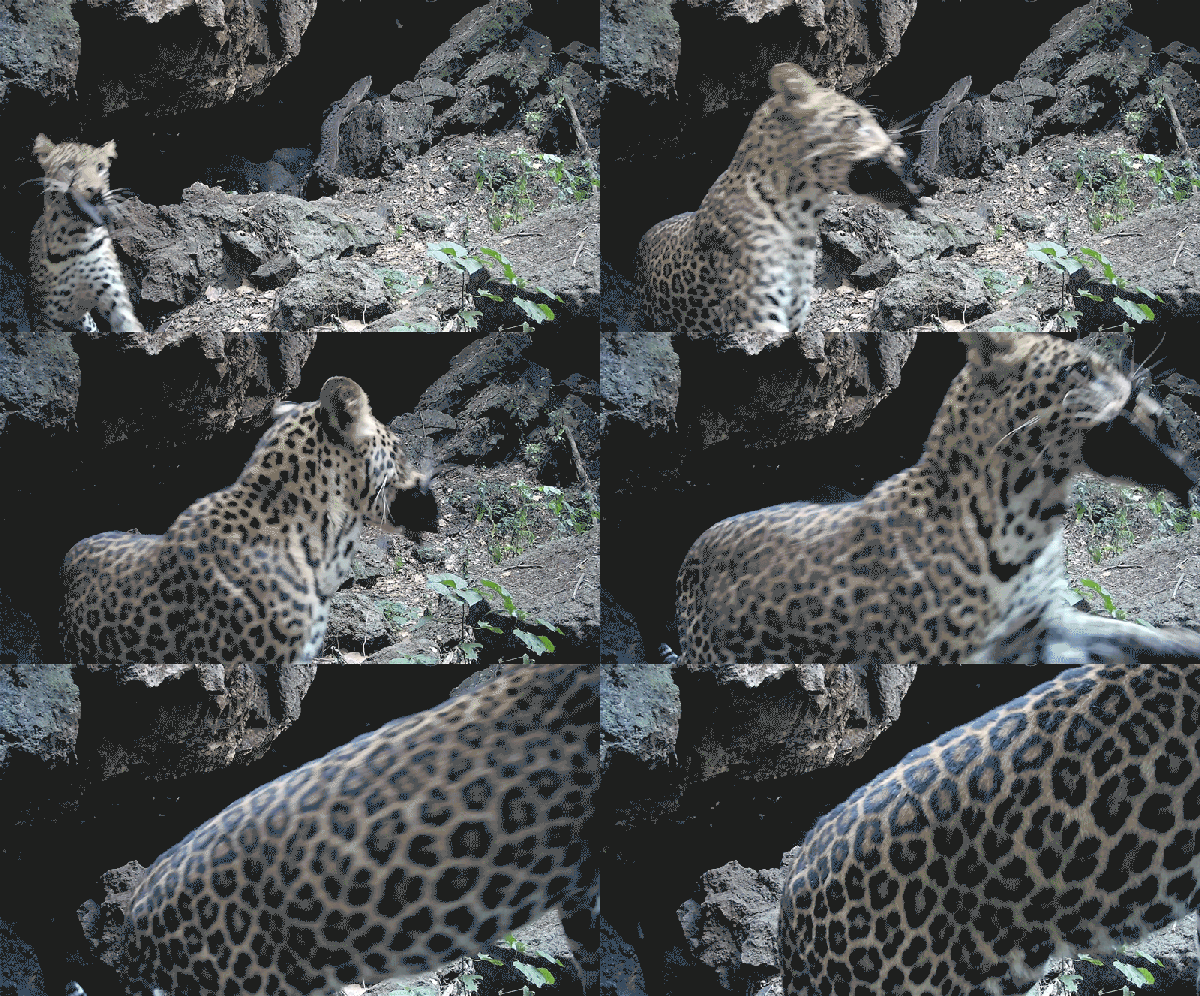
Researchers caught an African leopard on camera eating bats from a cave in Uganda. It might be the first confirmation that leopards eat live bats.
Bosco Atukwatse/VSPT Kyambura Lion Project
When researchers in Uganda set up camera traps to monitor African leopards (Panthera pardus pardus) and spotted hyenas (Crocuta crocuta) in a national park last year, they had no idea that they would record so much more than just those animals. Several of the traps, placed outside a cave known to host Egyptian fruit bats (Rousettus aegyptiacus), caught on video a multitude of creatures feasting on the winged mammals. The bats are known carriers of Marburg virus, which can transfer into humans and cause a fatal haemorrhagic fever, so the footage offers real-time insight into how disease can spread.
Scientists know that bats can transmit viruses to humans either directly, or through an intermediate animal, from forensic detective work and other studies. The team in Uganda thinks this is the first time that potential intermediate animals have been caught on camera in a known hotspot for Marburg virus, which is in the same family as Ebola virus. “It is certainly the first in such a well-documented form,” says Gábor Kemenesi, a field virologist at the University of Pécs in Hungary, who was not involved in the study.
The researchers, who published their findings today in the journal Current Biology after posting them in a Zenodo preprint 10 months ago, reported videoing 10 species scavenging on or catching bats at Python Cave in Uganda’s Queen Elizabeth National Park. They saw blue monkeys (Cercopithecus mitis) dipping into the cavern to grab bats, a fight between a crowned eagle (Stephanoaetus coronatus) and a Nile monitor (Varanus niloticus) over two bats captured by the eagle, and a leopard standing almost upright to snag bats from the cave. This might be the first confirmation that leopards hunt live bats. “It’s never been seen,” says study author Alexander Braczkowski, who is the scientific director of the Kyambura Lion Project in Kampala. “Sometimes he would eat 30, 40 bats in a night.”
On supporting science journalism
If you’re enjoying this article, consider supporting our award-winning journalism by subscribing. By purchasing a subscription you are helping to ensure the future of impactful stories about the discoveries and ideas shaping our world today.
Dangerous visits
Even more astounding is that the team caught on video more than 200 people — tourists, trainees from a local wildlife institute and children with school groups — approaching the cave during the four-month period when the cameras were active. Only one visitor, a tourist, wore a mask. This is despite warnings posted around the cave about Marburg virus, which has no proven treatment or vaccine.
“I was pretty shocked,” says Elke Mühlberger, a virologist at Boston University in Massachusetts. Contact with caves is the largest known contributor to humans contracting Marburg virus. According to an unpublished analysis shared with Nature by Adam Hume, a virologist at Boston University, 43% of the 21 outbreaks of Marburg confirmed since 1967 have been associated with visits to a cave. For 29% of the outbreaks, cave contact has been ruled out; the remainder have unknown origins.
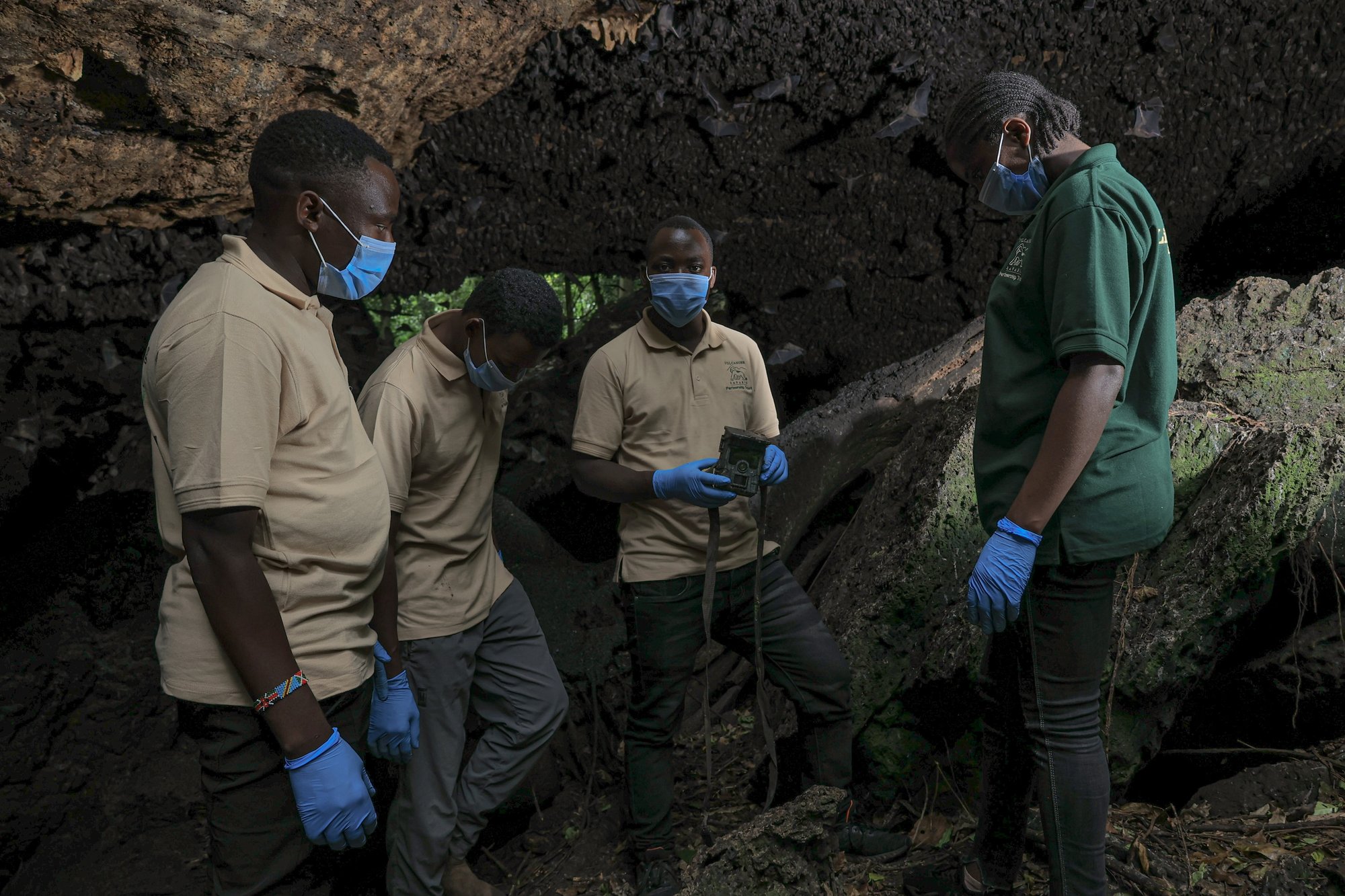
Members of the Kyambura Lion Project check their camera traps at Python Cave: from left are Yahaya Ssemakula, Bosco Atukwatse, Johnson Muhereza and Winfred Nsabimana.
Bats in Python Cave have, in fact, been linked directly to outbreaks of Marburg. An outbreak in 2007 at Kitaka mine, 50 kilometres from the cave, was traced to bats that fly to the cave. And two tourists who visited the cave in 2007 and 2008 became infected. One of them died. There are conflicting accounts of whether both the tourists went into the cave or merely peered into it; the surviving tourist tells Nature that they went about 3 metres into the cave and “peered in for at least 30 minutes.” Jonathan Towner, a viral ecologist at the US Centers for Disease Control and Prevention (CDC) in Atlanta, Georgia, who has visited and sampled the site extensively, says that they probably came into contact with bat faeces or urine as the animals flew.
Warning signs
These incidents prompted the building of a partially enclosed viewing platform 30 metres from the cave entrance in 2011, and the placement of warning signs to keep visitors away. “From a tourism standpoint, you obviously don’t want your visitors potentially becoming infected,” says Trevor Shoemaker, an epidemiologist at the CDC who was stationed in Uganda during the construction and consulted on the project.
And yet, visitors are openly flouting the rules and approaching to within “a few metres,” says Braczkowski. This wasn’t obvious before the team set up its camera traps, says Bosco Atukwatse, an ecologist with the Kyambura Lion Project and an author on the study. The area looked “really undisturbed,” says Atukwatse, who has since informed park management of the team’s findings.
The Uganda Wildlife Authority, which manages Python Cave and its surrounding wildland, did not respond to Nature’s request for comment.
Seeing all the animals on camera, and suddenly piecing in Python Cave’s connection to Marburg virus history — “that was the holy crap moment for the whole team,” Braczkowski says. “It’s not just a bat roost.”
This article is reproduced with permission and was first published on April 20, 2026.
It’s Time to Stand Up for Science
If you enjoyed this article, I’d like to ask for your support. Scientific American has served as an advocate for science and industry for 180 years, and right now may be the most critical moment in that two-century history.
I’ve been a Scientific American subscriber since I was 12 years old, and it helped shape the way I look at the world. SciAm always educates and delights me, and inspires a sense of awe for our vast, beautiful universe. I hope it does that for you, too.
If you subscribe to Scientific American, you help ensure that our coverage is centered on meaningful research and discovery; that we have the resources to report on the decisions that threaten labs across the U.S.; and that we support both budding and working scientists at a time when the value of science itself too often goes unrecognized.
In return, you get essential news, captivating podcasts, brilliant infographics, can’t-miss newsletters, must-watch videos, challenging games, and the science world’s best writing and reporting. You can even gift someone a subscription.
There has never been a more important time for us to stand up and show why science matters. I hope you’ll support us in that mission.