


Opinion polling shows Australia’s two-party political system could become a thing of the past at the next federal election.
A survey by polling company DemosAu, answered by 1,502 people between May 15 and May 20, showed One Nation with a 28 per cent share of primary support, eclipsing Labor for the first time.
Labor had 26 per cent share of the vote, with the coalition on 23 per cent.
DemosAu research director George Hasanakos said if polling continued to reflect this survey, Australia was headed for a hung parliament.
A fractured right, in which voters of all persuasions are turning to ‘populist’ ideas, is likely to result in a different kind of minority government than Australia has seen before.
The DemosAu results are more favourable to One Nation than a national Newspoll, conducted from May 14 to May 17 with a sample size of 1,252.
Newspoll had One Nation on 25 per cent, up three points from the April poll, with Labor on 31 per cent.
A Resolve poll gave Labor 29 per cent of the primary vote, while One Nation rose two percentage points to 24 per cent.

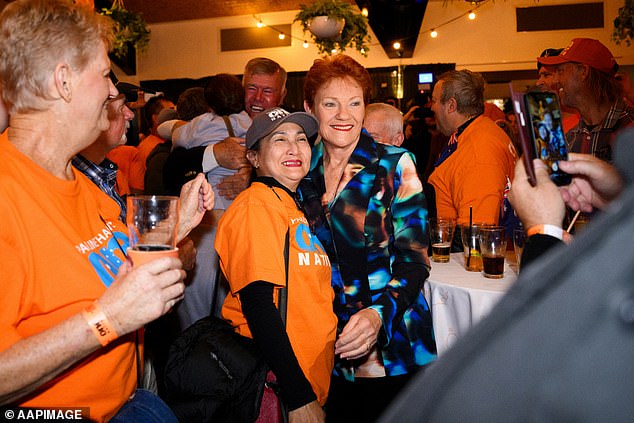
A survey has shown One Nation with a 28 per cent share of primary support of voters (Pictured, One Nation Leader Pauline Hanson posing at the Farrer by-election reception)

University of Canberra historian Frank Bongiorno (pictured) said the political right was the most likely place for votes to splinter, but the left was not immune
Join the discussion
How would a surge for One Nation change Australia’s politics and everyday life for ordinary voters?
Mr Hasanakos said Australia was likely moving away from a system in which major parties relied on minor parties and independents to govern, and that a more complex tapestry of government was likely to emerge.
Labor received 34.6 per cent of the primary vote in the 2025 federal election, with the coalition garnering 31.8 per cent.
One Nation collected 6.4 per cent and did not win any seats.
University of Canberra historian Frank Bongiorno said the political right was the most likely place for votes to splinter, but the left was not immune.
‘One Nation’s stances on wages are probably attracting people who are more like a traditional Labor voter, despite it being a right-wing populist party,’ he said, noting Australia’s politics were still affected by the 2008 global financial crisis.
He said One Nation’s ability to continue disrupting the political sphere relied heavily on whether it could stabilise internally ahead of the next election.
‘The party has a poor record of being able to keep its politicians in the tent once elected,’ he said.
The next federal election is not expected until May 2028 and polling tends to fluctuate until closer to election time.

Mr Bongiorno said the Anthony government had released an ‘ambitious’ Federal Budget
Join the discussion
What does One Nation’s surge say about Australians’ trust in traditional political parties?
Professor Bongiorno said any polling results and reaction to the recent divisive Federal Budget should also be understood in the context of Labor holding government by a significant majority
Labor had tactically released an ambitious Budget just a year into its second term, with two years left to win back voters, he said.
‘The Budget wasn’t designed with current polling in mind,’ he said.
‘It was designed to engage voters who feel shut out of economic prospects.’