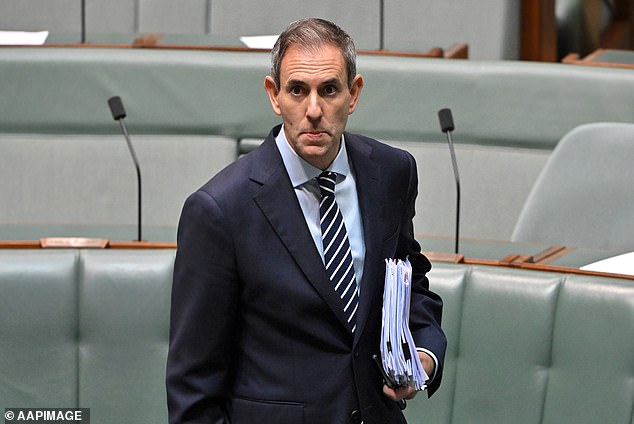
Australians will pay more at the bowser from Monday after treasurer Jim Chalmers announced the temporary fuel excise discount will come to an end.
The 16-cent-per-litre fuel excise discount, which was extended last month, will expire on Sunday, August 2, Chalmers confirmed.
‘That fuel excise relief will end midnight on Sunday and that’s because it has played a really important role helping to take some of the sting out of these cost-of-living pressures,’ Chalmers said.
‘It was never the government’s intention for that to be permanent. We began to taper that off at the start of the month, deliberately, so that we could provide a bit more cost-of-living help.’
The Labor government halved the fuel excise for three months from April in response to rising prices as a result of the US-Israeli war with Iran, saving drivers 32 cents a litre on fuel.
The measure was extended for a further month in July, but at a reduced rate of 16 cents per litre.
Fresh tensions between the US and Iran have caused Brent crude oil prices to rise to more than $US100 a barrel, but the government has ruled out further relief.
Drivers have been warned petrol prices could reach more than $2 a litre as the excise discount is wound back.

Australians will pay more at the bowser from Monday after treasurer Jim Chalmers announced the temporary fuel excise discount will come to an end

Prime Minister Anthony Albanese said a continuation of the conflict would lead to economic pressure
Average prices for unleaded petrol have climbed to more than $1.80 per litre in all state capitals in recent days, up from about $1.50 at the end of June.
The jump in oil prices comes as Iran-aligned Houthi militants fired on Saudi oil installations on the coast of the Red Sea and Tehran attempted to shut down shipments through the Strait of Hormuz again.
US strikes have recommenced in response to Iranian attacks on vessels travelling through the strait, a key oil transit route.
Prime Minister Anthony Albanese said a continuation of the conflict would lead to economic pressure.
‘The war is having an impact here in Australia and the longer it goes, the bigger the impact will be,’ he said.
‘This is a war on the other side of the world.
‘We are not protagonists in it, but we are impacted by it and we’ve consistently called for a de-escalation.’