
The US stock market total value-to-GDP ratio, otherwise known as the ‘Buffett Indicator’, is at record highs.
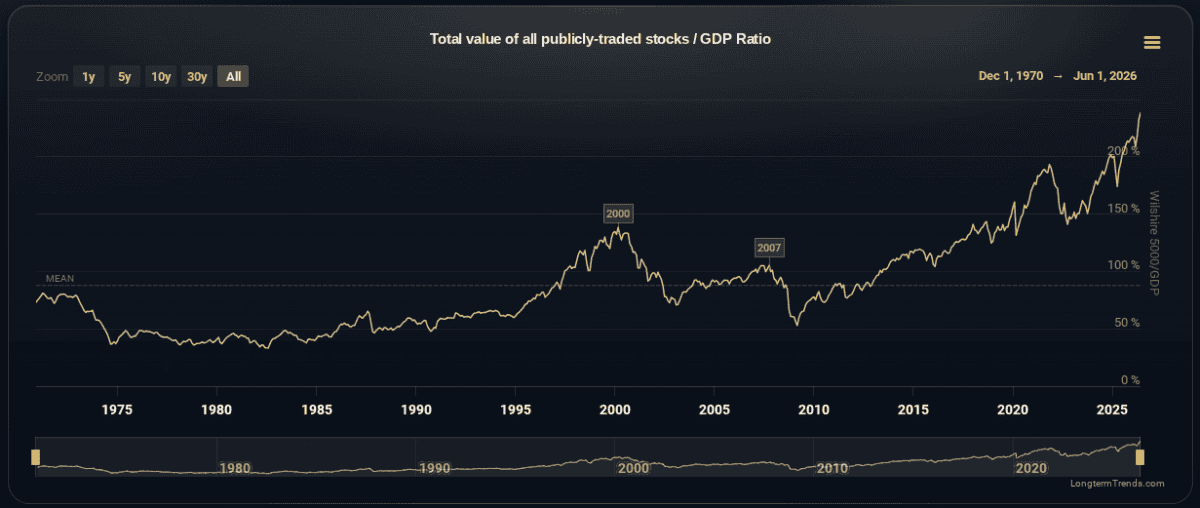
Since February 2009, it’s climbed from 52.88% to a whopping 237.8% — suggesting it’s valued at 137.8% higher than GDP.
The ratio compares US GDP to the Wilshire 5000, an index widely regarded as the definitive benchmark for the US stock market. The growth means it’s now two standard deviations above its trendline, an event that’s only occurred three times in history:
- Before the 1968 stock market crash.
- Before the dot-com bubble.
- Before the 2022 bear market.
What’s more, the 30-year US Treasury yield hovered above 5% for 11 consecutive days in May, the longest period since 2007. And we all know what happened in 2008…
So what does this mean for UK investors?
Will the stock market crash?
No single indicator, even one this prominent, can accurately predict a market downturn. But in any case, extremely high valuations are worth being concerned about.
Here’s a few ideas on how to prepare, and — more importantly — what NOT to do.
1. DON’T panic.
2. Trim risky portfolio positions.
3. Diversify into high-quality stocks.
4. Increase cash holdings.
These four steps aim to achieve the following: avoid panic selling, limit losses, and prepare to buy cheap stocks if the opportunity arises.
History shows investors that sold during market dips typically missed out when the market inevitably recovered. If you’re investing for the long-term, selling during a crash seldom benefits.
But trimming risky positions such as hyped-up US tech stocks can help. These are typically stocks with the highest valuations, having grown rapidly in recent years.
Rather, try to shift funds into high-quality companies with durable earnings, strong balance sheets and reliable cash flows. These stocks, often referred to as ‘defensive’ shares, tend to do better during downturns.
A defensive UK pick
One example of a good defensive UK company is GSK (LSE: GSK). Unlike cyclical or discretionary products, medicines and vaccines maintain demand during market downturns.
Since demerging its consumer health division as Haleon in 2022, it has focused purely on its pharmaceutical business.
In 2025, sales rose 7% to £32.7bn, with particularly strong growth in Specialty Medicines, up 17%. Core profit rose 11% to £9.8bn and it generated £8.9bn in cash.
Pretty solid numbers in anyone’s book, but not risk-free. Like all pharma giants, it’s at risk from patent expiries. Its key HIV drug Dolutegravir expires in the US in 2027 and Europe in 2029, potentially slashing revenue by 20%.
Still, a key characteristic of defensive shares is their income potential, and GSK’s no exception. It currently pays an annual dividend of 70p per share, equating to a yield of 3.6%, slightly above the UK average.
Its defensive credentials are further backed by the recent repurchase of £2bn in shares, helping increase shareholder value.
The bottom line
When the stock market looks shaky, don’t panic. All it takes is a bit of careful portfolio rebalancing to minimise losses without having to exit the market. Plus, building up a small cash pile opens opportunities to grab any wishlist stocks at below-average prices.
GSK’s just one of many defensive UK stocks to consider when aiming to recession-proof a portfolio.
Should you invest £5,000 in GSK right now?
When investing expert Mark Rogers and his team have a stock tip, it can pay to listen. After all, the flagship Twelfth Magpie Share Advisor newsletter he has run for nearly a decade has provided thousands of paying members with top stock recommendations from the UK and US markets.
And right now, Mark thinks there are 6 standout stocks that investors should consider buying. Want to see if GSK made the list?
Mark Hartley owns shares in GSK.