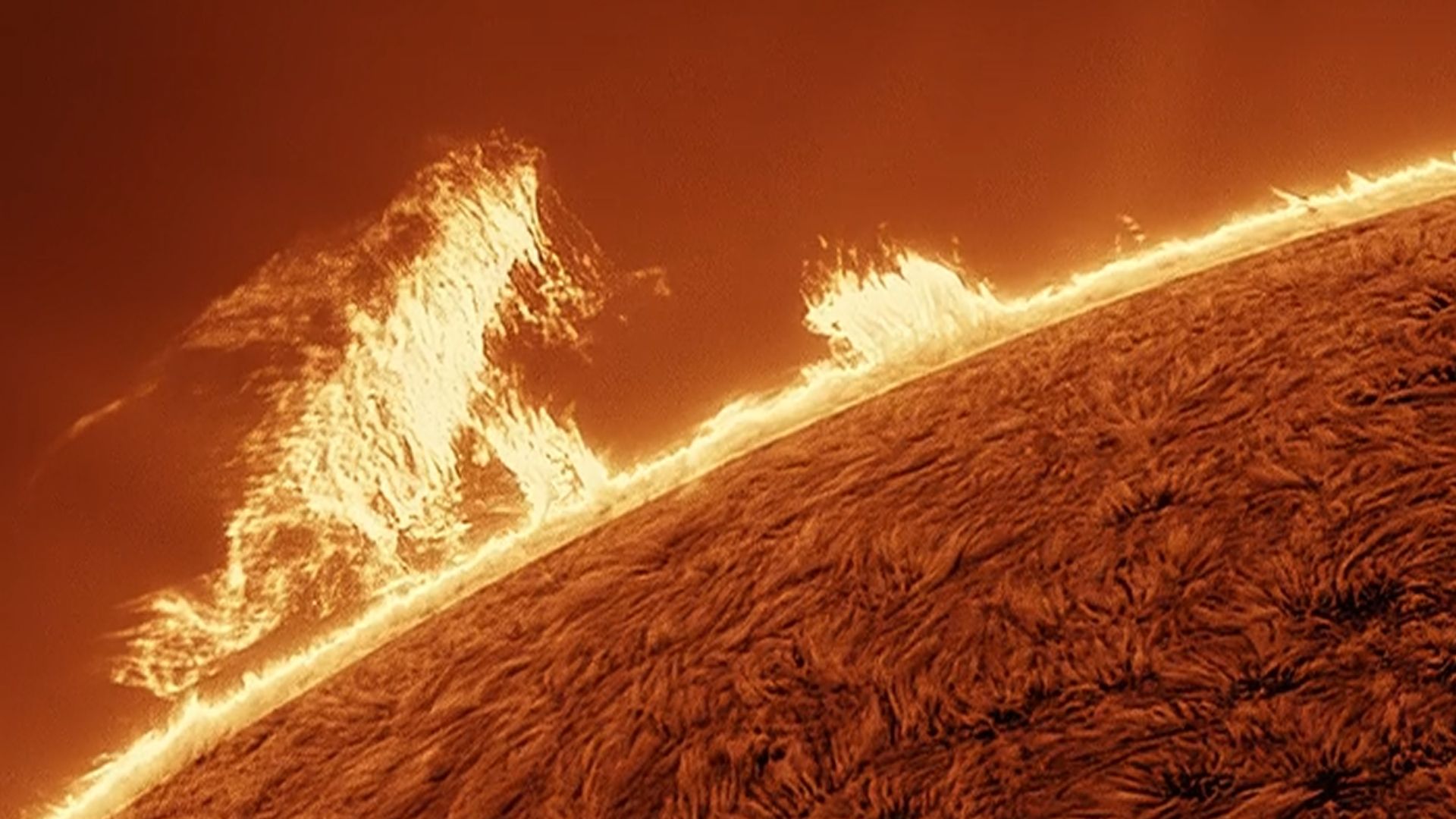
Astrophotographer Mark Johnston has captured two mesmerizing views of giant solar prominences — towering clouds of glowing plasma suspended above the sun by magnetic fields.
The first video, captured on May 22, 2026, shows a remarkable prominence releasing streams of material that appear to fall back toward the sun as coronal rain. The second, filmed on May 31, 2026, reveals a ‘Godzilla’-like prominence looming above the solar surface.
Johnston explained that the flowing plasma may appear wind-swept, but the motion is largely controlled by the sun’s magnetic field.

“The movement you see may look like wind effects, but it’s mostly caused by magnetic fields and, to a lesser extent, gravity. The hydrogen on the limb is ionized, so magnetic fields pull it along invisible field lines,” Johnston told Space.com in an email.
Johnston captured the footage from his backyard in Scottsdale, Arizona, using a 160mm refractor equipped with a specialized hydrogen-alpha solar filter.
“I try to image the Sun every clear morning, and I’m always looking for interesting features,” Johnston told Space.com in an email.

While the prominence resembles a fiery eruption, Johnston notes that looks can be deceiving.
“It’s not flame. There’s no fire on the Sun. Just as your stove can glow red-hot and not be on fire, the hydrogen on the Sun is so hot it glows too.”
Solar prominences are immense structures of superheated plasma that extend outward from the sun’s surface while remaining tethered by magnetic fields. When viewed against the dark backdrop of space, they can appear as glowing arches, curtains or towering clouds along the sun’s edge. The same structures are known as filaments when seen against the bright face of the sun, where they appear as dark ribbons because they are cooler and denser than the surrounding material.
Remember, viewing the sun without the right equipment can be dangerous. Never look directly at it with the naked eye or through a telescope unless you’re using certified solar filters.
Editor’s Note: If you snap an awesome astrophoto and would like to share it with Space.com’s readers, send your photo(s), comments, and your name and location to spacephotos@space.com.