


Follow us
Add us as a preferred source on Google
The Euclid space telescope has spotted the most distant and ancient quasar ever seen, a bright cosmic event powered by a supermassive black hole with 360 million times the mass of the sun.
The supermassive black hole is seen as it was just 630 million years after the Big Bang. 40 million years further back in time than the previous record holder for the most ancient quasar.
The discovery further deepens the mystery of how supermassive black holes grew so massive so soon into the history of the universe. That’s because previously, scientists had theorized it should take 1 billion years of feeding and merging for black holes to reach supermassive status of millions or billions of times as massive as the sun.
Quasars occur when supermassive black holes are surrounded by vast amounts of gas and dust on which they feed. The immense gravitational influence of the black hole causes this material, in the form of an accretion disk, to glow brightly and to blast out bright jets of plasma. That means quasars at the heart of galaxies in regions called active galactic nuclei (AGNs) like this one can often be brighter than the combined light of every star in the entire surrounding galaxy, but only briefly.
The newly discovered quasar, designated J1504+6252 and nicknamed Dún Aonghasa, is in this brief phase of its existence. It was discovered among millions of objects in 18 months of data from Euclid.
Euclid’s initial observation of Dún Aonghasa was followed up by an array of ground-based and space-based telescopes, including the W.M. Keck Observatory, the Large Binocular Telescope Observatory, the Hubble Space Telescope, and ultimately the James Webb Space Telescope (JWST). It was the JWST that determined the mass of this supermassive black hole.
What is interesting about Dún Aonghasa is that it is unlike other supermassive black holes seen at a similar period of the early universe. That’s because this black hole is feeding relatively slowly. That means if it engaged in rapid feeding to reach its massive size, that period of gorging on gas and dust has either ended or it has paused.
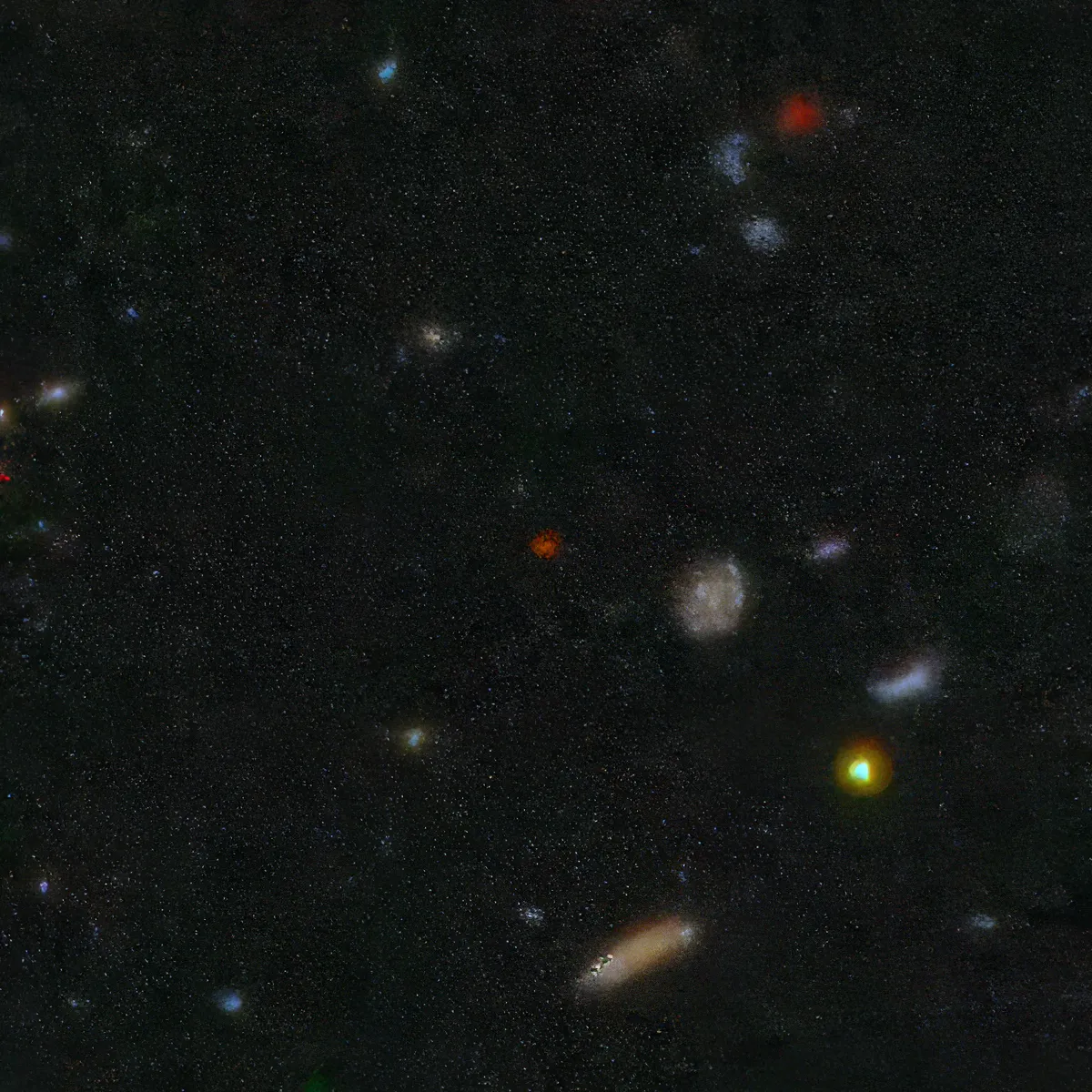
That is something that further complicates our picture of supermassive black hole growth.
By staring back 13.1 billion years in time to see Dún Aonghasa, Euclid is also observing a crucial time in cosmic history when the first stars and galaxies were taking shape, and the clearing of cosmic gas was ending the dark ages of our universe by allowing light to travel freely.
Euclid’s primary mission is improving our understanding of dark energy, the mysterious force accelerating the expansion of the universe, and dark matter, the most mysterious “stuff” in the cosmos. Collectively, these aspects of the universe account for around 95% of its matter-energy budget and have come to be collectively referred to as the dark universe. Hence Euclid’s nickname as the “dark universe detective.”
This research, along with Euclid’s discovery of at least 12 that date back around 13 billion years, shows that this pioneering space telescope launched in 2023 could also make a major contribution to our understanding of black holes and their growth.
The team’s research was published on Tuesday (Nov. 24) in the journal Astronomy & Astrophysics.

