


As the jet fuel crisis continues, many airlines have felt the effects.
There have been raised ticket prices, and flight cancellations around the world – and some airlines have even been forced to close down completely.
Despite it all, Ryanair has been consistently confident about its supplies.
So confident are CEO Michael O’Leary and his staff, in fact, that the budget airline’s chief financial officer, Neil Sorahan, recently called out ‘weaker carriers’.
He told City AM: ‘The recent spike in fuel is putting a lot of weaker carriers into a very precarious situation. We’ve seen in the US Spirit go out of business in the recent past,’ he said.
‘I wouldn’t be surprised to see some failures over this winter as the high fuel costs hit our unhedged and unprofitable competitors in Europe.’
The blockage of the Strait of Hormuz since the start of the Iran war has caused issues globally, with countries having to quickly find other suppliers.
Ryanair has insisted throughout the ordeal that it stands in a good position to survive the jet fuel crisis, but should it be so confident?

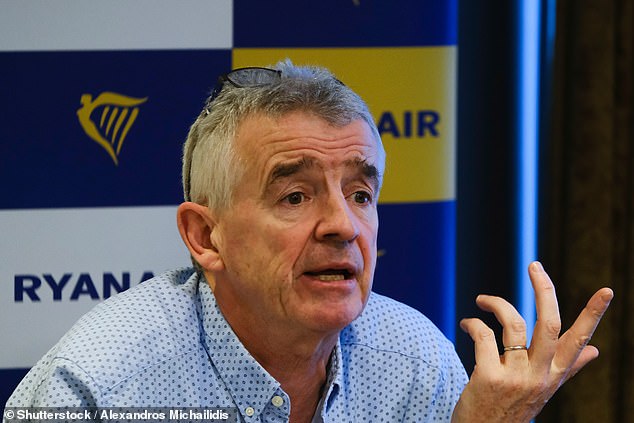
Ryanair’s CEO Michael O’Leary has remained confident about the airline’s fuel supply since the start of the war
Hedged fuel supplies
O’Leary stressed back in April that the budget airline was ‘reasonably well-hedged’ on 80 per cent of jet fuel.
Fuel hedging means airlines lock in future fuel prices in advance. Usually, it is a dry accounting tactic buried in company reports.
But when oil and jet fuel prices rocket, it can decide which airlines have enough breathing space to protect their summer schedules – and which are under pressure.
O’Leary did note, however, that ‘we do run the risk of supply disruptions in Europe in May and June’, if the war continues.
Revealing he was paying $150 (£112) a barrel for around 20 per cent of his fuel, he insisted the more ‘immediate concern’ was if there would be enough jet fuel to keep planes flying.
Jet fuel prices doubled from roughly $100 (£73) per barrel in late February to around $200 (£146) per barrel in early April following disruption caused by the conflict in the Middle East.
Holiday Extras’ airline fuel hedge tracker shows how 75 per cent of Ryanair’s fuel is pre-purchased at locked-in prices by the end of this year.
Next year, however, seems to be a different story, and in Q1 only 20 per cent of the fuel is hedged. This goes on to drop to 10 per cent by the end of 2027.
‘Ryanair is holding off locking in summer 2027 hedges, waiting for oil prices closer to $70/barrel before committing,’ Holiday Extra says.
A recent Daily Mail investigation analysed ten major carriers used by UK travellers and found that Jet2 tops airline resilience rankings, followed by Ryanair.
The research, carried out with aviation intelligence platform My Flight Path, ranked key airlines on fuel hedging and schedule stability.
Budget giant Ryanair scored 89 out of 100 in the study, with approximately 82 per cent of its 2026 fuel hedged at £49 per barrel – among the cheapest locked-in rates of any carrier globally.
Join the discussion
Should airlines be allowed to hike prices during crises, or is that taking advantage of travelers?

Holiday Extra’s airline fuel hedge tracker shows how 75 per cent of Ryanair’s fuel is pre-purchased at locked-in prices by the end of this year
Outlook for the summer
O’Leary has previously insisted the summer season depends on whether the strategic passage, the Strait of Hormuz, can be freed once again for the travel of vessels carrying oil.
The company recently revealed it doesn’t expect to increase prices for the summer, with pricing ‘trending broadly flat’.
‘The conflict in the Middle East has created economic uncertainty and we still don’t know when the Strait of Hormuz will reopen,’ O’Leary said in a statement.
‘Despite this, Europe remains relatively well supplied with jet-fuel, with significant volumes sourced from West Africa, the Americas and Norway.’
Ryanair has a ‘conservative jet-fuel hedging strategy’ that it hopes will ‘insulate’ the airline’s earnings.
O’Leary said: ‘Pricing in recent weeks has eased somewhat in response to economic uncertainty caused by higher oil prices, the fear of fuel shortages and the risk of inflation adversely impacting consumer spending.
‘As always, Ryanair will pursue its ‘load-active/yield passive’ strategy to drive traffic growth, ancillary revenue and lower unit costs.’
However, 20 per cent of the airline’s fuel is unhedged and has ‘spiked’ in price ‘due to the Middle East conflict’.
O’Leary said, as reported by CNBC: ‘We can guarantee people there’ll be no price increases, no fuel hedging, no fuel surge levy surcharges, regardless of what happens to summer supply.’

Ryanair has a ‘conservative jet-fuel hedging strategy’ that it hopes will ‘insulate’ the airline’s earnings
What other airlines and travel companies are saying
But how are other companies coping with the current situation? In a bid to reassure customers, Jet2 said today it is looking ahead ‘with confidence’ in regards to its jet fuel supply.
Steve Heapy, CEO of Jet2 said: ‘We are in regular dialogue with our fuel suppliers, and the current picture is one of increased production and imports, meaning we continue to look ahead with confidence.
‘We have already been very clear about our plans to operate our schedule as normal this summer, and our message to holidaymakers is that summer is on.’
He added: ‘This confidence, on top of the incredible value that our award-winning holidays offer right now, means it is a fantastic time to get that well-deserved holiday locked in, and we know that many people are taking advantage of that right now.
‘Everything is geared up and ready for a busy summer and we look forward to welcoming everybody onboard and creating fantastic memories with Jet2.’
Online travel agent loveholidays also announced it will not introduce surcharges this summer.
It had previously pledged never to apply its own surcharges to holidays – but its updated policy now shelters customers from the risk of any of its 140 global airline partners applying their own surcharges to existing bookings.
Loveholidays outlined its commitment to protecting customers: should an airline apply a surcharge to a booking retrospectively, loveholidays will not pass the price increase on to its customers.
This applies to flights departing up to 30 September 2026, giving customers confidence that the price they pay when booking their summer holiday will not change.
Tui, one of the UK’s most popular providers, has made its assurances.
Neil Swanson, managing director of Tui UK & Ireland, said: ‘Our teams are here to support people who are thinking about booking, and those who have already booked with Tui can be reassured that their holiday price is fixed, with no fuel surcharges added.’
EasyJet confirmed to the Daily Mail that customers can book with confidence as they will not have to pay any surcharges including fuel surcharges after they book – and the price is locked in and will not increase post-booking either.