Conny Waters – AncientPages.com – Archaeologists have discovered the largest collection of Latin cave inscriptions ever found in the Roman Empire at the Cova Dones site in eastern Iberia.
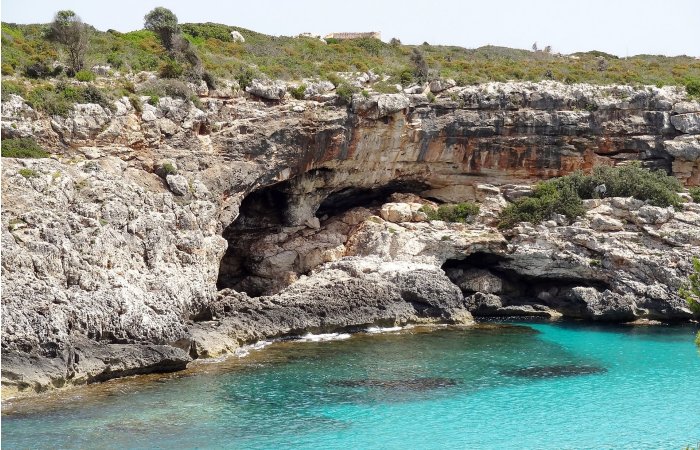
Cova Dones. Credit: Olaf Tausch – CC BY 3.0
The unprecedented find of at least 120 inscriptions reveals an underground sanctuary dedicated to a female deity, proving that women held prominent ritual roles that were highly unusual for Roman society.
A Hidden Sanctuary Unearthed Underground
The international research effort was conducted by the DONARQ project, co-led by Dr. Aitor Ruiz-Redondo of the University of Southampton and the University of Zaragoza, alongside Dr. Virginia Barciela from the University of Alicante. Cova Dones previously gained international attention for its extensive Paleolithic rock art, but excavations in 2024 revealed a hidden Roman sanctuary located more than 200 meters underground. Before the team’s latest analysis, only 15 Roman inscriptions were known to exist at the site.
Reflecting on the ongoing research, Dr. Aitor Ruiz-Redondo explained: “Each new discovery reinforces the idea that Cova Dones served as a landmark place for the communities inhabiting this region over thousands of years…” For the full quote and further details, please refer to the referenced web document.
Advanced Technology Decodes Invisible Text
Because the ancient texts are nearly invisible to the naked eye, the team utilized high-resolution photogrammetric recording to reveal and separate the writings on the walls and ceilings. Votive inscriptions confirm that visitors worshipped a goddess known as “Domina” (“the Lady”). Dr. Silvia Alfayé noted that the find confirms active worship of Domina and female participation in her cult.
“Thanks to a group of five votive inscriptions, we can now state with certainty that, during the Roman period, worship was conducted inside the cave to a goddess reverentially referred to as Domina (‘the Lady’), and that women played an active role in her cult. This goddess possessed a specific epithet, possibly connected with water, whose definitive reading is currently under study,” Dr. Alfayé said.
Challenging Traditional Views On Roman Society
Preliminary readings indicate that women played an exceptionally active role in this cult, writing vows without a mediator—a sharp contrast to the male predominance in other known Roman sanctuaries.
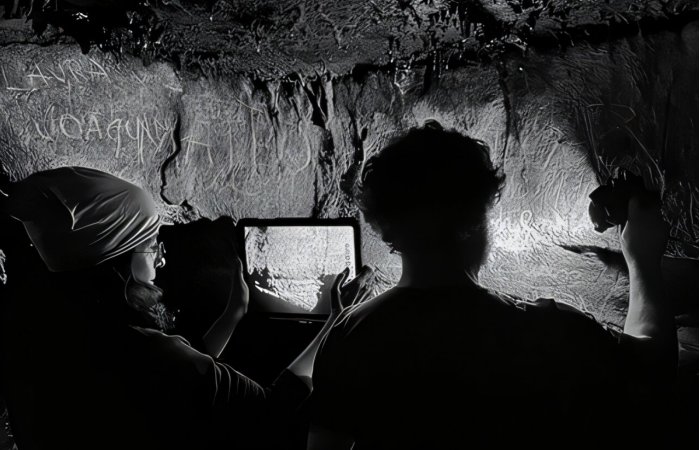
Dr Silvia Alfayé and Dr Sergio García-Dils working in the Roman sanctuary. Credit: University of Southampton
“The fact that at least five inscriptions are dedicated to the same Domina clearly demonstrates that this was not simply a cave visited for general religious purposes. It was the setting for the worship of a specific deity under a particular cult title. Moreover, the marked concentration of these inscriptions within a single sector of the cave strongly suggests a well-organized, structured cult,” Dr. Sergio García-Dils said.
Ritual Offerings Point To Ancient Female Heritage
Archaeologists also recovered physical offerings such as jewelry, ceramics, and spindle whorls, a textile-working implement traditionally associated with women in antiquity.
See also: More Archaeology News
“This evidence fits remarkably well with the epigraphic data pointing to women’s active participation in the sanctuary’s ritual life,” explains Dr Barciela. “It also invites us to reconsider the earliest recorded name of the site, Cova de les Dones (‘Cave of the Women’). It is possible that this name preserves the fossilized memory of a place long associated with women – or with female supernatural beings.”
Digital Tours Planned For The Future
Preserving both archaeological materials and rock inscriptions in situ within a Roman underground sanctuary is exceptionally rare.
A substantial part of Cova Dones still awaits detailed investigation, and many inscriptions remain under study.
While investigation continues, upcoming public dissemination programs will introduce immersive virtual tours of the cave.
Source: University of Southampton
Written by Conny Waters – AncientPages.com Staff Writer