


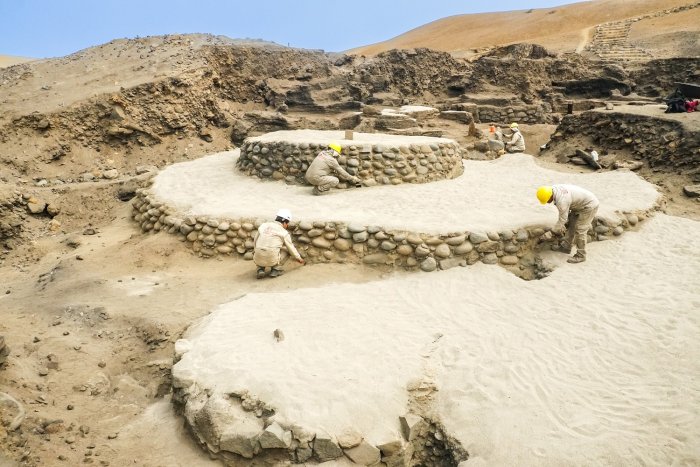
Conny Waters – AncientPages.com – Archaeologists working in Áspero, Peru, have uncovered an ancient structure interpreted as an “observatory” used by the Caral civilization to track the sky long before telescopes existed. This space likely allowed its builders to monitor the movements of the sun, moon, and key stars to mark the seasons, organize agricultural and maritime activities, and conduct ceremonies aligned with celestial cycles.
Credit: El Ministerio de Cultura
The find highlights that Caral society was far from “primitive.” Instead, it demonstrates a sophisticated understanding of how astronomical events influenced life on Earth. The Caral (or Caral-Supe) civilization flourished between about 3000 and 1800 BCE in the Supe Valley of north-central Peru and is considered the oldest known civilization in the Americas.
Located roughly 200 km north of Lima, Caral was a major urban center with monumental architecture, including large platform mounds and sunken circular plazas, serving as a hub for trade, agriculture, and religious rituals.
Credit: El Ministerio de Cultura
This discovery adds to the evidence linking astronomical knowledge with social organization and sustainable resource management in one of the earliest urban centers in the Americas. According to Peru’s Ministry of Culture, through the Caral Archaeological Zone – Executive Unit 003, the newly identified structure in Áspero—a coastal, fishing settlement of the Caral civilization in Supe Puerto (Barranca province)—is a complex architectural space associated with astronomical observation.
Led by Dr. Ruth Shady Solís, the research team has identified this as a specialized area in which experts likely recorded celestial phenomena and their connections to environmental conditions. Such information would have been crucial for decisions related to fishing, shellfish gathering, and trade with agricultural communities in the Supe Valley.
The announcement coincides with the commemoration of 21 years of research, conservation, and development at the Áspero archaeological site (3000–1800 BCE), underscoring its importance as a center of knowledge and innovation at the dawn of civilization in the Americas.
An Architecture Oriented Towards The Sky
Research indicates that ancient inhabitants carefully observed the Sun, Moon, and stars to predict tides, weather patterns, and the availability of marine resources—factors that were crucial for organizing their productive activities.
Credit: El Ministerio de Cultura
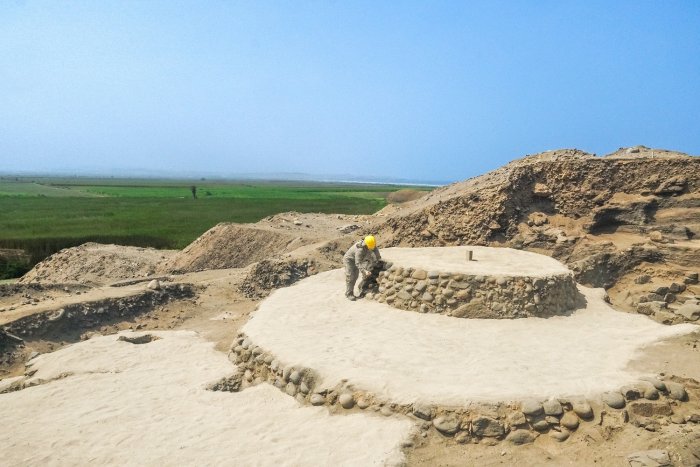
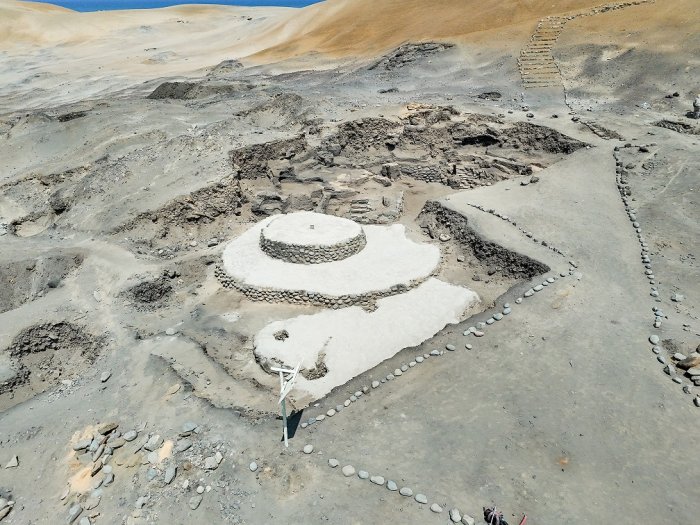
In Sector J1, archaeologists uncovered a strategically positioned structure near the settlement’s main pyramidal buildings. From this location, both the coastline and the lower section of the Supe Valley can be seen, a vantage point that would have supported the systematic observation of natural and astronomical phenomena, similar to those documented at Caral.
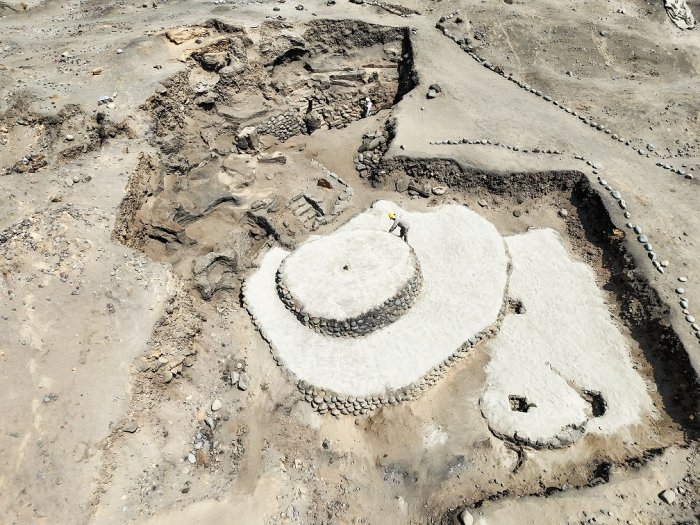
Excavations revealed four distinct construction phases, showing how the building’s architecture and function evolved over time. In the earliest phase, it appears to have served as a public ceremonial structure. In a subsequent phase, it was remodeled to include an oval platform measuring 3.18 meters in diameter and 63 centimeters in height, with a vertical stone, or huanca, at its center—an Andean symbolic element associated with ritual practices and used as a spatial reference marker.
During the third construction phase, the structure underwent further architectural development with the addition of a double stepped platform: a lower platform 9.40 meters in diameter and one meter high, and an upper platform 4.80 meters in diameter. A rectangular stone was placed at the center, and an adjacent enclosure contained a ceremonial hearth. These features point to an intensification of ritual activities, likely connected to astronomical observation.
Credit: El Ministerio de Cultura
Specialists propose that this architectural arrangement may have been used to track solar and lunar cycles and their relationship to climatic changes and the behavior of marine resources—information vital to the fishing communities. In its final stage, the area was filled in and converted into residential spaces, indicating social transformations and the gradual loss of the specialized functions that had previously characterized the settlement.
Ancient Astronomy And Land Planning
The discovery in Áspero adds important new evidence to the Caral team’s ongoing research on Andean astronomy. It strengthens the current understanding of the Caral Civilization, particularly its advanced and sustainable environmental management thousands of years before many other societies.
At present, a multidisciplinary team is analyzing the site’s architectural orientation, stratigraphy, and recovered materials. These data are being correlated with radiocarbon dates to refine the chronological framework and deepen our understanding of the scientific and astronomical knowledge this civilization possessed.
Áspero, A Key Port Of The Caral Civilization
The Áspero settlement, located 700 meters from the Pacific Ocean and covering 18.8 hectares, was a key port within the social interaction network of the Caral Civilization (3000–1800 BCE). The identification of twenty-five architectural complexes at the site indicates a complex social organization sustained by marine resources and trade with populations from the coast, highlands, and rainforest.
See also: More Archaeology News
Notable discoveries include elite funerary contexts, such as the “Lady of the Four Tupus,” the “Elite Male,” and, more recently, the burial of a high-status girl. These findings provide evidence of Áspero’s political, economic, and symbolic importance within the broader Caral network.
Current research shows that Áspero functioned not only as a fishing center but also as a place for the development of scientific and ritual knowledge. Astronomical observations conducted there helped its inhabitants understand and predict environmental changes, highlighting the settlement’s advanced knowledge of its natural surroundings.
Source: El Ministerio de Cultura
Written by Conny Waters – AncientPages.com Staff Writer