


Follow us
Add us as a preferred source on Google
New research suggests that collisions between stars in the early universe were common, which could help explain the rapid growth of supermassive black holes and the existence of strange Little Red Dots seen by the James Webb Space Telescope (JWST).
The team behind this research performed simulations of the early universe and found stellar systems were densely packed, leading to stars frequently slamming into each other. While rapid collisions would have destroyed the stars involved, slower collisions would have led to repeated mergers, creating single over-massive stars, which could collapse and form larger-than-usual black holes at the end of their lives. These could be the seeds of the first supermassive black holes.
Dense stellar environments do still exist in the modern universe at the hearts of galaxies; however, these aren’t conducive to the types of collisions that would birth ultra-massive stars. That is because there are already supermassive black holes at the hearts of modern galaxies, and their immense gravitational influence speeds up orbiting stars, meaning collisions that do occur are high-speed and destructive, thus failing to birth overmassive stars.
“Perhaps the strangest outcome of our simulations is that stars can merge repeatedly within the cluster until they form one gigantic star with a mass equal to that of an entire cluster,” team member Claire Williams, of the University of California, Los Angeles (UCLA), said in a statement. “When a star this huge reaches the end of its life, models suggest that it may have no option but to collapse into itself and form a massive black hole.”
My, haven’t you grown? How did supermassive black holes get so big so fast?
The existence of supermassive black holes before the universe was even 1 billion years old is something that has puzzled astronomers since the JWST started spotting them in 2022.
This is because black holes should need at least 1 billion years to complete the feeding and merger processes that result in a “supermassive” status of possessing millions or billions of times the mass of the sun.
One suggestion put forward by scientists to explain this is that supermassive black holes don’t start out from scratch. Instead, they form from black hole seeds called intermediate-mass black holes.
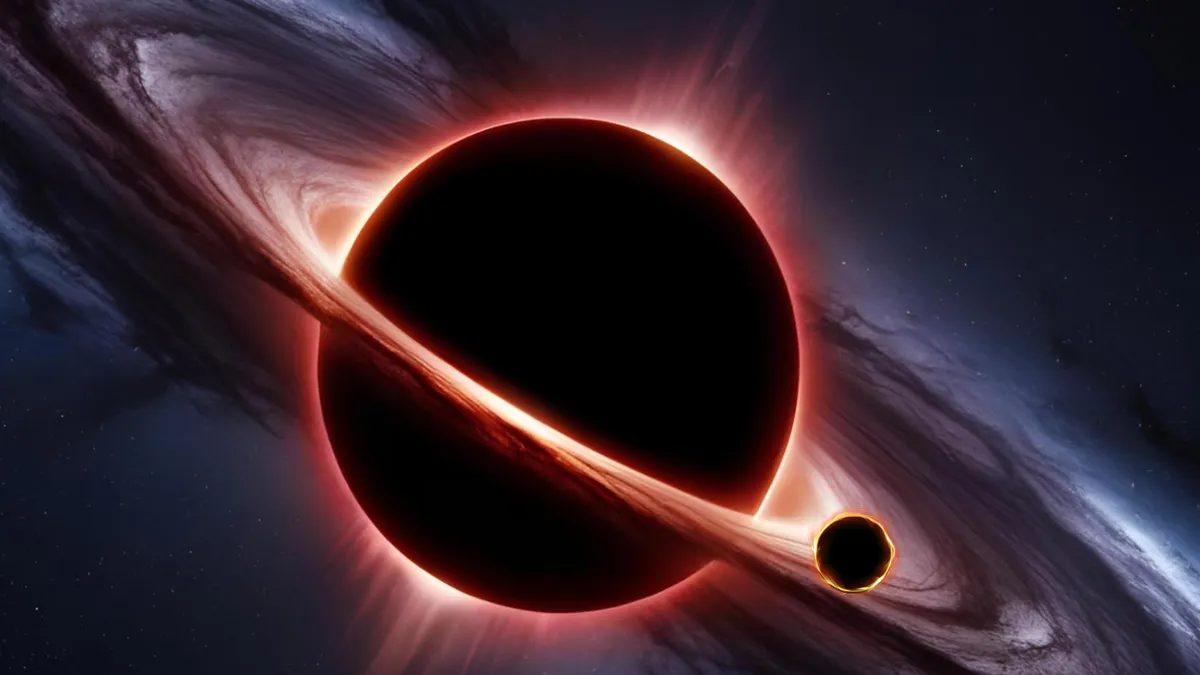
Normally, when a massive star collapses, it births a stellar-mass black hole possessing a mass between 10 and 100 times the mass of the sun. This is considerably smaller than supermassive black holes that dominate the hearts of all modern galaxies with masses millions to billions of times the mass of our star.
Intermediate-mass black holes are thought to sit between these two families of cosmic titans with masses between 100 and 100,000 times that of the sun. The problem is, no single star should have enough mass to collapse and create an intermediate-mass black hole. But that is valid only for the conditions we see in the “modern” 13.8-billion-year-old universe in our immediate cosmic vicinity. Conditions were very different further out into the universe and further back in time.
Indeed, such seeds emerged from these new simulations in environments of dense star clustering, which could solve this mystery by allowing those growth processes to get a head start.
“Dense star clusters provide a natural birthplace for massive black-hole seeds in our model,” Williams said. “The same environment that forms the black hole can also provide stars and gas that influence its subsequent growth.”
However, this could be a two-for-one deal. The JWST has also been routinely discovering astronomical bodies called Little Red Dots in the early universe. Little Red Dots are curious because they seem to have completely disappeared by the time the cosmos reached 2 billion years old.
Little Red Dots the cosmic elephant in the room
Little Red Dots are extremely compact objects in the early universe that get their moniker from the fact that they look like red dots.
“Little Red Dots are a hot topic in astronomy. You can compare studies of people trying to understand Little Red Dots to the tale of blind people who are trying to describe an elephant by touching it, and each person describes it differently based on what part they’re touching,” team member and UCLA researcher Smadar Naoz said. “Our research connects several of those perspectives together and may help us see more of the elephant.”
There have been many suggestions about the true nature of these objects, but one theory suggests that they possess a rapidly growing black hole at their hearts.
The team’s simulations suggest that Little Red Dots may be dense star clusters that are constantly being rocked by repeated stellar collisions. This results in a very large star, which eventually collapses to become an intermediate-mass black hole.
But if that is the case, why were there no Little Red Dots around to celebrate the 2 billionth birthday of the universe?
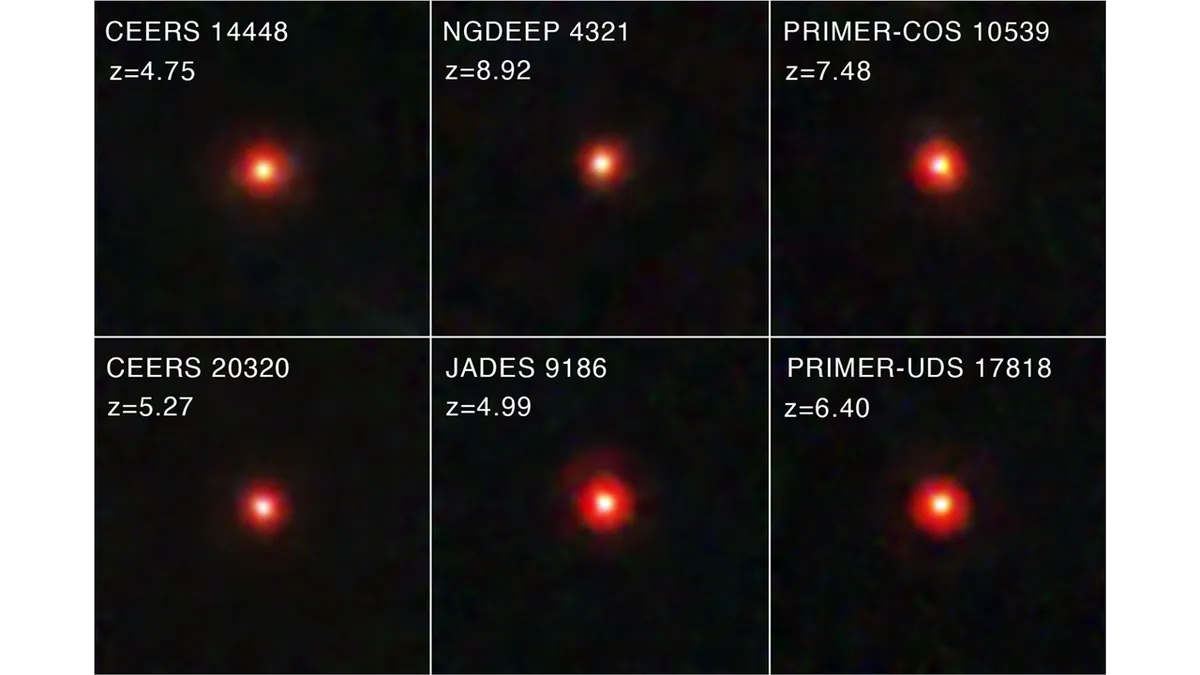
Less than 1 billion years after the Big Bang, the universe was devoid of well-ordered spiral galaxies, but was instead filled with dense and chaotic clusters of star birth. As these regions were rocked with frequent star collisions, the conditions were right for ultra-massive stars to form and collapse into intermediate-mass black holes.
However, as the universe cooled and expanded, these sites became the building blocks of far less chaotic galaxies. Thus, if Little Red Dots are chaotic star clusters needed to form intermediate-mass black holes, progress toward an equilibrium state could explain why they suddenly disappeared from the universe. The cosmos just wasn’t extreme enough to maintain Little Red Dots anymore.
The team’s research was published on Monday (Oct. 26) in the Astrophysical Journal.

