Conny Waters – AncientPages.com – High on a steep cliffside in central Mexico, ancient red paintings hidden in a small rock shelter have been decoded, revealing that pilgrims from the great metropolis of Teotihuacan once used the cavern for fiery rituals honoring fallen warriors.
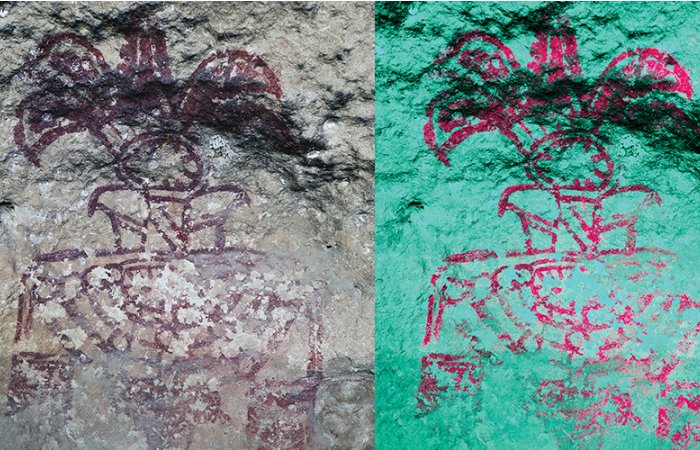
Credit: Helmke C, Nielsen J, Meza Rodríguez C, Córdova Tello M, Antiquity
A new study published in the journal Antiquity examines three painted glyphic compounds inside Cave 19 at the archaeological site of Chalcatzingo, located roughly 90 kilometers southeast of Mexico City. While Chalcatzingo is famous for its monumental Olmec-style rock carvings dating to 900–500 BC, researchers from the University of Copenhagen and Mexico’s National Institute of Anthropology and History (INAH) found that the mountain remained a potent sacred site nearly a millennium later.
Using advanced digital photographic enhancements to bring out the faded hematite pigment, archaeologists Christophe Helmke, Jesper Nielsen, Carolina Meza Rodríguez, and Mario Córdova Tello determined that the symbols belong to the ancient Teotihuacan writing system and date to between the fourth and sixth centuries AD.
For decades, many scholars debated whether Teotihuacan—one of the largest and most influential cities in the ancient Americas—possessed a true writing system or merely a collection of symbolic icons. The findings in Cave 19 add crucial evidence to a growing consensus that Teotihuacanos used a functioning logo-phonetic script.
The researchers identified three distinct elements painted along the back wall of the tiny, 7.4-square-meter shelter on the western face of Cerro Delgado:
* A Sacred Place Name: The first glyph depicts a stylized mountain flanked by speech scrolls emerging from an open mouth. Researchers translate this compound as “Singing Mountain”—a direct match to a place name recorded in murals back in the city of Teotihuacan, and closely aligned with the hill’s later Nahuatl name, Cuicatepec. This suggests Cerro Delgado was a recognized pilgrimage destination for Teotihuacanos.
* A Martial Title: The second glyph shows a beaded necklace and a piece of cloth pierced by an upright dart thrown by a spear-thrower (atlatl). In Mesoamerican poetic tradition, pairing weapons with fine regalia evokes military prestige and wealth, leading the authors to interpret the sign as a formal warrior title or the emblem of a specific military order.
* A Starry Awning for the Dead: The third painting is not a word, but a large rectangular frame adorned with five-pointed stars. Similar starry frames appear on elaborate Teotihuacan incense burners, representing ceremonial awnings erected during rituals to commemorate deceased warriors.
Evidence Of Fiery Ceremonies
The placement of the third glyph provides a major clue as to how the cave was used. The starry rectangular frame is painted directly behind a low bedrock shelf at the rear of the cavern, and the rock wall and ceiling directly above it are heavily blackened by soot.
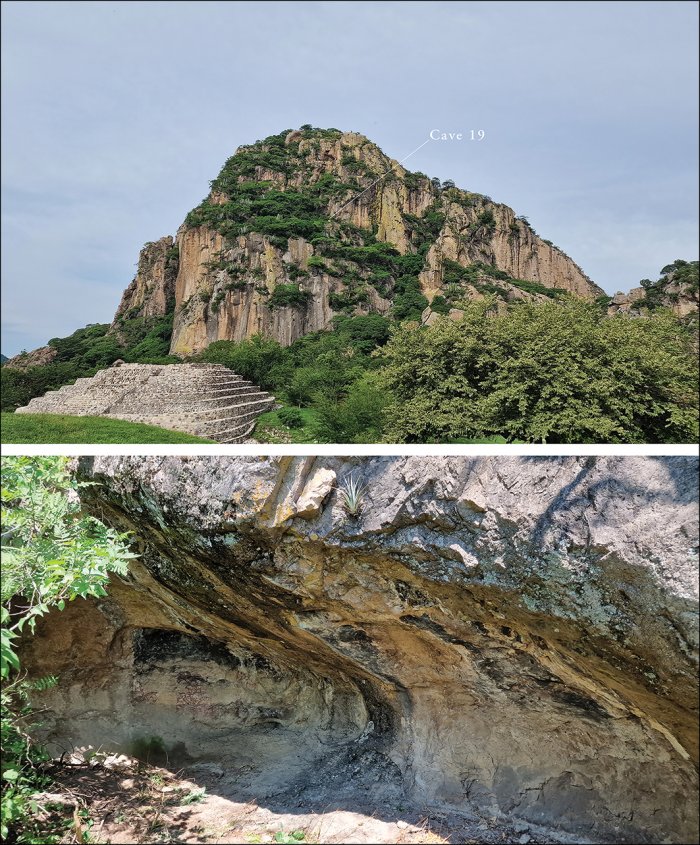
The western face of the Cerro Delgado (top), showing the location of Cave 19. Painted glyphs can be seen in the back of the cave (below) with fire-clouding above them (photographs by Christophe Helmke
According to the researchers, this fire-clouding points to ancient pyrolytic rituals. At Teotihuacan, fire ceremonies played a central role in religion, including both burning incense and cremating exalted warriors. While exposure to the elements has long since erased any ash or physical remains from the shelf, the authors suggest the ledge may have held an incense burner or even supported the funerary bundle of a fallen warrior during cremation rites.
A Steep Climb To The Sacred
Today, Cave 19 is so perilous to reach that modern archaeologists must hike to the summit of Cerro Delgado and rappel down the sheer western cliff face. In antiquity, visitors likely accessed the shelter from the valley floor using wooden scaffolding, ladders, and footholds carved directly into the stone.
See also: More Archaeology News
The discovery also ties into broader patterns of Teotihuacan expansion. Just 13 kilometers south of Chalcatzingo lies San Ignacio, a major provincial enclave built along Teotihuacan’s signature urban grid to secure fertile farmland and trade routes. The paintings in Cave 19 demonstrate that Teotihuacan’s presence in eastern Morelos was not merely economic or strategic—it was deeply spiritual, weaving the empire’s warrior cults into a sacred mountain landscape revered for centuries.
The study was published in the journal Antiquity
Written by Conny Waters – AncientPages.com Staff Writer