Conny Waters – AncientPages.com – Young adults, not families, drove migration in Bronze Age communities. Researchers analyzed skeletal samples from Greek archaeological sites to assess mobility during the Middle and Late Bronze Age. The results show that young people actively sought new communities.
These findings challenge traditional views of mobility and migration in prehistoric societies. Previous research suggested women were more likely to move between communities, particularly through marriage in patrilineal societies.

“Our study demonstrates that the numbers of nonlocal women and men are comparable, suggesting that several different factors might have been driving an individual’s mobility,” says Serena Sabatini of the University of Gothenburg.
The Mediterranean underwent significant sociocultural and economic changes during the Bronze Age, with regional and temporal variations. Expanding exchange networks contributed to these developments. However, the extent to which these exchanges involved the migration and settlement of foreign individuals in local communities remains unclear.
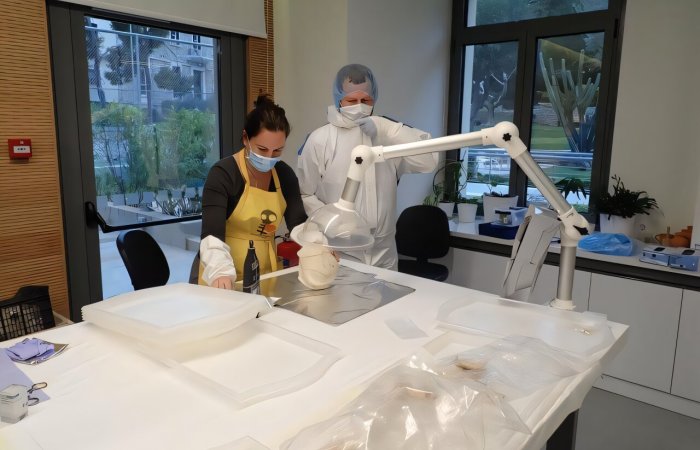
The researchers have taken samples from skeletons at various archaeological sites in Greece. Here they are in the Malcolm H. Wiener Laboratory for Archaeological Science, American School of Classical Studies at Athens. Credit: University of Gothenburg
Researchers determined the childhood origins of 199 Bronze Age individuals from southern and central Greece.
The study found that 5% to 10% of individuals analyzed in each Bronze Age community in modern Greece were classified as “foreigners.”
See also: More Archaeology News
“Interestingly, nonlocal individuals were identified across different burial practices, featuring both unremarkable and richly furnished graves, revealing that individuals were mobile regardless of their wealth or status,” Sabatini says.
The study found no “foreigners” among the children studied. Young adults under 30 were most likely to be nonlocal, indicating that migration primarily involved single young individuals, not entire families.
The study was published in PLoS ONE
Written by Conny Waters – AncientPages.com Staff Writer