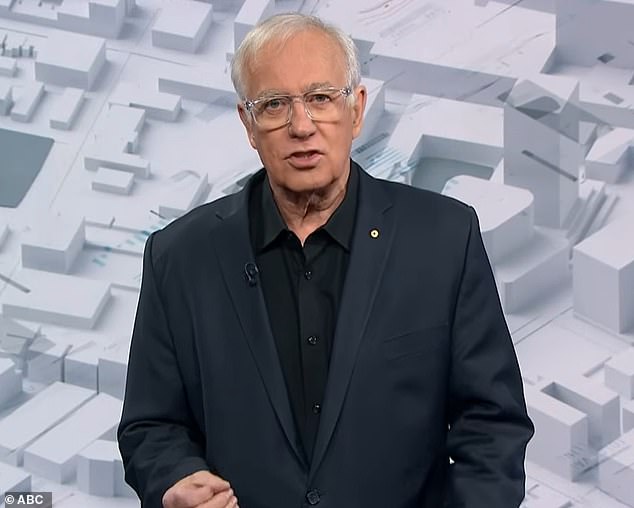
Alan Kohler has ripped into Pauline Hanson, comparing her to Donald Trump, and claiming that she favours the rich and lacks the ability to run Australia’s economy.
The ABC star claimed in a column on Monday that she was not ‘someone who springs to mind as the best manager of a complex economy’.
Kohler argued that despite her lack of credentials, Australians seemed to be turning to the One Nation leader.
Hanson has enjoyed a meteoric rise in the opinion polls over the last few months, with the One Nation leader overtaking the Coalition on primary votes.
A Roy Morgan poll released last Monday showed One Nation is at 26 per cent while the Coalition is at 21.5 per cent. Labor remains at the top on 28 per cent.
Kohler argued that even though the Australian economy was ‘strong’ and that it had been performing well, voters were ‘pissed off’, putting their hope into Hanson and Barnaby Joyce.
‘Australians are as pessimistic about the economy and as pissed off as they have ever been, so much so they are turning to Pauline Hanson, an inhabitant of the Australian political fringe for 30 years and not someone who springs to mind as the best manager of a complex economy,’ he said.
‘And do they think Barnaby Joyce is the treasurer who will turn things around? Yet here we are.’

Alan Kohler (pictured) said frustrated voters were looking to ‘break the system’ with Hanson
Kohler argued that soaring household debt, worsening housing affordability and rising inequality have fuelled voter discontent and created fertile ground for anti-establishment movements.
Drawing parallels with the United States, he said Australians were increasingly embracing the same anti-system politics that helped propel Donald Trump to power.
‘Australians are now following Americans down the path of turning to a “break the system”, anti-immigration grievance candidate,’ he wrote.
Citing RedBridge pollster Kos Samaras, Kohler said One Nation’s support is concentrated among mortgage-stressed, working-class voters in outer suburban and regional communities who feel abandoned by both Labor and the Coalition.
He said many of these voters bought into the promise of home ownership only to find themselves burdened by rising debt and stagnant income growth.
According to Kohler, Hanson’s growing popularity reflects despair rather than optimism in Australian voters.
‘And like Democrats and traditional Republicans in the United States, neither the Coalition nor the ALP have looked after them or given them any reason to hope,’ he wrote.
‘In a way, voting for the Trumpism of One Nation is the absence of hope.’

Kohler said that Hanson (pictured) and her party would not turn Australia’s economy around
Join the discussion
Is Australia’s political frustration really best solved by backing anti-establishment leaders like Hanson?
Kohler pointed to what he described as a contradiction at the heart of Hanson’s appeal, arguing that many voters angry about inequality are backing politicians supported by wealthy interests.
‘The great irony of it is that the victims of this global increase in inequality… have turned to politicians who are part of the billionaire class,’ Kohler said.
While noting Hanson is not a billionaire herself, Kohler highlighted her relationship with mining magnate Gina Rinehart, who has become one of One Nation’s most public and powerful supporters.
‘Hanson is not a billionaire like Trump, of course, but she has the backing of Australia’s richest woman Gina Rinehart, who gifted her a million-dollar plane, and her policies tend to favour the rich,’ Kohler wrote.
Despite ongoing debate over migration levels, Kohler argued immigration is being unfairly blamed for broader economic frustrations.
He said housing costs, mounting debt, pressure on infrastructure and falling disposable incomes are driving public anger far more than migration.
‘Migration is not the cause of rock-bottom consumer sentiment despite a healthy economy, but it’s getting a lot of the blame,’ Kohler wrote.
Hanson has long been a fierce critic of the ABC and refuses to grant interviews to the national broadcaster.
During a recent National Press Club address, she also outlined plans to abolish SBS entirely, arguing the broadcaster is no longer necessary in the internet age, while making deep cuts to the ABC.
Hanson said taxpayers could continue funding some regional broadcasting services, but proposed shifting the ABC to a subscription-based model for most of its operations.