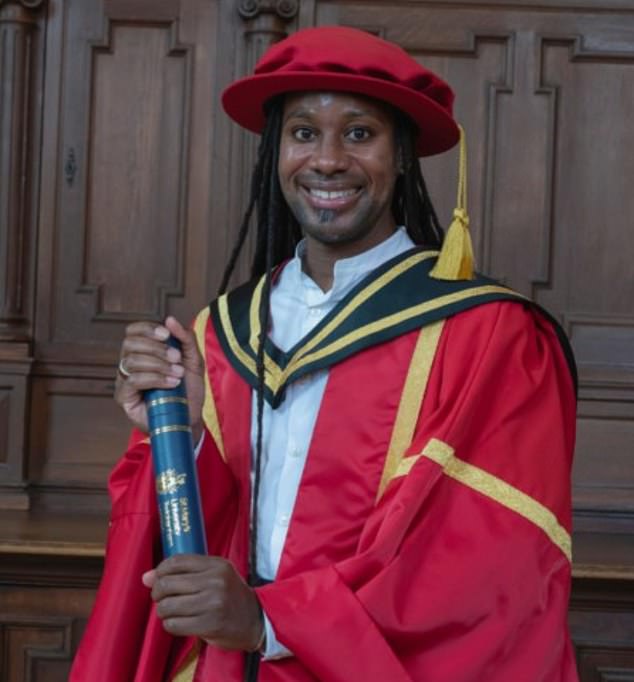
It’s a heartwarming tale straight out of Hollywood: how Professor Jason Arday forged a path from south London council estate to the ivory towers of Cambridge University.
The working-class son of immigrants overcame severe autism, crippling dyslexia and a range of bizarre medical conditions that would have poleaxed a lesser mortal to achieve fame and fortune in the field of academia.
Along the way he’s been garlanded with awards, appeared on endless TV shows and podcasts, and pursued a lucrative second career as a freelance public speaker, travelling the globe to give motivational accounts of how he not only conquered huge personal odds but also raised more than £5million for charity.
This month, Arday’s incredible journey will be the subject of a high-profile autobiography, Great And Unfortunate Things.
Yet as publication looms, there are growing fears that his incredible life story doesn’t quite add up. Here are some of its strangest chapters…
‘Genius’ mother
Jason Atta Kwei Arday was born in Lambeth in May 1985 and delivered by an African midwife who announced that he had peculiarly long fingers.
‘Where I come from, babies with long fingers are special,’ she declared. ‘This boy is destined for great things.’
His parents, Joseph and Gifty, were Ghanaian immigrants who had come to the UK in the early 1980s, married soon afterwards, and moved into a flat on the Willard Estate, just north of Clapham Common.

Professor Jason Arday has been accused of plagiarism, while multiple claims about his personal life have come under scrutiny

In his book, Arday claims he played football ‘semi-professionally’. Pictured with the Olympic torch for the London Olympics in 2012
Joseph worked as a chef while Gifty was, in various versions of Arday’s life story, a social worker, mental health nurse, charity boss and bereavement counsellor.
Despite also raising three sons, one of whom was severely autistic and required intensive daily care, she over the years allegedly found time to gain a truly remarkable number of university qualifications. ‘I know people always speak well of their mums, but my mum is a very learned person,’ he told a podcast in 2023. ‘She holds five degrees.’
Speech therapy mystery
At the age of three, Jason was diagnosed with ‘global development delay,’ a form of autism which he has likened to Asperger’s. He vividly describes the development in his forthcoming book. ‘“There’s no one in there,” the doctors told Gifty. They said that I was “deficient”, and that I’d never be able to talk, read, or write. One doctor insisted I was “no better than a vegetable”.’
Gifty didn’t take that news lying down. She instead found time in her packed schedule to devote the next seven years to her son’s speech therapy. On a podcast in 2023, Arday recalled: ‘I spent thousands of hours in speech therapy, seven days, six days a week, three hours a day.’
The following year, he alleged something similar, albeit with different numbers, saying: ‘From the age of two to 11, I spent probably 10 hours a day in speech therapy.’
Assuming that’s true, speech therapy provision in Thatcher-era south London must have been extraordinarily generous, unless Gifty was able to pay for the care privately. Either way, in the end it clearly worked: one day shortly before his 12th birthday, Arday says a therapist named Olywn Donnelly persuaded him to utter his very first word: ‘Hello.’
The TV series that wasn’t
Arday has claimed that, as a child, he’d starred in the famous BBC documentary series Seven Up. ‘I was part of a programme which doesn’t really exist anymore, but was called Seven Up at the time,’ he told the University of Bath’s Racial Equality Taskforce. ‘Seven Up is basically when they follow you over the duration of your life. So they follow you at seven, 14, 21. I was pulled out of the project when I was 14.’
Strangely, all of the BBC show’s participants were born in either 1956 or 1957, making them almost 30 years older than Arday.

Arday has also claimed to have run 300 miles in three days in 2013, and 600 miles in six days in 2015 (though he later changed the timeframe to a dozen days)
A follow-up series, launched in 2000, followed individuals who were seven years old at the turn of the Millennium, an age bracket he didn’t fall into, either.
The BBC this week confirmed that Arday had ‘nothing to do with our films,’ prompting the professor to declare that he’d never really meant to suggest he’d taken part in the BBC show.
Arday denies lying, however. He insists that he was instead talking about a ‘local community and parent-led initiative’ with a completely different name.
A spokesman said: ‘The reference to Seven Up was used informally as a shorthand illustration of the concept. It was not intended as a literal comparison and should be understood in the context in which it was made. This was a local community and parent-led initiative developed around the Ubuntu principle that ‘it takes a village to raise a child’. The reference to Seven Up was used informally as a shorthand illustration of the concept.’
Unhappy schooldays
Within months of learning to talk, Arday was packed off to the local secondary, Southfields Community College. It was not a great success.
Although corporal punishment was banned in England in 1987, when Arday was an infant, he claims in his forthcoming memoir that when he failed to complete a task in class, teachers would subject him to Dickensian treatment whereby they’d ‘use the same pen to bang on my knuckles, all while breathing down my neck’.

The upcoming publication of Arday’s autobiography has been thrown into doubt by the allegations swirling around the Cambridge professor
By the time GCSEs came around, he remained unable to read or write, so passed just two of them: PE and textiles. His subsequent academic transformation was achieved with the help of two people he met shortly afterwards. One is Debbie McKenzie, a trainee teacher who became first Arday’s girlfriend then his wife. The other is Sandro Sandri, a tutor at Merton College in south London, where he enrolled on a BTec in PE. They agreed to devote hours each day to tutoring him.
‘Before classes even started each day, I’d have to spend over an hour with Sandro working on reading and writing. After classes were over, I’d spend another two hours with Debs.’
With their help, Arday claims he became able to read at 18. Mrs McKenzie remembers things differently. In an appearance on the TV show Surprise! Surprise! in 2013, she said: ‘Jason’s just an amazing guy… he learned how to speak when he was 11 and he couldn’t read or write until he was 16.’
Either way, Arday went on to complete a degree at St Mary’s University, followed by a Postgraduate Certificate in Education. He then says he gained two MAs and a PhD at Liverpool John Moores University, before embarking on a career in academia.
Sporting prodigy
Arday claims in his autobiography to have played football first for his school, then his county. Elsewhere, he has talked of following a professional career path, although details of that alleged chapter in his life are curiously absent from the book.
‘As a child, I was fortunate to play football well, so I was in the academy system and then played semi-professionally,’ he once said.
It’s unclear which academy he represented but his senior career, such as it was, involved a stint as goalie for Lewisham Borough in the Southern Counties East Division One, which is the tenth tier of English football, at the bottom of the non-league pyramid.
During his time in secondary school, he also recalls becoming an accomplished snooker player, bunking off to practice at a local snooker hall called Riley’s and beginning to win significant sums of money on the local competitive circuit. ‘I would record my first century in an actual match, a total clearance of 122 points in a single visit. Still my highest break to date… a couple of times, I won the competition and made about £300… it got to a point where I became so good that I could afford to have my own snooker cue made by John Parris Cues, the best cue maker in the world.’
At one point, he’d made so much loot that his mother discovered wads of banknotes in a tin under his bed and became concerned that he was dealing drugs. Later in life, he would supposedly become an elite marathon runner. Of which more later.
Bizarre medical troubles
Arday’s academic and sporting success is all the more remarkable given the medical challenges he’s faced on top of his severe autism.
He has variously talked of being born deaf in one ear (‘I actually have a hearing aid that I’m supposed to use, which I never use, apart from when I’m lecturing’) and being diagnosed with both dyslexia and dyscalculia, a learning disorder that makes it hard to understand numbers.
After being mugged at a bus-stop as a teenager, he also says he began suffering from severe epilepsy: ‘I had seizures at work, at college, on public transport, in shops and in the street.’
Then, while he was completing his PhD, Arday began to experience intermittent trouble with balance. Doctors allegedly discovered a small tumour near the base of his brain ‘pressing against my pituitary gland’.
It turned out to be benign but an operation to remove it via endoscopic transsphenoidal surgery (a relatively uninvasive technique in which the brain is accessed via a patient’s nostril) took place a mere month before Arday had to complete his PhD viva. Ten days after the operation, he says he ‘collapsed in a heap’ and was rushed back to hospital ‘where the doctors told me I’d had a transient ischemic attack, or mini-stroke’.
This meant he ‘couldn’t access my short-term memory’.
Passing a viva in such circumstances might sound like a tall order. But rather than defer on medical grounds, he went ahead. Arday was driven to Liverpool by mentor Sandro. Somewhat bizarrely, given his medical history, Arday recalls him delivering the following pep-talk: ‘“I’m going to do something to you now because I love you… I’m going to slap you across the face to calm you down.”
‘And that’s what he did. I felt his hand land across my cheek with a loud slap. Stunned, I reached my hand to my stinging face and found myself miraculously able to breathe again.’ He duly passed, becoming Dr Arday in 2016.
Missing charity money
Arday says a visit to a homeless centre in 2003 inspired him to dedicate his free time to raising money for charity.
This work first made headlines in 2010, when he decided to complete 30 marathons in 35 days. During the 21st race, he suffered an epileptic fit and fell to the ground, fracturing his fibula, yet nonetheless managed to complete another nine marathons with a broken leg. ‘My right leg ballooned to twice its size,’ he later recalled. ‘To this day, I don’t really know how I did it.’
Arday has also claimed to have run 300 miles in three days in 2013, and 600 miles in six days in 2015 (though he later changed the timeframe to a dozen days) seemingly while unable to balance properly due to the aforementioned brain tumour.
The problem is that no record of those challenges being completed exists and covering such distances would be impossible for anyone aside from a world-standard ultra-runner.
There are also questions about the amount of money he raised. Arday’s citation for a Pride Of Britain award said that ‘in total, he has raised more than £5million for 80 charities over an 18-year period’. And in 2023 he claimed that he’d raised ‘£5.5 million and counting’.
Asked to provide evidence of this prolific fundraising, Arday confessed at the weekend that he hadn’t actually raised that much money. Instead he claimed to be part of a ‘syndicate’ of around 100 people but refused to identify them, or to elaborate on which charities had benefited, claiming he’d signed a bizarre NDA agreeing to keep further details secret.
Drip drip of scandal
As well as raising money for charity, Arday has claimed to be a selfless volunteer, waxing lyrical in his book about travelling to the favelas of Brazil to ‘install water pumps’ for impoverished locals.
The trip is documented in his book, where he recalls a conversation with a local aid worker ‘as I bent down to help one of the children’ who told him ‘you have a very beautiful heart’ and added: ‘I can tell you’re destined to do great things.’
Further details are provided via his profile on the website of the Simon & Schuster Speakers Bureau, which stated until recently: ‘He has also undertaken and completed relief work in South America and West Africa with WaterAid installing water points, which provide drinkable and clean water.’
The charity says otherwise, however: it never sends volunteers abroad, stating: ‘It’s vital that each community is responsible for managing their own projects’ and that ‘out of respect for the people we work with, we don’t encourage or facilitate self-funded visits either’.
Dodgy CV
According to Arday’s official CV on the Cambridge University website, he holds an array of glamorous jobs including visiting professorships at Glasgow University and Ohio State University in the US where he allegedly works in the ‘Office of diversity and inclusion’.
There are but two problems: Glasgow insists that Arday ‘was never a visiting professor’, while Ohio State University says it ‘has no record of an employee of that name’ adding that ‘visiting professors appear in our employment records’.
The profile also describes him as an ‘honorary professor at Durham University in the Department of Sociology’. Although Professor Arday previously held several roles at Durham, the Daily Mail has been told he no longer has any ‘formal’ position there, contradicting his online biography.
Police called on critics
For a high-flying academic, with a salary to match, Arday takes a strangely aggressive approach to scrutiny. Last year Jack Grove, a reporter for Times Higher Education who had emailed questions to Cambridge regarding allegations of plagiarism in Arday’s academic work, found himself being reported to the police for ‘harassment’. The Metropolitan force spent four months investigating before deciding in February to close the case.
Professor David Harris, an academic from Plymouth Marjon University who had contacted Cambridge with his own concerns, was also reported to police. The Devon and Cornwall force refused to investigate.
Meanwhile the combative law firm Carter-Ruck was hired to send threatening letters on Arday’s behalf claiming that the ‘apparent attack’ on him ‘may be … racially motivated’. Cambridge University has denied paying the legal company’s bill.
The pig’s head
Arday has claimed that recent scrutiny stems from a campaign of racist intimidation and abuse stretching back years.
In an open letter to then Woman And Equalities minister Jacqui Smith in 2025 he claimed to have been ‘threatened with a knife, physically assaulted and spat on; [had] rape and death threats being made to him and his family; bananas and bullets being posted to him via the university campus; and corrosive substances and mutilated animals sent to his family home’.
At the weekend he told The Guardian the ‘mutilated animal’ was a pig’s head. He added that police had investigated the incident and found a butcher’s shop that had sold a ‘whole hog’ on the morning of the alleged incident.
Weirdly, the butchers named by Professor Arday as being involved denied any visit by police or knowledge of the affair. When asked if they were sure, the butcher said ‘that’s the kind of thing we’d remember’.
Shown Arday’s claims, the Metropolitan Police said they were ‘categorically’ incorrect.
The force insisted no such investigation took place and said it could find no record that officers had visited any butcher.
Knifeman who vanished
Elsewhere in The Guardian interview, Arday made the chilling claim that he’d twice been accosted at his Cambridge faculty building by a masked man threatening to harm him if he did not resign. On the second occasion, the intruder supposedly produced a knife and threatened him with it.
Although the building has what is described as ‘enhanced CCTV’, it did not capture the intruder on either occasion.
Meanwhile Arday waited a surprising length of time before reporting either of these traumatic incidents, telling The Guardian that after being confronted by the knife-wielding attacker, he continued his working day and even conducted a PhD viva for a student less than two hours later.
It remains a mystery why he did not inform colleagues that a masked man with a knife was in the faculty building.
It would appear to be just another crazy chapter in a scandal that’s taken on a life of its own.