



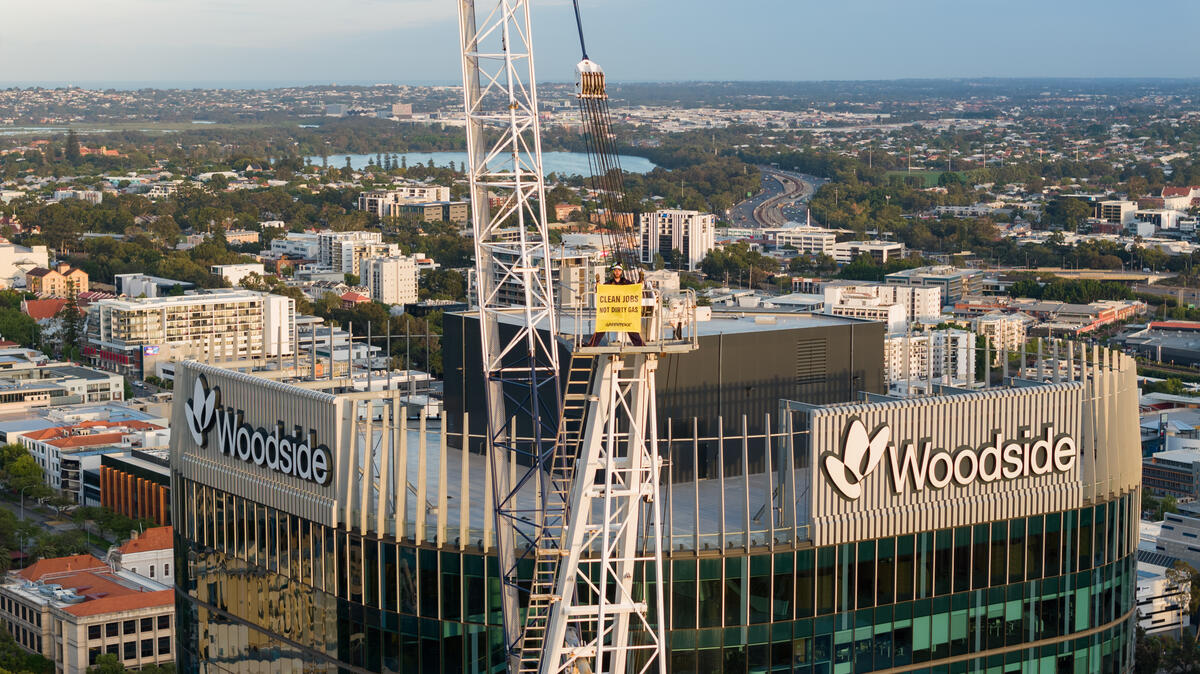
PERTH, Tuesday 12 May 2026 — In response to Woodside’s Browse economic modelling released yesterday, the following comments can be attributed to WA Campaign Lead at Greenpeace Australia Pacific, Geoff Bice:
“Greenpeace has analysed Woodside’s report on the polluting Browse gas project against independent modelling of WA’s energy system and emissions, and found glaring holes in the case made for the project.
“Woodside has reached a new low by modelling WA’s emissions reduction and energy transition pathway based on wildly expensive and risky decarbonisation options simply to justify its reckless Browse development at Scott Reef, initially rejected by the WA Environmental Protection Authority on environmental grounds.
“The WA Government cannot allow climate policy to be directed by climate vandals like Woodside. The clearest way to get WA’s emissions down is by setting clear emission reduction targets, which Greenpeace continues to call for.”
Key points from Greenpeace’s analysis of Woodside’s modelling follow:
- Gas is the most expensive form of available electricity generation, according to the CSIRO; IEEFA also found that Browse gas would be about four times higher than the current average production cost of domestic gas in WA.
- Direct air capture (DAC): The model assumes WA will be able to capture 6.9Mt of CO2/year by 2050. Worldwide, the current total volumes captured are 0.01 Mt CO2/year. DAC is currently priced at a minimum of $USD-400/tonne with many estimates ranging higher. Even reduced to $200/tonne, the cost per year of the volumes modelled becomes a staggering $1.38 billion, or $34.5 billion by 2050.
- Carbon dumping, or carbon capture and storage (CCS): The model requires 40 times the amount of sequestration that occurred last year at WA’s only CCS operation on Barrow Island (32.4Mt compared to 1.3Mt). Barrow Island CCS has consistently failed to meet requirements and last year alone cost $344m (at 265 AU$/tCO2). At those prices the Woodside modelling results in a cost per year by 2050 to be $8.6 billion.
- Woodside’s Pluto gas facility has been supplying less than 4% to the WA market, far short of the 15% required under the WA domestic gas reservation policy.
- Woodside includes $1.6 billion payable via the Offshore Petroleum Levy. The Levy was implemented to offset offshore decommissioning costs to the taxpayer but is set to expire in 2030 — 3 years before the Browse field is proposed to come online.
-ENDS-
High res images and footage of Scott Reef can be found here
Media contacts:
Emma Sangalli on 0431 513 465 or [email protected]
Kate O’Callaghan on 0406 231 892 or [email protected]