


“Join xAI if the idea of mass drivers on the Moon appeals to you,” CEO Elon Musk proclaimed yesterday following a restructuring that saw a stream of former executives exit the AI lab.
This is an interesting recruitment strategy after the company’s merger with Musk’s rocket maker, SpaceX, and the combined company’s anticipated IPO. You might think that xAI employees ought to be fascinated with achieving AGI, using deep learning models to disrupt traditional software companies, or simply bad wordplay like “Macrohard.” But instead, Elon is going to the moon.
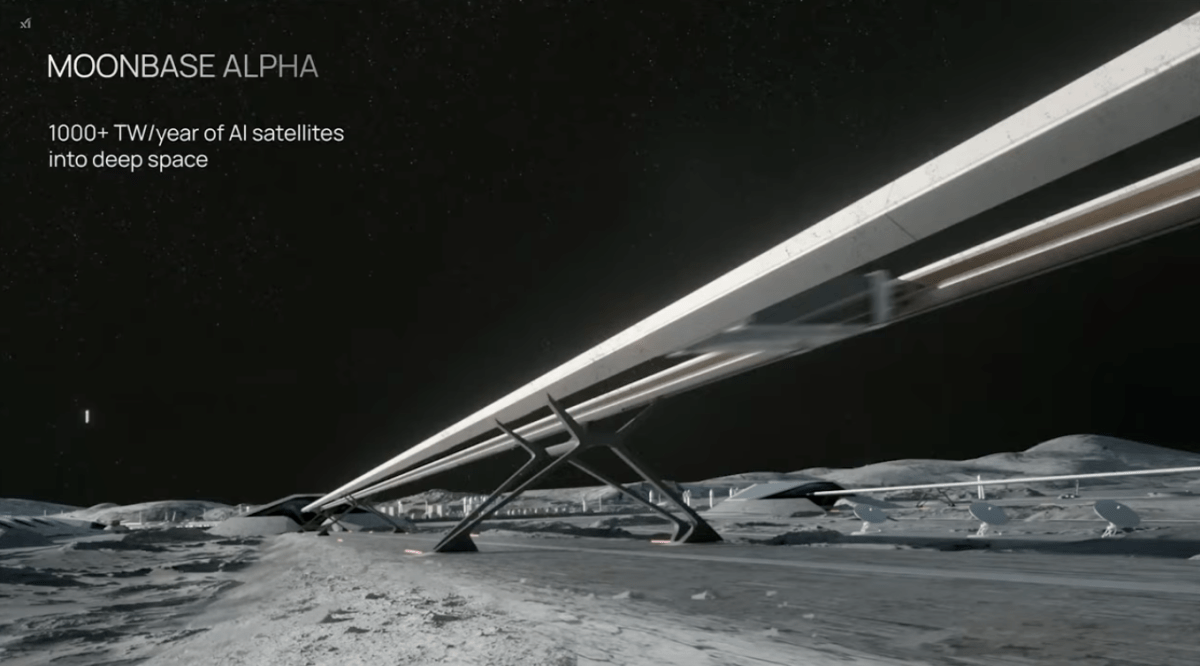
After outlining plans to build AI data centers in orbit, the primary synergy between the two companies, Musk took the idea further. “What if you want to go beyond a mere terawatt per year?” Musk asked. “To do that, you have to go to the moon…I really want to see a mass driver on the moon that is shooting AI satellites into deep space.”

In Musk’s telling, the step beyond data centers orbiting Earth is even larger computers in deep space. And furthermore, Musk says the best way to achieve that is to build a city on the Moon to manufacture space computers and hurl them into the solar system using a big maglev train.
If that all feels a bit much, veteran Musk watchers know there’s a clue about where the discussion appears in a video of an all-hands meeting xAI shared with the public. The slide describing the Moon base comes at the end of the presentation deck, where, during SpaceX pep talks, Musk typically shares renderings of SpaceX rockets landing on Mars and waxes rhapsodic about the future of multi-planetary humanity.
Notably, the Moonbase comes just after SpaceX has publicly backed away from its long-held goal of colonizing Mars. Now, with xAI in the corporate fold, Musk needs a new science fiction metaphor for the future: In this case, the Kardashev Scale, a theoretical measure of galactic civilizations coined by the eponymous Soviet astronomer in the 1960s. The idea is climbing the scale of energy usage — early civilizations figure out how to leverage all the power sources on their planets, and then (hypothetically) go to space and build infrastructure to capture the energy of the sun.
With the Moon base, Musk says the company could harness “maybe even a few percent of the sun’s energy” to train and operate AI models. “It’s difficult to imagine what an intelligence of that scale would think about,” he told his staff, “but it’s going to be incredibly exciting to see it happen.”
Techcrunch event
Boston, MA
|
June 23, 2026
In the nine years since Musk unveiled his plan for Martian exploration and colonization, the vision has been an effective hiring tool for SpaceX: The founding tale of Musk’s interest in the Red Planet offered a long-term vision that united the company’s various development efforts, and signaled the company’s ambition among other space contractors that settled for incremental work on government priorities. “Occupy Mars” t-shirts offered a visible symbol of SpaceX’s aspirations.
That’s where the hypothetical Moonbase fits in—part of a long history of Musk wrapping his companies in a powerful narrative. It’s one million people living on Mars, but now catering to a future where AI is the most interesting thing. Martian mission creep became apparent less in Musk’s May 2025 Starship update, when the presentation ended with a now-cancelled vision of Tesla Optimus robots clomping across the Red Planet.

There was just one problem with SpaceX and Mars: No one wanted to pay them to go there. Plans announced in 2016 to repurpose the company’s Dragon spacecraft as a Mars lander were abandoned the next year after the technical challenges became too costly. And since Musk unveiled the vehicle that would become Starship in 2016, its capabilities, initially intended for Mars colonization, have been scaled back to focus on two more remunerative tasks: Launching satellites for the Starlink comms network and $4 billion worth of contracts to land astronauts on the Moon for NASA.
Unlike a multi-planetary civilization, there may be some logic in having SpaceX purchase a money-burning AI and social media to build data centers in Earth orbit, particularly if forecasts of rising demand and costs on the ground come true. Experts suggest that it might be possible in the 2030s.
Hypothetically, building satellites on the Moon would require a lot more of Musk’s other dreams coming true first. Scientists and start-ups are experimenting with building chips and other precision components in space. But mass-producing many tons of advanced computers on the Moon means we’re living in a universe where it is dramatically cheaper to get to space, which is the central requirement for those technologies, getting all the raw materials for such an effort to the Moon, plus whatever is required for a “self-sustaining city.”
In a sense, that’s the point: This is the, uh, stretch goal. If meme-happy retail investors buy the argument, they could turn SpaceX shares into the next Tesla. The engineers, AI or aerospace, who Musk needs to achieve his goals may find the shift jarring. But the vision is one way to explain what xAi is about, other than an LLM perhaps best known as a pervert. As one of the company’s departing executives said on his way out the door, “all AI labs are building the exact same thing, and it’s boring.”
Mass-producing a solar system-scale supercomputer on the Moon is many things (I’m going to get emails for not using the word “insane”), but it is not the exact same thing, and it is not boring.