Conny Waters – AncientPages.com – Radiocarbon and isotopic dating have confirmed that an ancient human skeleton unearthed during the construction of Mexico’s Felipe Ángeles International Airport (AIFA) is roughly 13,000 years old, placing the individual among the earliest known inhabitants of the Americas.
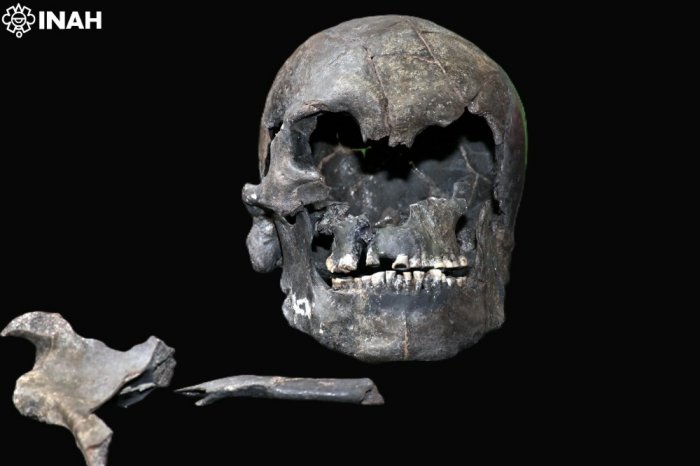
Dating places the Yotzin human skeleton at 13,000 years old. Photo: Melitón Tapia, INAH.
According to an announcement by Mexico’s National Institute of Anthropology and History (INAH), the remains—named Yotzin, meaning “unique” in Nahuatl—date back to the transition between the Late Pleistocene and Early Holocene epochs. The dating places Yotzin among the 23 oldest human specimens ever recovered in the Basin of Mexico.
Two independent laboratory analyses established the skeleton’s age using a sample extracted from its third molar. Testing on endogenous collagen conducted by ISOTOPIQ AGING INC. in Belgium yielded a calibrated range of 13,087 to 12,987 years before present (BP), while bioapatite analysis at the University of Georgia’s Center for Applied Isotope Studies in the United States produced a range of 12,050 to 11,700 years BP.
An Unexpected Discovery Among Ice Age Megafauna
Archaeologist Israel Peña originally discovered the skeleton in 2021 in the northwestern sector of the airport grounds in Santa Lucía, State of Mexico. The bones were embedded in swampy, silty sediments known as Solonchak, alongside the fossilized remains of Late Pleistocene megafauna, including mammoths and prehistoric camels. Like the surrounding animal fossils, Yotzin’s bones had turned a dark brown or black hue over millennia.
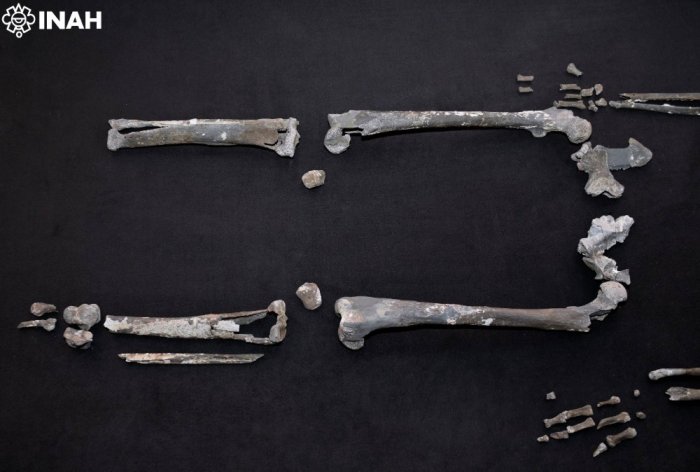
His robust bones indicate that he was a hunter, 1.75 meters tall, accustomed to walking long distances and engaging in combat. Photo by Melitón Tapia, INAH.
Peña initially mistook the large, heavy bones for those of a prehistoric camel before expanding the excavation and realizing they were human. Under the direction of project lead Rubén Manzanilla, the team conducted a controlled excavation—documenting stratigraphy, sediment samples, and burial profiles—though no funerary offerings or artifacts were found with the remains.
Portrait Of A Preceramic Hunter
At INAH’s Archaeological Salvage Directorate in Mexico City, physical anthropologist Arturo Talavera González analyzed Yotzin alongside three other skeletal collections recovered from the airport site. Standing approximately 1.75 meters (5 feet 9 inches) tall with unusually dense bone mass, Yotzin stood out immediately.
“Without a doubt, he was a hunter accustomed to walking long distances and engaging in combat,” Talavera González said in the INAH report.
An examination by dentist Sandra López Flores revealed severe tooth wear but no cavities. Researchers attribute this to a preceramic hunter-gatherer diet devoid of refined sugars, combined with chewing tough roots and bark and using teeth as a “third hand” to soften animal hides and strip plant fibers.
Clues To Early Migration Routes
Beyond his age, Yotzin’s physical traits have intrigued researchers. Unlike other ancient skulls recovered from the Basin of Mexico, Yotzin features an elongated cranium reminiscent of northern Mexican groups like the Pericúes—an Indigenous population that inhabited the southern tip of the Baja California peninsula before disappearing following European contact.
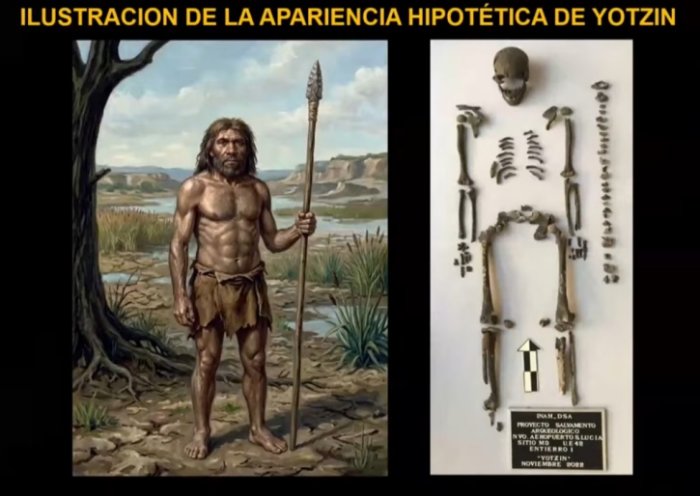
A close-up of Yotzin’s appearance. Courtesy of Arturo Talavera. Screenshot.
That anatomical link carries significant weight for anthropologists. In a 2003 study published in Nature, a research team led by Rolando González-José found that Pericúes skulls more closely resembled ancient human remains in Brazil than modern Indigenous Americans, suggesting the group was an isolated remnant of one of the continent’s earliest migration waves.
See also: More Archaeology News
“The most important thing is not just having an ancient date, but knowing where he comes from and what his lineage is, which could shed new light on human migrations across the American continent,” Talavera González noted.
Genomic testing is currently underway at the University of Burgos in Spain, with results expected in the first quarter of 2027. Once all studies conclude, Yotzin will join the 22 other specimens in the Basin of Mexico Preceramic Collection at the National Museum of Anthropology.
Source: INAH
Written by Conny Waters – AncientPages.com Staff Writer