Conny Waters – AncientPages.com – Even when faced with catastrophic climate disruptions that drove them to the extreme measure of human sacrifice, ancient societies along the desert coast of northern Peru remained remarkably peaceful in their everyday lives, according to a new archaeological study.
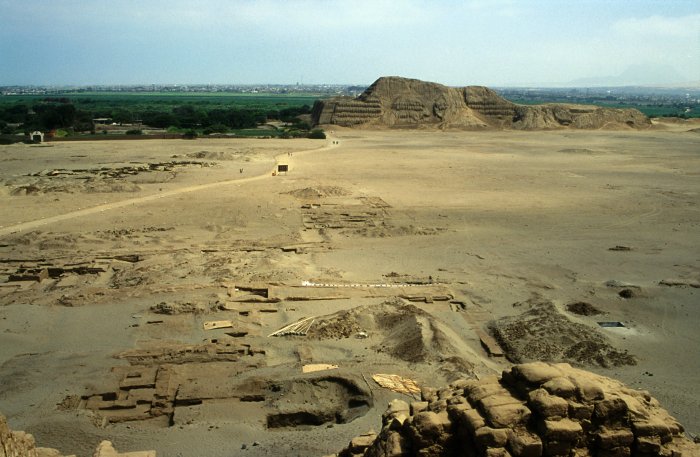
Huaca del Sol (in the distance) and Huaca de la Luna (front), religious and ceremonial centers of the Moche civilization. Credit: Tyler Bell – CC BY 2.0
The research, published in Frontiers in Environmental Archaeology, challenges the long-held assumption that resource scarcity and ecological collapse inevitably trigger widespread social unraveling and interpersonal violence. Instead, researchers found that everyday violence was extraordinarily rare across thousands of years of environmental upheaval.
“Widespread violence isn’t a predetermined response to climate change,” said Dr. Thomas Snyder, an archaeologist at New York University and co-author of the study. “As a society, we both get to and have to choose how we respond to our own climate crisis.”
Skeletons Tell A Story Of Resilience
To understand how past civilizations reacted to extreme weather, scientists analyzed the skeletal record of the Lambayeque Valley Biohistory Project.
The team examined the remains of 1,633 individuals spanning more than 3,000 years of history, matching clear dates of death against advanced paleoclimatic modeling.
The researchers tracked two specific types of physical trauma: cranial injuries, which typically point to interpersonal violence, and postcranial fractures, which usually indicate accidental injuries.
El Niño Shocks And Ritual Sacrifice
Periodic El Niño events repeatedly upended the region’s fragile balance, decimating marine life and unleashing torrential rains that devastated local food supplies. During these severe ecological crises, political elites from cultures like the Moche and Sicán—whose power relied on perceived divine authority—resorted to large-scale ritual human sacrifice to appease supernatural forces.
Scientists initially hypothesized that these desperate ceremonies would mirror a broader societal collapse, spilling over into daily life as a surge in interpersonal violence and homicide.
The main thing that jumped out at us was just how few cases of interpersonal violence we observed outside ritualized contexts,” said Dr. Snyder. “This really highlights that widespread violence isn’t a predetermined response to climate change. As a society, we both get to and have to choose how we respond to our own climate crisis.”
Peace Amid Upheaval
The skeletal data defied expectations: only 25 individuals (1.6%) showed evidence of interpersonal violence, and 77 (5.1%) bore signs of accidental trauma, with no statistical correlation to climate shifts or biological sex. Unlike other Andean regions where environmental collapse sparked civil war, Lambayeque’s access to maritime food networks or unique social structuring likely curbed domestic conflict.
See also: More Archaeology News
While acknowledging limitations—such as the inability of bone records to track soft-tissue wounds—the researchers stress that history offers an encouraging lesson.
“The Lambayeque Valley was home to a sequence of creative, innovative and resilient cultures,” said Dr. Haagen Klaus of George Mason University, co-author of the study. “The people of ancient Lambayeque were probably very different from us. On the other hand, archaeological evidence shows that in so many ways they were mirrors of us—in how they lived their daily lives, interacted with their world, ran their economies and confronted (and sometimes contributed to) environmental crises.”
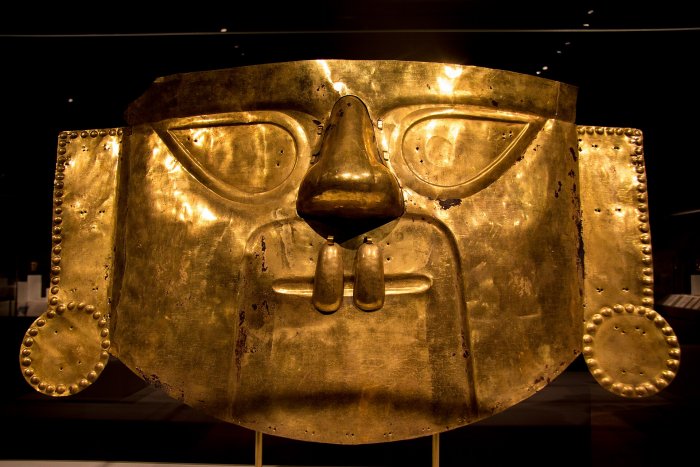
Lambayeque Funerary Mask – Peru. Credit: Andrew Moore – CC BY-SA 2.0
The valley normally had very little rainfall, but it benefited from rivers and seas bursting with life. El Niño events killed off fish stocks and flooded the valley with torrential rain, throwing local food production systems into crisis.
“Leaders of the Moche and Sicán appear to have held power partly by their claims to be intercessors with the natural world,” explained Klaus. “Large-scale events of human sacrifice just before the collapse of the Moche and Sicán political systems appear like attempts at bringing the forces of nature back into balance by offering their most precious lives to the supernatural. It’s here where the most extensive evidence of violence is found in Lambayeque.”
“If these big ritual sacrifices were indicative of some underlying crisis, we hypothesized that these events might have been extending into people’s everyday experience of the world,” added Snyder.
“In Lambayeque there are 6,000 years of creative adaptations to El Niño and longer-term changes in climate, and widespread violence wasn’t one of them,” said Dr. Haagen Klaus. “Violence and social unraveling are not destined outcomes, ever.”
The study was published in the journal Frontiers
Written by Conny Waters – AncientPages.com Staff Writer