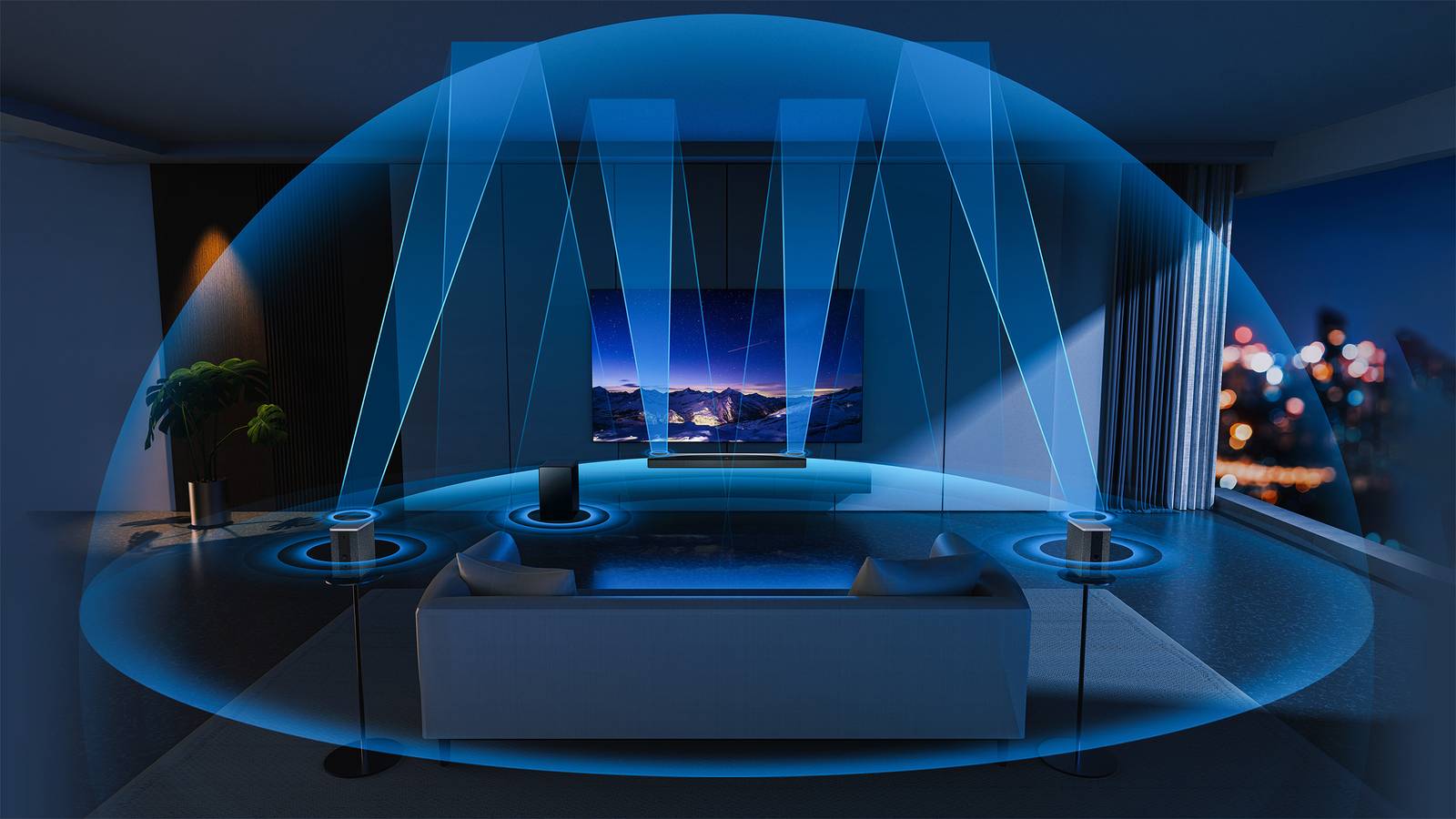
When I bought my first home, wireless speakers weren’t quite the option that they are today. Nevertheless, I was geeked to put together my home theater system. Unlike many of today’s systems, that one didn’t have a soundbar as the centerpiece; instead, it used front-right and front-left speakers, a center-channel speaker, a subwoofer, and two rear surround speakers. All wired.
I’d purchased this home theater system for my new home, and since I owned it, I could drill all the holes I wanted to, and did. I crawled up into my attic to run the wires, but the room I was drilling holes for was on one edge of that home, and the rear speakers I was mounting to the wall would be in the tightest section of the attic crawl space, near the edge of the home. I was literally face down in insulation, finding the spots and pushing wire through, which led to me vomiting when I came down because I had all that dust and insulation in my lungs.
With the ubiquity of wireless setups, your options are so much more convenient than mine were at that time, so let’s talk about the reasons why you’d want a wireless home theater system over a wired one.
Your space determines your setup
Apartment dwelling cuts down your options

When we live in an apartment, many of us won’t have access to attics or the types of crawl spaces that would allow us to run wires across our living rooms. That may also mean that you can’t do any demo work in your unit to feed wires through your walls, so you need a more temporary, free-standing setup.
This is one of the strengths of wireless setups: adaptability. Now, you could just run wires and try to hide them under a rug, or just have them out, but that becomes a tripping hazard, and, let’s face it, that just looks “ugly.” With a wireless setup, speed is your friend. The last system I reviewed took me five minutes to set up because it was only a soundbar and subwoofer. The one before that took about 15 minutes because it had a soundbar, subwoofer, and rear-channel speakers to set up, and they needed their firmware updated.
That’s still faster than the time it takes to do any low-key wire runs, or more time-consuming demo work.
Spatial placement for spatial audio
Being in the right place at the right timing

Object-oriented audio formats, including DTS:X and Dolby Atmos, focus on replicating sound positioning by matching audio with the expected location of objects in a scene. If someone is standing on the right side of your TV, yelling at a garbage truck driver on the left side of the screen, you’re expecting to hear someone on your right yelling at someone on the left, but it doesn’t stop there! You expect to hear the sounds of the garbage truck coming from the left, and the sounds of a cityscape all around you.
Wireless speaker setups give you the flexibility to position your equipment exactly where it will maximize the impact of spatial audio, allowing you to fully experience the precise three-dimensional soundscapes crafted by filmmakers and sound designers. Sure, you can do this in many cases with wired speakers, but that may not always be the case. Structural issues in the room, along with building materials, may determine where you’re able to place wired speakers without doing any serious demolition work for proper positioning.
The best part about that freedom of placement is that higher-end systems will also have room calibration software that allows the speaker system to use sound to “see” your room, its acoustics, any obstructions, and time the distances of the speakers from the TV and your seating position to improve the experience regardless of your speaker placement. Because wireless technology gives you the freedom to position speakers nearly anywhere, it creates a beautiful harmony between your speaker placement and the overall effectiveness of room calibration.
Wireless makes your home smarter
Hey Google! Play my “Smooth Jazz” playlist throughout the house

Many wireless speakers in midrange and premium systems connect to Alexa, Google, and other platforms to form a whole-home smart speaker system. That gives you the power to choose which room(s) you want to play music in. It also enables voice commands to control your home theater system, or your other smart home components directly from your home theater system.
There was a time when I might have urged you to go wired, but wireless is easy and more stable than before, thanks to the variety of powerful routers on the market and the ever-increasing internet speeds that your ISP is offering. As we make our homes smarter with consumer electronics like smart wireless speakers, ultimately our internet bandwidth gets eaten up and congested, causing bottlenecks, but when you look at the availability of gigabit speeds being offered by companies like Spectrum, those bottlenecks are much less a concern than they have been.
There are so many reasons to go wireless, including the ease of upgrading components in the future without having to tussle with any in-wall wires. Wireless isn’t without it’s issues, but for many people it will likely be the best way to go because you don’t have to demo anything and for the less tech-savvy among us, ease of setup is a huge plus!

- Brand
-
Bluesound
- Connectivity
-
2x dual band WiFi 5, Two-way Bluetooth 5.2 aptX Adaptive, IR sensor, Bluetooth headphone output, RCA/Wireless PULSE SUB+ output
- Integrations
-
AirPlay 2, Spotify Connect, Tidal Connect, Roon Ready, Creston, Control4, RTI, Nice, URC, Lutron, Amazon Alexa Skills
- Ports
-
HDMI eARC, Gigabit ethernet, Toslink Optical, RCA analog, USB Type A
- Audio Format
-
MP3, AAC, WMA, WMA-L, OGG, OPUS, FLAC, MQA, ALAC, WAV, AIFF, MPEG-4 SLS, DSD256
- Power
-
500 watts