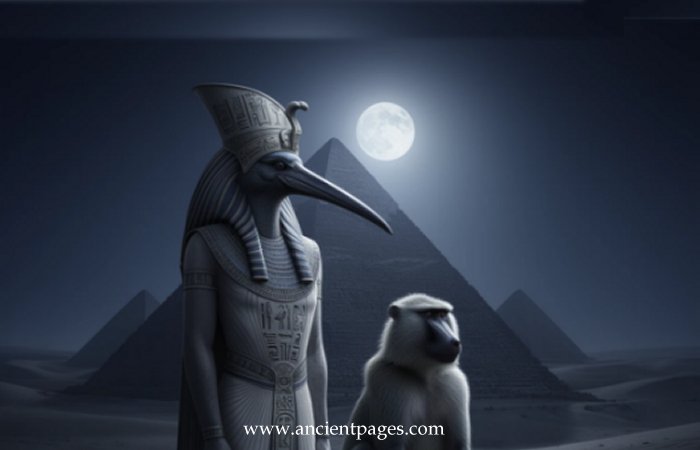
Jan Bartek – AncientPages.com – Thoth, the ancient Egyptian god of wisdom, writing, magic, and the moon, was represented by two animals: the sacred ibis (Threskiornis aethiopicus) and the sacred baboon (Papio hamadryas). The reasons for these animal associations remain unclear.
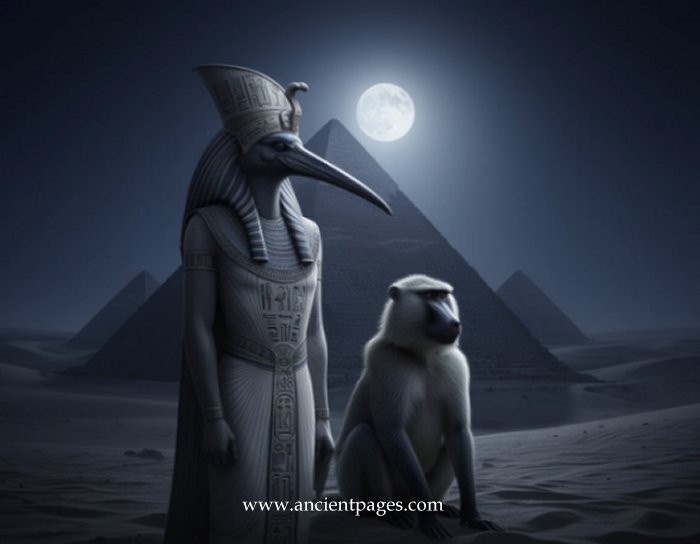
Researchers suggest the sacred ibis was selected for its crescent-shaped beak and black-and-white coloring. The reason for the baboon’s association is less clear.
Recent research from the University of St Andrews offers new insights into the link between baboons, moonlight, and Thoth.
The new study traces the Egyptian name for Thoth to North African terms meaning “bright/white thing,” connecting this to the sacred ibis’s white plumage.
Researchers from St Andrews and Dartmouth University used spectroscopy to objectively measure color. They found that both the ibis and the baboon have spectral profiles that closely match moonlight.
These findings support the idea that the sacred ibis and baboon were considered divine because their coloration resembles moonlight.
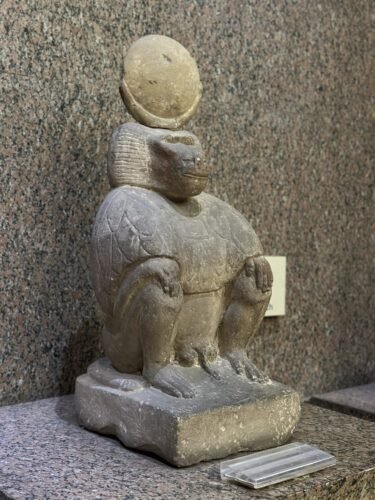
Thoth as baboon. Credit: Catherine Hobaiter
Lead author Professor Catherine Hobaiter, primatologist from the School of Psychology and Neuroscience at the University of St Andrews, said: “Why would two such different animals be used to represent one deity? Most other Egyptian deities are represented by just one type of animal.

Spectroscopy results. Credit: Catherine Hobaiter
Ancient Egyptians were familiar with at least three species of ibis, but they chose the white one for embodying Thoth. They were also familiar with two species of baboon, along with vervet monkeys and patas monkeys, but again they chose the silver-white species. So, sacred ibises and hamadryas baboons are different in many ways, but one thing that unites them is their moon-like color.”
Most African cultures view baboons negatively, primarily due to crop destruction and resulting conflicts over food. In contrast, Ancient Egyptians are unique in not only venerating but also deifying baboons.
See also: More Archaeology News.
This unusual relationship remains a puzzle for anthropologists and primatologists. While much of our knowledge of ancient Egyptians is based on archaeological evidence, opportunities to understand their perspectives are limited.
This new research offers valuable insight into the worldview, beliefs, and consciousness of ancient Egyptians.
Source: University of St Andrews
Written by Jan Bartek – AncientPages.com Staff Writer