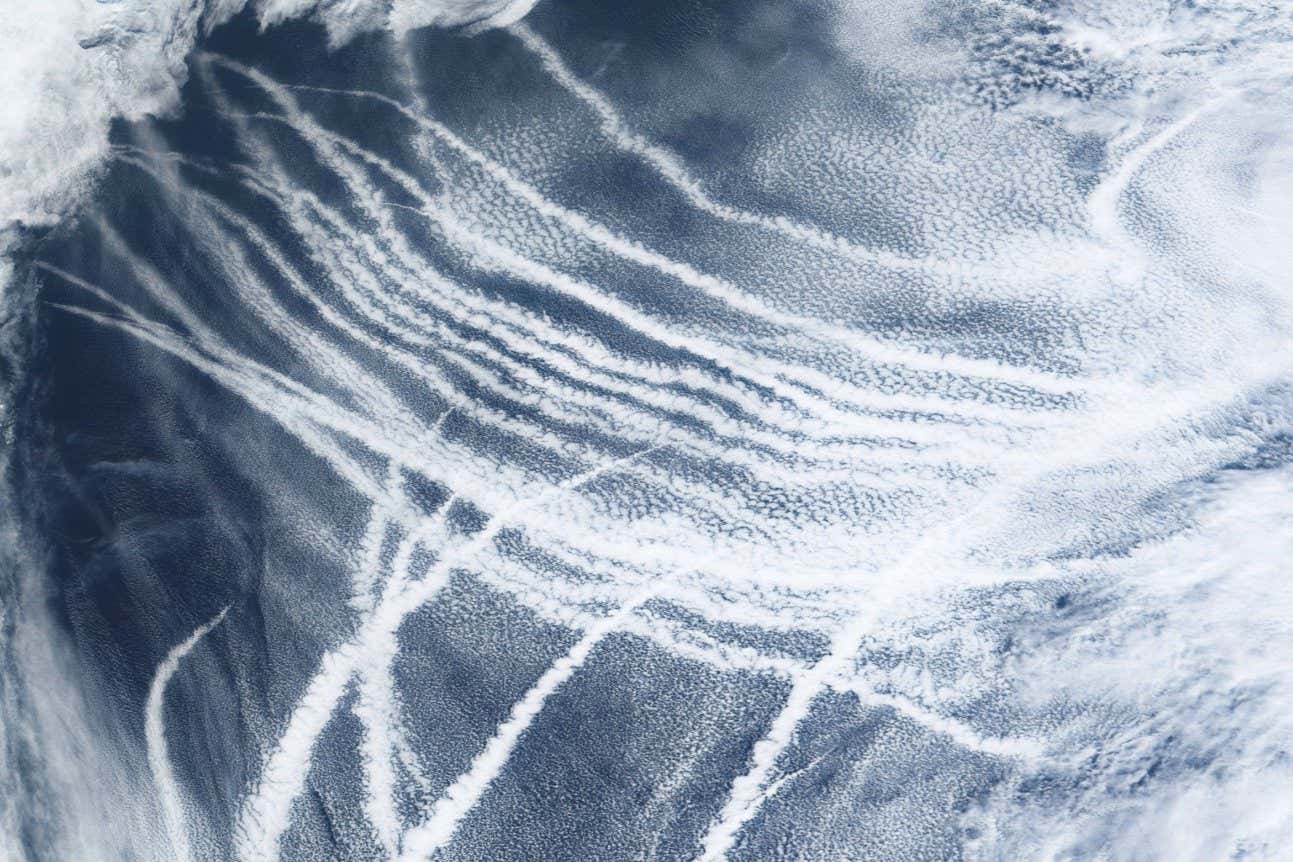

Particles in ships’ exhaust inadvertently cause cloud brightening, and a similar effect could be employed to engineer the climate
NASA’s Earth Obervatory
Short-term geoengineering to brighten clouds over the eastern Pacific Ocean could limit the damage caused by El Niño and save the global economy trillions of dollars, although there could be winners and losers from the disruption of natural cycles.
The El Niño climate phase occurs when easterly winds weaken, allowing warm water built up in the western Pacific to slosh back across the central and eastern parts of the ocean. That heats the atmosphere and raises global temperatures, with losses to economic growth estimated in the trillions of dollars.
What could become a very strong or “super” El Niño is now developing in the eastern Pacific. But climate modelling has suggested that, in the future, a geoengineering method called marine cloud brightening might be able to cut this warming short.
The technique involves spraying tiny droplets of seawater into the air below low-lying stratocumulus clouds, where moisture condenses onto them. The clouds become whiter thanks to the increase in the number of droplets, reflecting more sunlight back to space.
Shading part of the eastern Pacific called the Niño 3.4 region via cloud brightening could interrupt the feedback loops that cause an El Niño to develop. Cooler sea surface temperatures would strengthen the trade winds to again blow warm water back into the western Pacific. More cool water would then well up from the depths of the eastern Pacific, further cooling surface temperatures, and so on.
“You can basically stop the dominoes from falling early when you do marine cloud brightening,” says Jessica Wan at the University of California, San Diego, who worked on the study. “We’re kicking the cycle in the other direction.”
Wan and her colleagues got the idea from the “black summer” of catastrophic bush fires in Australia in 2019-2020, which were followed by La Niña, the opposite phase of El Niño that lowers global temperatures. Research has suggested that drifting smoke particles brightened clouds and cooled the eastern Pacific, intensifying and prolonging the “triple dip” La Niña that began in 2020 and persisted through three winters, rather than just one or two.
The study modelled what cloud brightening could have done to the super El Niño events of 1997-1998 and 2015-2016. It found that nine months of spraying seawater would have nearly halved warming of the Niño 3.4 region, from 2°C or more to a little over 1°C. It would have ended the El Niño by January, shaving several months off the events.
The hypothetical cloud-brightening mission would have been massive, involving an estimated 2400 ships and delivering an amount of seawater spray that isn’t possible with current nozzle technology. But it would have turned a super El Niño into a moderate one.
Wan says she was surprised how well it seemed to work, given that it could only be started in June, once El Niño had clearly begun developing.
Mat Collins at the University of Exeter, UK, warns that these results might not translate to the real world, where warming seas typically start dissipating low-level clouds, leading to further warming and dissipation through a feedback loop.
“In a model with a stronger cloud feedback, you would have to do more aerosol injection,” he says. “The experiments seem to be at the limit of what can be done.”
Wan admits this approach could have unexpected consequences, since the model only projected the impact over two-year periods. In both simulations, La Niña started earlier after El Niño subsided, and in the 2015-2016 case, this subsequent cooler phase became stronger. That could be bad news for regions like the Horn of Africa, where strong La Niñas have, in the past, disrupted rainfall and contributed to widespread famine.
But she says the idea is worth further research. Unlike geoengineering aimed at reducing global temperatures for the long term, short-term geoengineering like this could avoid the risk of “termination shock”, where any disruption to the spraying of low-level seawater or stratospheric aerosols could allow years of pent-up warming to come roaring back.
“This study is opening up doors for a completely new target for geoengineering research, which is climate variability and things like El Niño,” says Wan. “It’s potentially very powerful, because you’re not locked into these long-term risks.”
Topics: