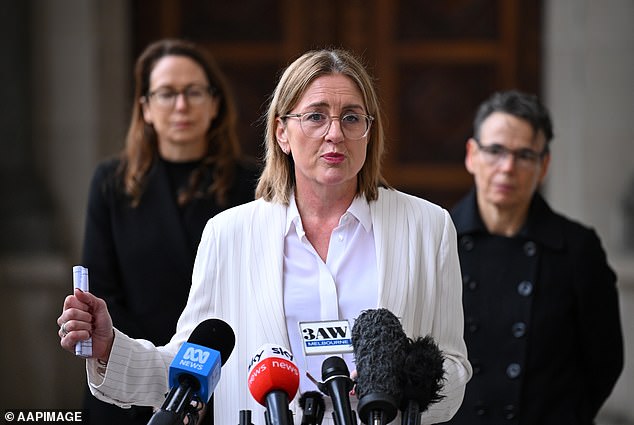
Victorian Premier Jacinta Allan has moved to entrench work-from-home rights in her state after a leadership challenge failed to materialise despite weeks of speculation and falling support in the polls.
It was considered the final chance for MPs to roll their leader unless a special meeting was called over the mid-winter break.
But momentum for a spill ground to a halt after Allan’s main internal rival, Deputy Premier Ben Carroll, ruled out a challenge on Monday.
Allan, who has been heavily criticised over rising crime rates and allegations of corruption on government project worksites, walked into the meeting with Carroll and other senior colleagues trailing behind her in a show of support.
After the 30-minute meeting, the Premier said she would ‘absolutely’ lead Labor to the November state election.
Now she has moved to entrench legislation that would require employers to allow employees to work from home two days a week where possible.
‘The Bill will amend the Equal Opportunities Act to create the right to work from home,’ Ms Allan told Parliament.
‘We know bosses want to take it away, Liberals want to cut it and Labor wants to protect it.’
The proposal, introduced to Parliament on Tuesday, will amend the Equal Opportunity Act and apply to full-time, part-time and regular casual workers whose roles can be performed from home.

Victorian Premier Jacinta Allan has moved to entrench work-from-home rights in her state after a leadership challenge failed to materialise despite weeks of speculation and falling support in the polls
The changes will take effect from September 1, with small businesses employing fewer than 15 staff granted until July 1, 2027, to comply.
Under the plan, disputes over work-from-home arrangements will be handled by the Victorian Equal Opportunity and Human Rights Commission, with unresolved matters referred to the Victorian Civil and Administrative Tribunal.
Casual and part-time workers will also be included in the scheme, with entitlements calculated on a pro-rata basis according to hours worked.
Allan pitched the reform as a cost-of-living win, citing estimates that working from home saves employees about $110 a week, or more than $5,000 annually, while cutting commuting time and boosting workforce participation.
‘Work from home works for families, it saves time and money and it gets more parents working,’ Allan said.
‘That’s why we’re protecting work from home in law.’
The Victorian Chamber of Commerce and Industry has opposed the move and said it would have a negative impact on the economy.
‘Complex, duplicative and unnecessary regulation of these matters undermines the employer and employee relationship, and adds to the many disincentives for businesses to set up and operate in Victoria, noting Victoria has the lowest business conditions across mainland Australia,’ the chamber said.