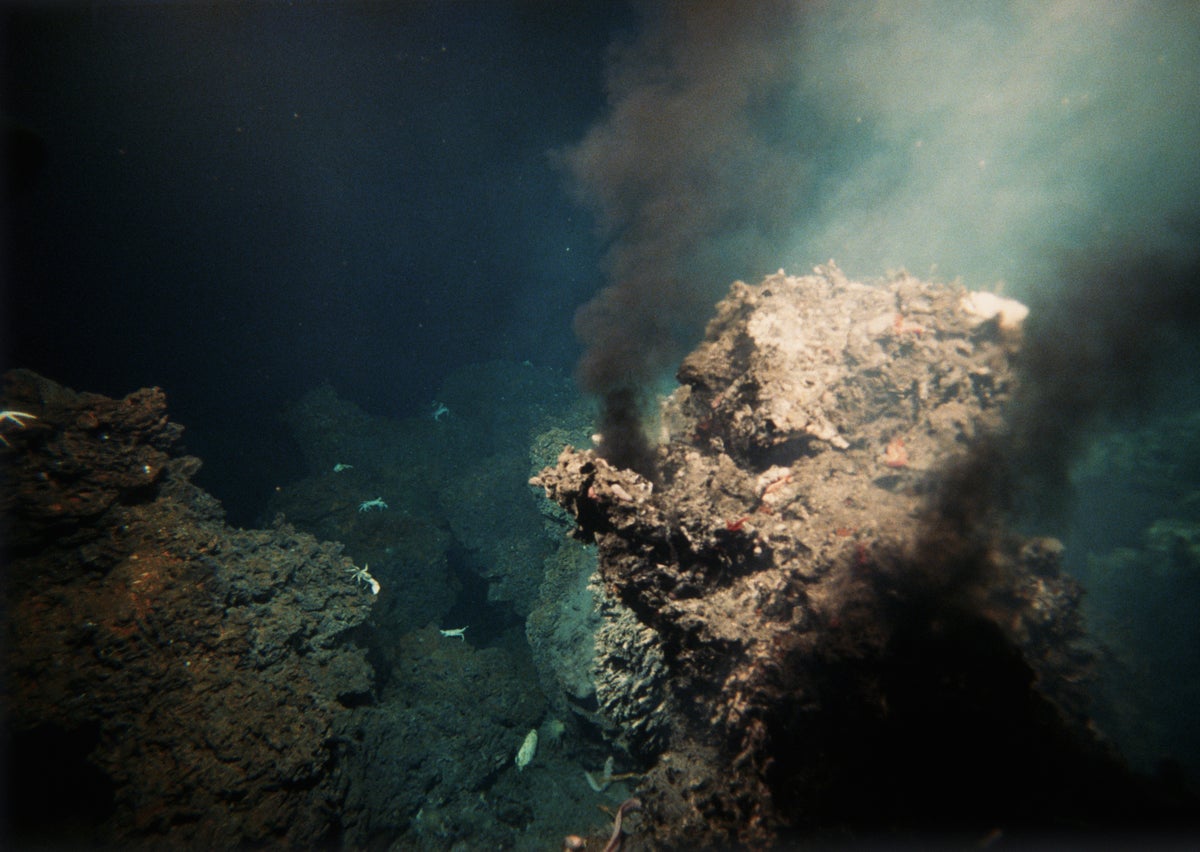
Hydrothermal vents are among the strangest ecosystems on Earth: eerie places where the planet’s deep heat and chemicals mingle with ocean water to support thriving networks of bizarre lifeforms that don’t need sunlight to survive.
Stranger still, sometimes short-lived versions of these ecosystems form when asteroids slam into Earth—including the space rock that killed off non-avian dinosaurs 66 million years ago. New evidence published in Communications Earth & Environment suggests that this impact created a hydrothermal vent system that lasted far longer than scientists thought was possible—perhaps as long as eight million years.
Previous research based on modeling had indicated that the impact site, called Chicxulub, likely did host hydrothermal vents after the asteroid hit, but for just two million years. Now, researchers have analyzed samples taken from within the structure itself—specifically, the peak-ring crater, an inner ring that forms when an impact produces enough debris that it forms a mound in the center of the crater that later collapses.
On supporting science journalism
If you’re enjoying this article, consider supporting our award-winning journalism by subscribing. By purchasing a subscription you are helping to ensure the future of impactful stories about the discoveries and ideas shaping our world today.
Annemarie Pickersgill, was one of a team of scientists who, in 2016, drilled into the crater left behind by the Chicxulub impact, along the coast of Mexico’s Yucatan Peninsula, according to a statement. The researchers snagged four samples from within the peak-ring crater from depths ranging from 2,316 to 2,480 feet (706 to 756 meters) below the sea floor. Then, they compared the ratios of two different isotopes of argon—this provides a chemical fingerprint that scientists can use to estimate the age of minerals in the rocks, and thus the hydrothermal system.
The analyses revealed a long span of hydrothermal activity at the site—with the oldest samples dating to around 66 million years ago and, the freshest to about 58 million years ago. It’s not clear whether that long-lived activity was localized to where the researchers got their samples, or if it was true across the structure more generally. Still, they posit the peak ring may have been particularly suited to supporting hydrothermal vents.
That’s intriguing for scientists, given how vibrant hydrothermal vent ecosystems can be. “The porous, fractured rocks created by impacts create microenvironments where micro-organisms can be protected from radiation and extreme temperatures,” Pickersgill, a scientist at the SUERC Centre for the Isotope Sciences, which is a collaboration of the Universities of Glasgow and Edinburgh, said in a statement. “Those conditions give life the chance to take hold and flourish.”
As intriguing as the results are for understanding the surprising potential for life in the aftermath of Earth’s most infamous cataclysm, Pickersgill and her team are considering whether the findings have extraterrestrial applications, too. It’s possible that similar phenomena may have unfolded on Mars, which could have offered an opportunity for any life on that planet to blossom at exotic hydrothermal vents.
“As we look to the future of space exploration, these findings could help future missions to other planets determine which impact craters might have been most likely to sustain life,” Pickersgill said.
It’s Time to Stand Up for Science
If you enjoyed this article, I’d like to ask for your support. Scientific American has served as an advocate for science and industry for 180 years, and right now may be the most critical moment in that two-century history.
I’ve been a Scientific American subscriber since I was 12 years old, and it helped shape the way I look at the world. SciAm always educates and delights me, and inspires a sense of awe for our vast, beautiful universe. I hope it does that for you, too.
If you subscribe to Scientific American, you help ensure that our coverage is centered on meaningful research and discovery; that we have the resources to report on the decisions that threaten labs across the U.S.; and that we support both budding and working scientists at a time when the value of science itself too often goes unrecognized.
In return, you get essential news, captivating podcasts, brilliant infographics, can’t-miss newsletters, must-watch videos, challenging games, and the science world’s best writing and reporting. You can even gift someone a subscription.
There has never been a more important time for us to stand up and show why science matters. I hope you’ll support us in that mission.