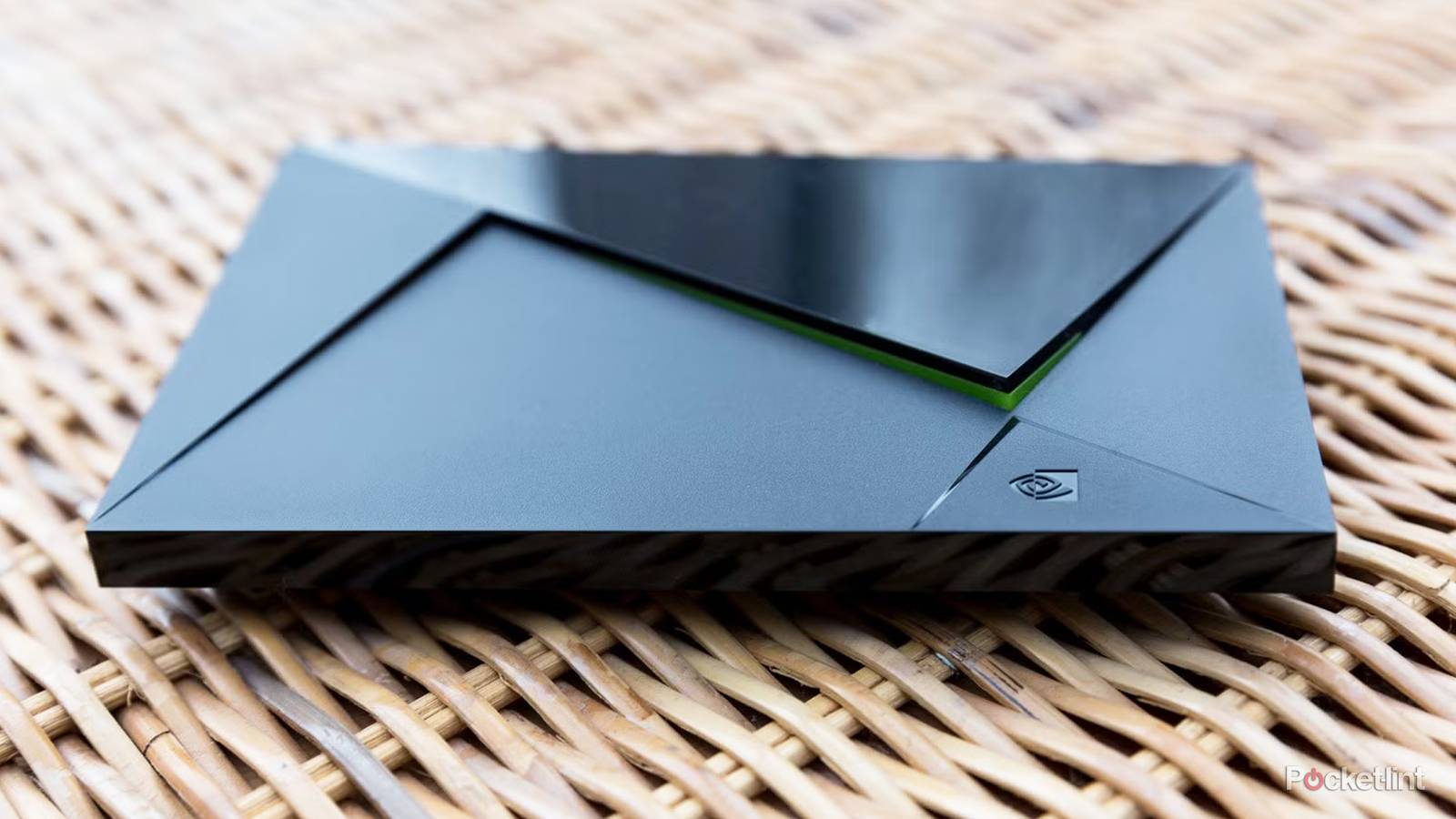
Usually, when I’m recommending streaming devices to friends and family, I suggest a few different options depending on their needs, such as the Google TV Streamer, Apple TV 4K, or Roku Ultra. But for anyone looking for a high-end streamer with all the flexibility that comes with Android, one of my favorite devices to recommend is the Nvidia Shield TV Pro.
Despite launching in 2019, the Nvidia Shield TV Pro remains one of the most powerful and versatile streaming devices you can buy. A big reason for that is its hardware, which has aged remarkably well. It packs an Nvidia Tegra X1 processor, 3GB of RAM, 16GB of storage, and support for modern streaming features many people rely on today, including HDR10, Dolby Vision, and Dolby Atmos.
But hands down, one of my favorite features is found on the back of the device. Alongside two USB 3.0 ports, you’ll find something I always appreciate on a set-top streamer: an Ethernet port.
Now, having an Ethernet port doesn’t automatically make the Shield TV Pro special. Other streaming devices, including the Roku Ultra and Onn 4K Pro, have one too. What makes the Shield TV Pro stand out is that its Ethernet port comes with a rare upgrade that frustratingly many streaming devices and smart TVs still lack today — and it’s the reason the Ethernet port on the Shield TV Pro is actually worth using.

- Brand
-
Nvidia
- Operating System
-
Android 11.1 powered by Android TV
- Resolution
-
4K
- Ports
-
Gigabit ethernet, HDMI 2.0b, two USB 3.0 Type A
4K streaming media player with Dolby Vision, Dolby Atmos, GeForce NOW cloud gaming, Google Assistant built-in, and more.
Nvidia didn’t cut corners on the Ethernet port
The Ethernet port on the Nvidia Shield TV Pro is actually fast

The biggest issue with the Ethernet ports on many smart TVs and streaming devices is that they often aren’t very fast and can actually be outperformed by modern Wi-Fi standards like Wi-Fi 6 and Wi-Fi 6E.
If you’re wondering how Wi-Fi can be faster than Ethernet, even though Ethernet is a direct wired connection to your router, the answer may surprise you. Many smart TVs and streaming devices still ship with Ethernet ports that max out at 100 Mbps. This is commonly called 10/100 Ethernet, or “Fast Ethernet.” While 100 Mbps may have been impressive in the early 2000s, it’s not exactly fast by 2026 standards, especially as fiber internet becomes more widely available across the US.
What makes the Nvidia Shield TV Pro stand out is that Nvidia was thinking ahead back in 2019 and equipped it with a Gigabit Ethernet port. Gigabit Ethernet is up to 10 times faster than 10/100 Ethernet, supporting speeds of up to 1 Gbps (1,000 Mbps).
…since the Ethernet port on the Nvidia Shield TV Pro is Gigabit, I think that makes it worth using, which I can’t say for the vast majority of smart TVs and streaming devices stuck with the antiquated 10/100 Ethernet standard.
The extra bandwidth that Gigabit provides is a game-changer. Whether you’re downloading apps, streaming, playing games from the cloud, or accessing media from a home server such as Plex or Jellyfin, the Shield TV Pro’s Gigabit Ethernet connection delivers a faster, more consistent experience.
Ultimately, since the Ethernet port on the Nvidia Shield TV Pro is Gigabit, I think that makes it worth using, which I can’t say for the vast majority of smart TVs and streaming devices stuck with the antiquated 10/100 Ethernet standard.
Why is Gigabit Ethernet so uncommon on streamers?
It’s an easy cost-saving measure for device makers

In addition to the Nvidia Shield TV Pro, only two other major streaming devices have Gigabit Ethernet: the Apple TV 4K and the Google TV Streamer.
That means virtually every other streaming device and smart TV is still stuck with 10/100 Ethernet, including Samsung and LG smart TVs, the Roku Ultra, the Fire TV Cube, and the Onn 4K Pro. This still shocks me. Gigabit Ethernet has been around for more than 25 years, so it’s not exactly new or groundbreaking.
So why is Gigabit Ethernet still so rare on streamers despite being significantly faster? I think it comes down to two main factors: cost and necessity.
For manufacturers, adding Gigabit Ethernet increases costs, and since most people connect their devices over Wi-Fi these days, it’s an easy corner to cut. Including a slower 10/100 Ethernet port lets them check the box of having Ethernet without spending extra money on better hardware.
If I’m spending hundreds of dollars on a TV or a set-top streaming device, I don’t think Gigabit Ethernet is asking too much.
The other argument is necessity. Most streaming services only require around 25 Mbps for 4K playback, which means 10/100 Ethernet is technically more than capable of handling the job. From a manufacturer’s perspective, it’s simply “good enough.”
The problem is that I don’t really buy either argument.
If I’m spending hundreds of dollars on a TV or a set-top streaming device, I don’t think Gigabit Ethernet is asking too much. The Apple TV 4K, Nvidia Shield TV Pro, and the Google TV Streamer all include it while remaining reasonably priced, and Gigabit Ethernet has long been standard on modern PCs and game consoles.
And while 100 Mbps may be enough for streaming Netflix or Disney+, that argument misses the bigger picture of how people use these devices today. Gigabit Ethernet really shines when you’re downloading large apps and updates, cloud gaming at high resolutions and frame rates through services like GeForce Now and Xbox Cloud Gaming, or streaming high-bitrate 4K content from a home media server running Plex or Jellyfin.
Overall, Gigabit Ethernet is a major upgrade over 10/100 Ethernet. It delivers faster speeds, greater reliability, and is more future-proof. I’m glad Nvidia had the foresight to include it on the Nvidia Shield TV Pro. Despite being more than six years old, its Gigabit Ethernet port and powerful hardware have helped keep it relevant all these years later.
A new Nvidia Shield TV remains a possibility
Nvidia hasn’t taken it off the table

While it’s been six years since the current-generation Nvidia Shield TV and Shield TV Pro were released, Nvidia hasn’t forgotten about them. Both continue to receive software updates, and Nvidia released its latest update for them at the beginning of the year, including bug fixes and the latest security patch.
As for whether Nvidia has any plans to make new Shield TVs, the company hasn’t explicitly said it’s currently working on any. But it has also taken the idea off the table, either. During an interview with Ars Technica earlier this year, Nvidia’s senior VP of hardware engineering, Andrew Bell, said, “We talk about it all the time — I’d love to,” adding that if Nvidia lands on a new Shield TV concept it’s passionate about, it could happen.
So while Bell stopped short of confirming a new Shield TV is coming soon, it’s nice to know Nvidia hasn’t written off the idea, and that it’s a possibility later down the road. For now, Nvidia will continue to sell the Nvidia Shield TV and Shield TV Pro, and it doesn’t have plans to stop releasing updates for them either.