June 1, 2026
2 min read

For 100 years, scientists thought these red markings were natural—now, they say they’re ancient human art
A new analysis of red lines inside a U.K. cave suggest they were made deliberately by ancient humans some 17,000 years ago
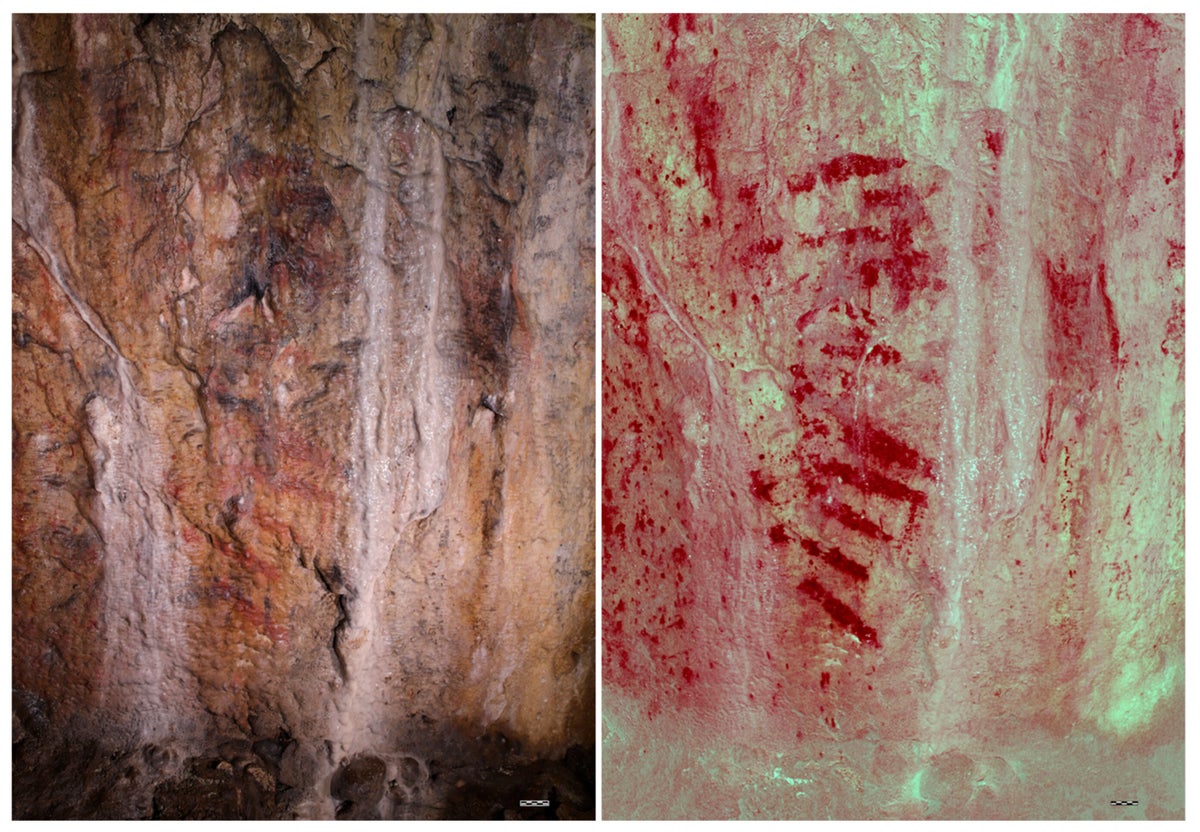
Curious red markings found in a U.K. that were once dismissed as geological features and defaced are in fact likely art made by prehistoric humans, according to a new analysis.
The markings were initially discovered in 1912 by a pair of archaeologists, William Sollas and Henri Breuil, inside Bacon Hole cave, which is located about 50 miles west of Cardiff in Wales. The cave itself was discovered in 1850; later, an Iron Age bowl was discovered in the mud as well as bones that appeared to have been modified by humans, leading researchers to conclude that the cave had once been occupied by prehistoric people.
Sollas and Breuil theorized that the cave’s former inhabitants may have made art; together, they documented 10 or so lines of red pigment that they believed were clear evidence of ancient human —indeed, they theorized the markings were possibly the oldest example of art dating to the Upper Paleolithic (between around 50,000 and 12,000 years ago) in the British Isles.
On supporting science journalism
If you’re enjoying this article, consider supporting our award-winning journalism by subscribing. By purchasing a subscription you are helping to ensure the future of impactful stories about the discoveries and ideas shaping our world today.
Others in the field, however, dismissed the markings as natural phenomena, such as iron oxide deposits, which also look red. Further archaeological investigations of the site were complicated by graffiti, too, and the site was largely left alone by scientists—until now.
During a series of expeditions from 2022 to 2024, a team of archaeologists used high-definition photography, color filter algorithms, spectroscopes and other high-tech tools to examine the markings. They compared samples of the marks with others taken from nearby rocks and iron oxide deposits, finding that the marks were created using a pigment made from hematite, a form of iron oxide. The results were recently published in the journal Quaternary. Photographic evidence, meanwhile, revealed that the painted lines were arranged equidistant from each other, “indicating a deliberate and structured pattern,” the researchers wrote in the study.
The analysis suggests the marks were made at least 17,000 years ago, although the scientists warned that further study is necessary to definitively determine their age. However, even if the new estimate is off by a century or two, the findings are late vindication for Breuil and Sollas: “the horizontal lines (or streaks) represent anthropogenic activity,” the study authors write.
It’s Time to Stand Up for Science
If you enjoyed this article, I’d like to ask for your support. Scientific American has served as an advocate for science and industry for 180 years, and right now may be the most critical moment in that two-century history.
I’ve been a Scientific American subscriber since I was 12 years old, and it helped shape the way I look at the world. SciAm always educates and delights me, and inspires a sense of awe for our vast, beautiful universe. I hope it does that for you, too.
If you subscribe to Scientific American, you help ensure that our coverage is centered on meaningful research and discovery; that we have the resources to report on the decisions that threaten labs across the U.S.; and that we support both budding and working scientists at a time when the value of science itself too often goes unrecognized.
In return, you get essential news, captivating podcasts, brilliant infographics, can’t-miss newsletters, must-watch videos, challenging games, and the science world’s best writing and reporting. You can even gift someone a subscription.
There has never been a more important time for us to stand up and show why science matters. I hope you’ll support us in that mission.