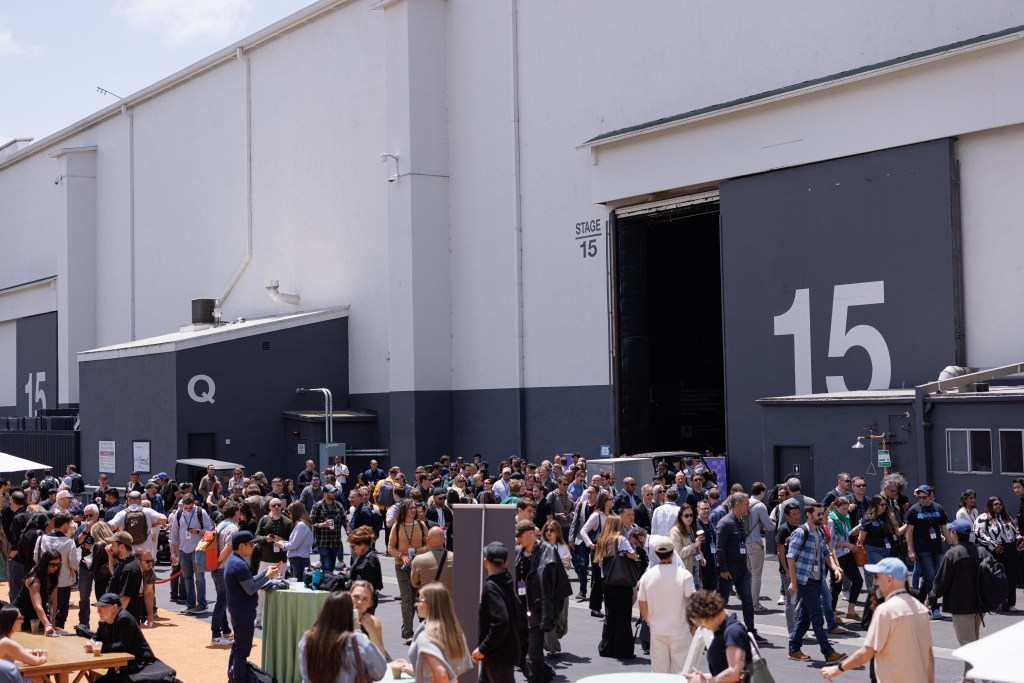
AI on the Lot, which has grown from a half-day conference for 600 in 2023 to a two-day draw for nearly 2,500, delivered another dose of techno-optimism this year. Hollywood, however, still has reservations.
Amazon MGM Studios hosted the event on its Culver City backlot and served as title sponsor. Prime Video, AWS and other Amazon operations and projects were woven through the programming. To walk the lot and the neighboring Culver Theater, taking in panels and hearing the views of participants was to fully appreciate the intensity of creative appetites for exploring AI.
The technology was largely depicted as a portal to the future, a tonic for the ailing Los Angeles production sector, and a way to finally wriggle free from the bonds of antiquated studio protocols. Beyond the confines of the conference, of course, skies aren’t quite so blue, as the industry at large reckons with the thorniest of its many tech-driven transformations. Titles of the panels reflected the dichotomy: “AI Has a Branding Problem”; “What’s The User Interface For Creative Work?”; “If You Don’t Control Discovery, You Don’t Exist.”
Here are three key takeaways from the conference:
1. It’s Still Tricky Territory
The general mood about AI’s potential has been improving of late, bolstered by successful contract renewals by the WGA and SAG-AFTRA with the studios and streamers. Anxiety over ChatGPT and other emerging technology helped derail talks with both unions and the AMPTP in 2023, leading to crippling dual strikes. Sora 2, OpenAI’s problematic generative video platform, was abandoned last December, reassuring many copyright holders.
“Between Cannes and this show, it feels like we’re at a tipping point,” said Jon Erwin, a filmmaker who heads House of David producer Wonder Project and also spearheads AI venture Innovative Dreams.
Amazon made a splash on Day 1, announcing Prime Video greenlights for three animated series supported by a generative AI creators’ fund backed by Amazon MGM Studios and AWS.
By Friday, though, one of the creators, Jorge R. Gutierrez, decided to scrap his project, Punky Duck, after backlash from creative peers and online followers. The established writer and director, whose credits include The Book of Life, apologized for embracing tools many in the creative community view as forces of destruction. The skeptical view of AI is that it will ravage original IP given that models train on copyrighted material.
Gutierrez apologized (“I promise to do better”), but his withdrawal then unleashed the other side of the debate online, with advocates of AI complaining that filmmakers can’t hold back the tide.
2. The Human Is Staying In The Picture (Mostly)
Screenwriter and director Paul Schrader, at nearly 80 years old an unlikely technology provocateur, delivered a talk at AI on the Lot peppered with pot-stirring takes. Chief among them was his conviction that fully AI protagonists will soon deliver big box office hits. The “next Clint Eastwood,” he posited, can easily be summoned by machines, and “us carbon-based fools [will] spend our money empathizing and caring about silicon-based creations,” he said.
Asked about Schrader’s prediction, most conferencegoers paid homage to the respected figure who wrote Taxi Driver and has directed critically beloved films like First Reformed, but they did not share his vision. Erwin, whose focus has been on real-time hybrid productions like The Old Stories: Moses with Ben Kingsley, said the performance capture element of his approach is irreplaceable.

Cheng agreed, emphasizing the point during his opening keynote appearance, citing copyright concerns in part. “We truly believe that at every part of the creative process, humans must be an active participant and a decision maker,” he said. “So, whether you be a writer, a director, or an actor, it’s really important to have humans involved in driving a process with AI as tools to empower and enable and accelerate everything that we do.”
Refreshingly, the name Tilly Norwood was seldom uttered, and that alone struck many attendees as progress.
3. Government Faces A Big Test
For the past 30 years, Section 230 of the federal Telecommunications Act has shielded internet companies from liability when users have defamed, defrauded or otherwise harmed others on their platforms. Now, the question facing policymakers and courts concerns whether that protection should be extended to AI companies. The consensus among experts at the conference was that it will not. It’s a new dilemma to be wrestled with: Is a creator using tools trained on other work and designed to deliver outputs accordingly the one to blame, or does the provider of the tools shoulder the responsibility?
On a panel devoted to the topic, Aaron Rubin, partner at Morrison & Foerster, argued that in “the most simple case of you typing some prompt into a chatbot, and the chatbot returns an output, and that output is unlawful in some way … it’s fairly hard to argue that section 230 applies.” Clearly, he continued, “the AI model has contributed in some way to that output. That is not just pure user-generated content,” which 230 has historically protected.
“It’s clear these platforms will not get immunity for the things they help generate,” said Luke Arrigoni, CEO and founder of Loti, a specialist in digital security and likeness protection. “Case law is substantiating that.” Added Abby North, president of North Music Group, “I can’t think of why I want to protect them.”
The age of AI is the latest episode in a long-running drama about the viability of Section 230 in a world dominated by social media and other platforms that could not have been envisioned in the 1990s.
“If you squint,” Arrigoni said, “it’s kind of like we’re in the same spot again. In 1996, we had a lot of questions about technology in the future. And we came up with a law that basically secured dominance in the internet industry in America.”
Misinformation on the app Gab, which led to a legal challenge that reached the U.S. Supreme Court. (Photo by Megan Jelinger/AFP via Getty Images)
Advocacy is rising in a similar fashion around AI with initiatives like the No Fakes Act, a bill championed by SAG-AFTRA and others in Hollywood that is is working its way through Congress. The related Take It Down Act is now federal law and is starting to be used to crack down on the spread of AI-assisted fake videos.
“There’s an unusual bipartisan alignment around pushing against 230 right now,” Rubin noted. “There are reasons that people on the left don’t like it, and then there’s different reasons that people on the right don’t like it. But there’s everybody has some reason not to like it. And in fact, there’s been a lot of narrowing” of the scope of protection.
Section 230 “protects the huge tech companies, and we all have whatever feelings we have about big tech,” Rubin observed.
“This conference is sponsored by Amazon,” parried moderator Joanna Popper, CEO of Laurel Beach and a former NBCUniversal and CAA exec.
“Exactly,” Rubin laughed.