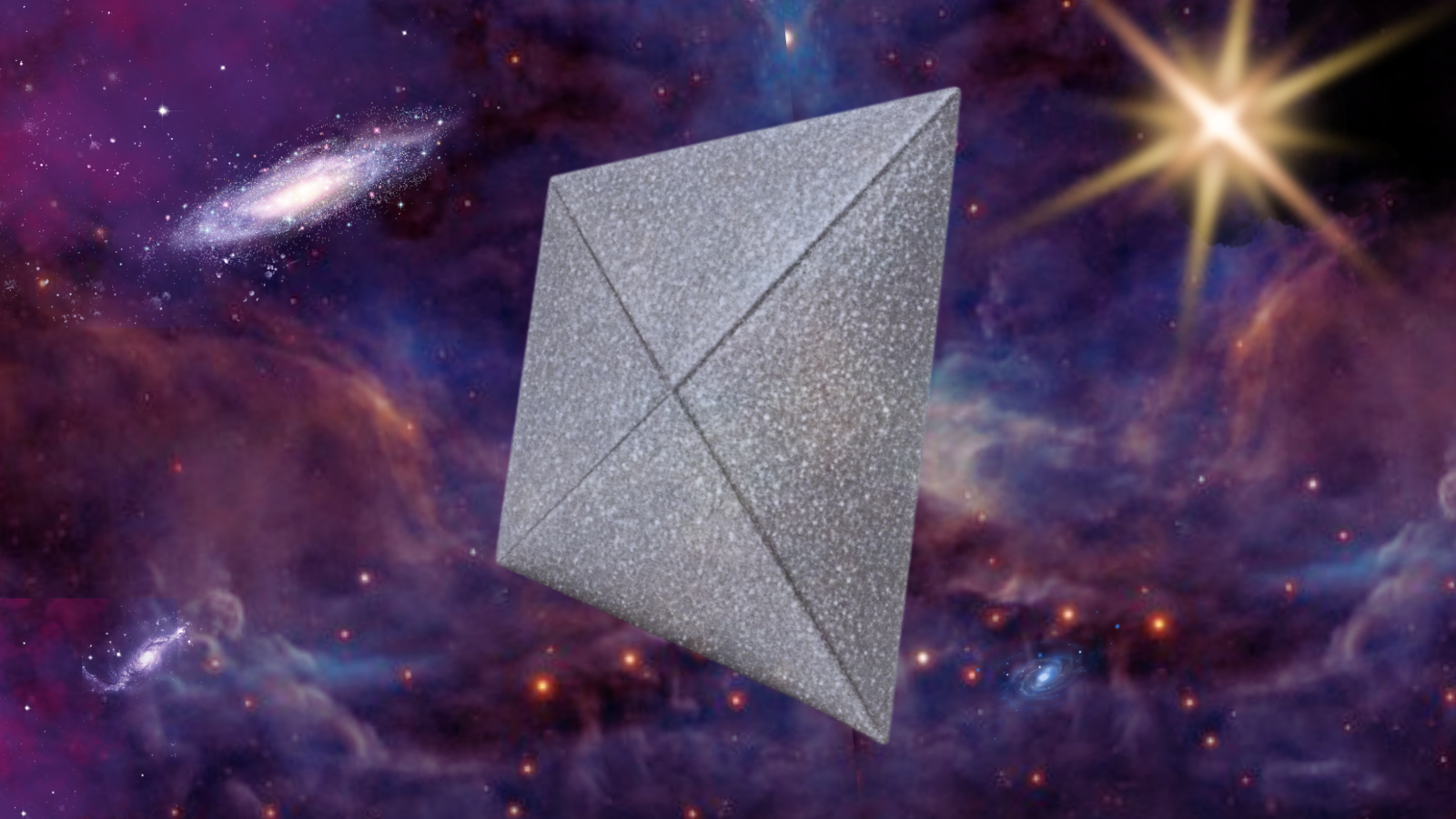
If humankind ever travels to distant stars, we might sail there — and it might be sooner than you think.
Some of humanity’s oldest ships used sails to harness the power of the wind, so it seems inevitable that we would do something similar in space. But instead of harnessing the wind for propulsion, scientists are developing ways to use light.
The result? Solar sails: vast, but thin, sheets of specialized material built to harness the pressure of photons and propel spaceships across the cosmos. So far, solar sails have seen only a handful of proof-of-concept flights (including a flight to Venus), experiments and simulations in labs around the world, and some very ambitious mission concepts. But a recent study by Imperial College London engineer Debdut Sengupta and his colleagues found that solar sails could carry spaceships to the edge of our solar system within the next 10 or 20 years. The exact future of solar sailing depends on who you ask, but it’s looking less like
From science fiction to spaceflight reality
For the few solar sails have flown so far, engineers at labs around the world developed lightweight booms to hold sail membranes steady, more heat-resistant sail materials, and worked to refine better overall sail designs. Missions like The Planetary Society’s Lightsail 2 (launched in 2019) and Japan’s Ikaros solar sail (which flew to Venus in 2010) proved that the fundamentals of lightsail propulsion could work.
But it’s been seven years since Lightsail 2’s launch, and NASA’s latest test flight of an advanced solar sail design suffered deployment glitches and ended up tumbling in space. Does the current state-of-the-art lightsail technology live up to ambitious mission concepts to send a solar-sailing ship past the edge of our solar system?
To answer that question, Sengupta and his colleagues started with three proposed lightsail missions (Breakthrough Starshot, Project Svarog, and Solar Cruiser), and then rated the readiness of all the technological pieces each mission would require, from Breakthrough Starshot’s giant laser to Solar Cruiser’s attitude control system.
Breakthrough Starshot, an ambitious project first announced in 2016, is probably the best-publicized and most ambitious lightsail project proposed so far (it’s a lightsail, rather than a solar sail, because it would ride on photons from a 200-gigawatt laser, not sunlight). It originally aimed to send a fleet of tiny nano-ships to Proxima Centauri, but the project has been on hold, its funding frozen, since late 2025. But Svarog and Solar Cruiser, in particular, are good examples of the two most likely types of solar sail missions.
Svarog, a student-led project at Imperial College London, hopes to send a solar sail probe to the heliopause, a region 9 billion miles (14.5 billion kilometers) from the sun where the solar wind collides with the interstellar medium. Instead of using giant lasers to fill the sails with photons, Svarog plans to do what’s called sun-diving: swooping close to the sun, where the radiation is most intense, to gain a big burst of speed — then slingshotting outward toward the heliopause. The team deployed a test sail from a high-altitude balloon in late 2024; Sengupta describes it as a “partial success.”
And Solar Cruiser, a project at NASA’s Marshall Space Flight Center in Huntsville, Alabama, would have studied the sun from a vantage point near the L1 Lagrange point, using its 40-meter wide sail to hold itself in position against the pull of the Sun’s gravity (picture a sailing ship here on Earth, using the speed from its sails to steer against the pull of currents and the push of waves). NASA shut down the project in 2023 but is still exploring some similar concepts.

Sengupta and his colleagues found that modern, state-of-the-art technology still lags behind what’s needed to fly some proposed solar sail missions, especially when it comes to keeping the sail from overheating under the barrage of photons from the sun (or the giant laser), providing a light-but-strong support structure for sail dozens of meters wide – one that won’t twist or buckle – and deploying the whole thing in space. But after studying how much effort it would take to close that gap, Sengupta and his colleagues say that some of these missions are closer to reality than you might expect. And other experts Space.com spoke with tend to agree.
The perfect playground for solar sails
Sometime in the next five to 10 years, lightweight spacecraft could be sailing the brilliantly sunlit inner reaches of our solar system to study the sun itself, according to Sengupta’s study.
Whether the goal is to orbit the sun like NASA’s Parker Solar Probe or to hold a steady position between Earth and the sun, this general type of mission would take advantage of one of the main selling points of solar sails: by using only the pressure of photons on the sail, a solar sail spacecraft would be able to maneuver — holding itself in an otherwise unstable orbit, or changing its trajectory, for example — without needing thrusters or fuel.
“One mission that would really utilize the advantages of a solar sail would be a solar storm warning mission,” Bruce Betts, Chief Scientist and LightSail Program Manager at The Planetary Society, toldSpace.com. “It would utilize the constant light pressure from the sun to maintain an otherwise unstable orbit directly between the Earth and the sun and inwards of what can be done otherwise. That would give increased warning and details of solar storms headed for Earth.”
That’s similar to the idea behind Solar Cruiser and other mission concepts.
Artur Davoyan, an aerospace engineer at the University of California, Los Angeles, added that sun-skimming solar sails could allow us to send a spacecraft to orbit the sun’s poles, studying our closest star from an angle that’s been otherwise impossible. Boosting a spacecraft into a polar orbit around the sun would take more propellant than a rocket can carry today, he added.
“The only way that can be done is with the solar sails,” he told Space.com.
And according to Sengupta and his colleagues, missions like Solar Cruiser or Betts’ hypothetical space-weather station are technologically feasible today.
“I think definitely Solar Cruiser could have launched if [some] small issues were fixed,” Sengupta said. The issues in questions had to do with reaction wheels: electric motors attached to flywheels that help keep spacecraft oriented correctly. Reaction wheels, including the specific model picked for Solar Cruiser, are used on all sorts of spacecraft, but the complex dynamics of a solar sail were a different challenge.
Even so, making a flight-tested set of reaction wheels work in a new situation is an almost mundane problem compared to the challenges facing solar sail-driven missions aimed at more distant destinations — missions that require a decade or more of research to develop the right materials. A heliophysics mission somewhere around L1 (a gravitationally stable point about 1 million miles from Earth), under sail, is technically possible today, according to Sengupta and his colleagues.
“For something like Solar Cruiser, the sail itself is already there, it’s just a matter of figuring out the more everyday aspects of space mission engineering,” Sengupta said. Those everyday aspects include attitude control, power, and communications, which Sengupta describes as “problems that you only face once you get to detailed design.”
That combination of factors, according to Sengupta and his colleagues, makes heliophysics missions like Solar Cruiser a logical next step after the solar sail missions we’ve already seen, including the Japanese Aerospace Exploration Agency’s Ikarosmission, which unfurled its 14-meter-square sail to fly past Venus in late 2010.
“That would be a very good stepping stone,” said Sengupta. “We can essentially test a lot of the big issues we have with solar sails with [a mission like] Solar Cruiser, so deployment systems and attitude control, as two examples.”
But sending solar sailing spaceships to the sun could also be a stepping stone toward other missions that will go farther afield — and get there by venturing even closer to the sun.
Extreme solar sailing
Missions like Svarog and a novel multi-sail concept called SunVane have different destinations and science goals, but share a general flight path: they’re meant to sun-dive to gain speed, then sail on to the outer solar system (or beyond).
In his lab, Davoyan and his colleagues worked on a concept they called extreme solar sailing, which would involve skimming just 2 million to 4.3 million miles (3.5 to 7 million km) above the sun’s surface (between 5 and 10 times the sun’s radius). That’s absolute daredevil spaceflight, technically passing inside the sun’s outermost layer; for comparison, NASA’s Parker Solar Probe made its closest approach at just over 3.7 million miles (6 million km). Diving that close would be like sailing through a howling gale of photons, giving the spacecraft a powerful burst of speed, which it would use to slingshot outward – propelled partly by gravity but mostly by the sunlight on its sail.
A sail-driven spacecraft that made such a daring sun-dive and survived would make record time to the outer planets, the heliopause, or even the focal point of the sun’s gravitational lens, where it could (in theory) use the sun’s gravity as a giant magnifying glass to study exoplanets. Davoyan and his colleagues calculate that such a mission could accelerate to a speed of about 50 AU (astronomical units; the distance from Earth to the sun) a year – compared with Voyager 1’s more sedate 3.6 AU a year. One AU is about 93 million miles, or 149 million km.
“So basically you will be passing Neptune in less than one year,” Davoyan says. “In three years, you will surpass Voyager 1, basically. So that’s the speed that we’re hoping to get.”
That’s the trade-off of a sun-diving slingshot mission: the faster you want to go, the closer to the sun you need to dive. And here’s where the ancient fable of Icarus becomes eerily relevant to modern spaceflight, because you also have to keep the sail from overheating while you skim the outer edge of the sun.
A solar sail needs to reflect most of the light that hits it on one side, and emit the rest, as heat, into the deep chill of space on the other side. Coming up with materials that will do that work is actually the easy part; turning them into the microscopically-thin film of a solar sail is the real challenge.
TheParker Solar Probe, for example, has a heat shield that does the job nicely at about 6 million km from the sun, but it’s also 4 inches (10 centimeters) thick — much too hefty for a solar sail, whose thickness should be measured in millionths of a meter, or microns.
“We don’t have that luxury, so we want to do something that is 2.5 or 3 microns,” said Davoyan. His lab is working on heat-tolerant materials like silicon nitride and titanium nitride, aiming for a sail that can withstand temperatures of around 1,000 degrees Celsius (that’s 1,832 degrees Fahrenheit) for long enough to pull off a sun-dive. At the moment, their best materials can take the heat within about half an AU from the sun, somewhere between the orbit of Mercury and Venus. That’s not enough for the kinds of missions he envisions, or for something like Sengupta and his colleagues’ Svarog project.
But the trade-off works both ways. If you’re willing to settle for less speed, you can design a mission with less extreme sun-dives. Based on Davoyan’s simulations, passing a more cautious 20to 25 solar radii (about 8.6 million to 11.8 million miles, or 14 million to 19 million km) away from the un’s surface would give you a top speed of somewhere between 5 and 8 AU a year: still slightly faster than Voyager 1. And the heat is a lot easier to manage.

“I think those kinds of missions can be built within a 5-year timeline from today, given that there is proper development funding involved. And then maybe in about 10 years, you can have more extreme missions, you know, getting closer to the Sun and traveling even faster,” Davoyan said. “If you want to get a little farther out, like maybe 30 solar radii away from the surface of the Sun, then I think the technologies are more or less ready.”
Meanwhile, Sengupta says a mission like Project Svarog should be launchable in the next 10 to 20 years, which lines up well with Davoyan’s estimates.
Unfurling the sails
Thermal management isn’t the only challenge facing long-range solar sail missions. In addition to being tough enough to survive a close encounter with the sun, solar sails for these missions need to be big enough to keep catching photons as far out as possible.
That means you’ve got to be able to pack a sail that big into a relatively small launch vehicle, and you’ve got to have a boom or other support framework that will hold the sail open and taut — so it gets pushed along by the pressure of the photons instead of just fluttering. That gets more challenging the larger the sail (and the longer the boom).
“Though not quite the same, picture how hard it is to deploy a tape measure to great lengths without it bending or collapsing,” Betts said.
Imagine if Betts’ hypothetical tape measure were about 100 meters long: the length of the booms required to support some of the largest proposed solar sails, 10,000-square-meter swaths of high-tech membrane. Here on Earth, the boom would warp or buckle because of gravity or wind, but in space, the causes are slight differences in temperature or radiation pressure, or even slight imperfections in the sail itself, putting different forces on the boom all along its length. So engineers need to design booms that are as light as possible, but also strong enough not to twist around in flight.
Also the whole thing has to fold out from a relatively compact spacecraft, and it has to be as lightweight as possible. These challenges are why solar sails aren’t yet plying the vastness of space. (At least not here. We can’t vouch for what might be going on in distant, alien star systems, because they won’t talk to us.)
“One of the biggest technological hurdles for developing longer distance missions with larger sails is the successful deployment of large structures in space,” Betts said. “Any deployment in space is tough, but deploying large structures that also have to be very low mass is challenging.”
“The bigger the structure, the bigger the challenge,” he added..
Every space mission struggles to keep its mass as low as possible, because mass costs fuel — and therefore money — to launch into space. But solar sails have tighter than usual mass “budgets,” because they can only push relatively light objects to the speeds Davoyan and others hope to achieve.
“It’s the acceleration that matters, and acceleration is, from school, just force divided by mass, right?” Davoyan said. “So I want to minimize the mass while keeping the area of my sail as large as possible.”
That necessity limits not only the design of the sail and its supports, but everything else on the spacecraft: power sources, instruments, and communications. Software engineer and physicist Viktor Toth, a recent member of NASA’s Solar Gravitational Lens team, is skeptical about whether it’s possible to pack enough into a spacecraft to make a long-range mission to deep space; Toth and his team considered a version of the solar gravitational lens mission that would use solar sails to reach a point beyond 600 AU.
“Deep space missions are unforgiving, because you need nuclear power for electricity on board, and you need physically large communications equipment,” Toth toldSpace.com. “Even if you forget about the science, just talking to the spacecraft and powering the spacecraft… the small payload pretty much precludes the use of nuclear power on board and precludes the use of large antennas for or large optics for real deep space communication.”
Davoyan disagrees, offering options like ultra-lightweight deployable antennas. “It’s not a bottleneck type of an issue,” Davoyan said. “These are resolvable challenges.”
On the other hand, Toth is more optimistic about solar sailing closer to home, relatively speaking, especially if solar power cells can be integrated into the fabric of the sail itself. If that works, Toth sees solar sails as a viable way to fly to places like Jupiter gaining enough acceleration from fairly sedate sun-dives to cut down transit times for the successors to deep space missions to the outer planets, like Europe’s JUICE mission to Jupiter’s icy moons, which launched in 2023 and won’t reach its destination until 2031.
Sailing into the future
So what’s the overall prognosis for solar sailing?
“I think these are not far-out type of ideas; they are not really futuristic ideas that we are talking about,” Davoyan said. “It’s not a major leap from one thing to another thing, so there is continuous progression from one to another one that can be done, and that can be done within a reasonable timeframe.”
Sengupta, meanwhile, envisions a not-too-distant future in which solar sails have proven their worth on heliophysics missions, and technological developments make sun-diving and long (but fast!) interplanetary cruises more feasible. Much of that future, of course, depends on factors like funding and space agencies’ priorities — which are harder to plug into equations but often determine the fate of missions or even whole programs. That’s part of why Sengupta thinks the heliophysics missions are likely to come first.
“We might need to focus on short-term missions that bring impact back to Earth, instead of just exploration,” he said. “Once solar sails are proven to be functional and effective in these kinds of orbits, especially on a scale when you have large sails, I think that could really help solar sails become a standard part of the space designer’s toolkit, in terms of propulsion.”