

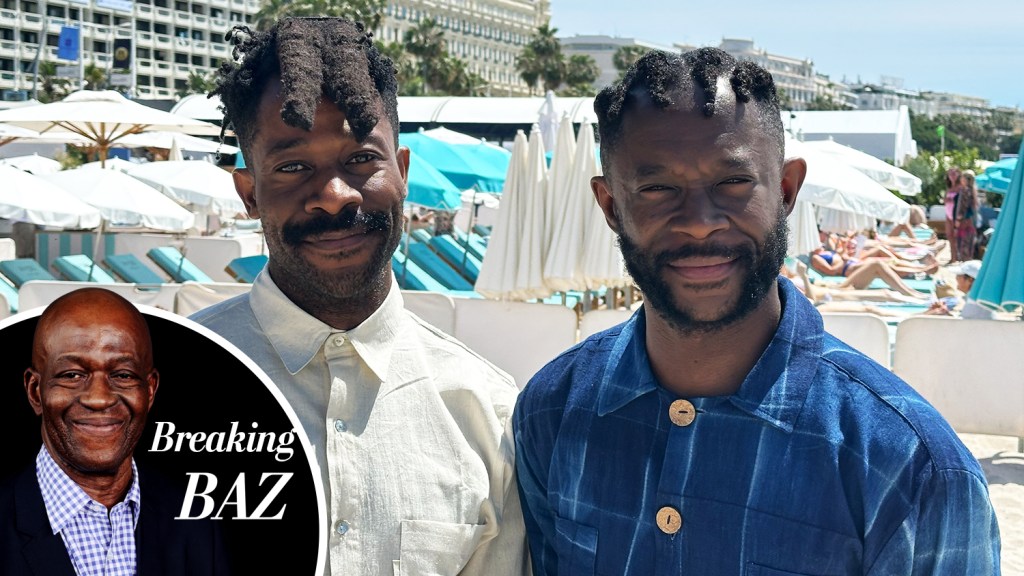
When twin brothers Arie and Chuko Esiri decided to adapt Virginia Woolf’s 1925 novel Mrs. Dalloway and give it the title of Clarissa, her Christian name, they say they were “freeing her” from being someone’s property, someone’s wife.
It’s as if the character has been freed from the shackles and allowed to be herself.
“That’s the idea, for her to be a person more than Richard’s wife,” says Chuko, referring to the name of her husband.
Sophie Okonedo plays Clarissa as a contemporary woman in present-day Lagos, Nigeria, and she seems more independent than how she’s characterized in the novel which is set in the years following the end of World War I.
Chuko notes that Nigerian households are a “deeply patriarchal society, and it falls on the women of the house. They run the house and there’s a great history of Nigerian women being the ones that move things forward… I think a lot of that is having grown up in a house and houses and seen our aunties and our mothers, like they run everything,” Chuko says as I collapse laughing because I know this to be one hundred percent fact.
The film played like gangbusters in Directors’ Fortnight. Neon was all over it long before it was announced for Cannes.
Mrs. Dalloway became Chuko’s favorite novel when he was aged 16 or 17.
“It’s a novel I love. I was at school, but it was not for school. Our mum’s a voracious reader and really instilled reading. Every home we lived in, there would be a room, and it would be where her book collection is, and that continues to grow and grow and grow. I think maybe, we were doing modernist literature. I think we were reading Katherine Mansfield short stories at the time and I love those. And naturally it’s like, well, I want to read more of this sort of thing and found my way to Virginia Woolf and into Mrs. Dalloway. And what I always say is that, at 17, I didn’t understand it, but I felt it.”
What was it he felt? “The writing is so beautiful and the emotions are so strong, and in your late teens, your emotions are naturally already very strong.”
Chuko came back to the book when he was in his mid 20s and he had a “great love for it.”
The last time he read the novel for leisure was eight years ago, in his early 30s, at a time when he was on track to becoming a filmmaker, “and you’re also at this quarter-life crisis place and also coming out of film school as well. It’s like, well, there’s no more school to hide in. So I guess I have to make life work. And then you start thinking about, did I make the right choice? Should I have done this? And growing up in a Nigerian household, it’s doctor, lawyer, architect, and our friends are doctors, lawyers, architects and finance guys. There’s my friend buying his first house, and it’s like, I’m still living at home with mum. Life feels like a sitcom. It’s like 33-year-old living at home with his mother and hasn’t really got gainful employment. So, all these things are happening. And then reading the book, not that the book is about that, but it then just became much clearer. I was like, ‘Oh, there are pieces of me in these characters,’” Chuko says.
The brothers were now of an age where, as Chuko notes, “you start speaking more to your uncles and aunties and your parents. And Nigeria being a very unofficial gerontocracy, the elders are not to be disturbed, and they don’t share their lives. But at that age, they feel a bit freer with sharing their life with you, and in the book it’s like, ‘Oh, this is some of the stuff my uncles and aunties went through.’ And it just became really, really, clear at that point.”
I turn to Arie, the other brother, and ask when he first became aware of Woolf’s novel.

Sophie Okoneno in ‘Clarissa’
NEON
“Honestly,” he responds chuckling, “when Chuko decided that this was going to be the next film that we’re going to make—Virginia Woolf was on his Mount Rushmore of authors. The desk that he writes at is called Virginia. Virginia’s engraved on the side of it. So I could see it coming. So for me, honestly, it was when he said, ‘Look, I’m thinking of adapting this and making this our next film.’ Then I started considering her work, and well, mainly obviously Mrs. Dalloway, and I fell in love with the very prose-y visual aspects of the book, and one of the things I said to him was like, ‘This is going to be very difficult to do.’”
From “day one,” their instinct, says Arie, was to extrapolate the tale and set it in contemporary Lagos.
He reasons that “we talk about classic Russian literature feeling like the world in which that takes place, feeling like modern day Nigeria with the way our society functions and still functions.”
Chuko goes on to suggest that Nigerian society is “very conservative” and that “the family sort of runs as a mini government,” a comment that elicits guffaws. “There’s a council of elders that are, I don’t know, the House of Lords,” while “cousins or the next generation above” are the members of parliament. “It really does feel like a period drama. Well, one of the things we said when we started working and speaking to people is, ‘I don’t know why in the UK in particular, they don’t have more African directors making period pieces because it’s just like, wait, we know this.’
“There was something about this novel that was very contemporary, even being a hundred years old as of last year, and that was really appealing,” Chuko adds.
While setting it in a modern day Nigeria—although there are story strands set in the past—they’ve also been able to incorporate aspects of the country’s history and its colonial past.
Approaches were made to Sophie Okonedo, and it helped that Jude Akuwudike, who’d worked with them on their 2020 film This is My Desire, knew Okonedo from their time studying at the Royal Academy of Dramatic Art.
That coincidence was a welcome surprise for Okonedo.
Sophie Okonedo (Baz Bamigboye/Deadline)
Also, says Chuko, “The idea of Jude being of Nigerian heritage and working in the UK all his life in her orbits, seeing him transpose his talents to his ancestral roots and imbibing by being this character in such an organic way was something that appealed to her. I think for her it was just like, ‘Oh, I would love to go on that same kind of journey,’ not just for artistic reasons, but very personal ones. The idea of doing something just spoke to her personally, but she didn’t know at that point we were adapting Mrs. Dalloway.”
Okonedo expressed as much to me when we first spoke about Clarissa. So keen was she, that even when the project was on the verge of collapse—more than once—she willed it to survive.
“That energy persisted throughout,” Arie says, smiling.
The trickiest part of the adaptation, says Chuko, was letting go of the book, and that didn’t happen until Theresa Park, who’s the lead producer, came on board and was the first person to read a presentable iteration of the draft “and came back with a set of notes and she was really like, ‘You can let go of the book now.’”
That gave them permission to jettison a lot from those early drafts, which allowed Chuko a firmer understanding that “I was writing a Nigerian Mrs. Dalloway. So, they share things, they share pasts, similar pasts, they share their society with the desire to throw a lovely party, and they’re very particular about the party and who comes and who doesn’t come. But she’s Nigerian so she’s inherently different,” Chuko suggests.
He surmises that Mrs. Dalloway from the novel and Clarissa in the film are cousins, really. “There were moments when I would have lines lifted out of the book in some of the characters’ mouths, and it didn’t feel right because I’m like, ‘I can’t imagine this person saying this,’” Chuko explains.
“So, that’s the first change that happens ,and then it’s like, leave the book behind, and so, left it behind completely, and then it morphs into something else. And yeah, I think that the ambition with adaptation is to maintain the spirit. It’s not supposed to be a certified copy. It needs to keep the spirit of the thing alive,” Chuko adds.
Indeed, and that spirit also shines through in the sense of the class aspect. There’s a moment when a former general upbraids a footman for not wearing gloves to serve food. It goes without saying that I would never behave in such a manner, but I remember observing much grander relatives behaving like exiled rulers, which, actually, they were.
But, I asked the bothers if they had witnessed their own relatives or elders behaving in an imperialistic way?
“I say that the thing about colonialism is everyone thinks of the physical occupation,” Chuko argues.
“But then there’s the mental occupation that happens alongside it, and with that is like, the general for example, his backstory, I imagine like all those guys did, they went to Sandhurst and they went to military school in England, and the military school is just a very feudal place as well. And you do the officers course, and so, you see these things and you think that is what sophistication looks like. You’re told that’s what sophistication is. You’re told this is how you behave… So, that thing takes generations to work your way through, and I think, like with most people that are converted, the convert is often more zealous than the actual person practicing it.
“And that’s what we have at home, both in social mores and mannerisms and the actual religion of Christianity as well. There’s more zeal. So yeah, not wearing gloves becomes a terribly big deal and it’s like the world’s collapsing, because if this is happening, then what does it say about me?”
My Nigerian aunts used to visit when I was a kid. They were boss ladies. I have a memory of them, dressed up to the nines in regal robes and hair scarves, commandeering a rowing boat at Richmond on Thames, demanding to be rowed across to the old ice rink on the other side. At the time, I wanted to run away and hide, but on reflection over half a century later, I feel proud of them, that they dared insist that these white men take them to their destination. But there were grander relatives than them, which is probably why Clarissa, the film, is so recognizable to me.
“There’s always somebody above you, and there’s always your elder, your auntie, your uncle, and it doesn’t matter what age you are, you are always at their beck and call. You’re conscripted at any moment, forget what you’re doing, drop it, your auntie needs help setting up the TV. And it’s like, well, okay, I guess I’ve got to get in the car and go help us with the TV,” Arie says as we all dissolve into fits of laughter.
A Nigerian version of Gosford Park would be an absolute hoot.
We, all three of us, go on to chat about how we’d have to throw ourselves to the ground and lay prostrate before our elders. But, let me tell you that I have not done that for decades, nor do I expect younger Nigerians to do that for me. A polite nod is sufficient.
“And it doesn’t go away,” Arie adds. “It doesn’t matter how old you are, age is everything in Nigeria, it stays with you from high school.”
That’s why it was important to cast veteran Nigerian actors with stature in the industry for some of the grander senior roles.
Talking of casting, how did they manage to contract Nina Gold to cast the picture?
Their reps suggested they approach Gold, one of the world’s leading casting directors – this was way before she landed the latest James Bond movie.
“We were like, she wouldn’t do something like this, this really tiny film,” Chuko says.
They were incredulous when “she took to it immediately and was so incredible to work with and was so committed, and on one of the calls, Arie sheepishly asked whether she would come to Lagos to do it because we assumed she’s going to send an associate to Lagos. She was like, ‘Oh no, I’m coming. I’ll be there.’ And she was true to her word,” Chuko states.
Okonedo was already loosely attached. Soon after Gold signed on, she went about ensuring that each character matched with their younger or older selves.
For instance, Gold chose India Amarteifo (Queen Charlotte: A Bridgerton Story) as the young Clarissa and Toheeb Jimoh (Ted Lasso) as her lover Peter. David Oyelowo plays older Peter.
India Amarteifio, Toheeb Jimoh, Sophie Okonedo and David Oyelowo at Deadline Studio at Cannes Film Festival 2026 on May 17, 2026 in Cannes, France.
Another big challenge was the decision to shoot on film. Chuko says that they love shooting on film. When he was studying at Columbia, he visited Kodak at their lab in Long Island and asked them to help him out. They gave him “a whole bunch of 60 millimetre cans that came from The Walking Dead, that they didn’t want, but which I was very happy to take, and it was just very hard to go back. The images just really come to life on film in a way that they don’t digitally.”
Several years later, they still shoot on film. The results for Clarissa, which was shot by Jonathan Bloom, are stunning.
Arie notes that he loves the practice of working on film and the idea “that none of us can see the image immediately. It just brings a certain amount of focus to set that’s just wonderful. I think everybody is clued in that every minute is precious and that really informs this type of classical type of filmmaking that we were trying to do, so it really informed the visual language of film, not just the way it looks, but the way it was shot, the manner in which we achieved that.”
And because they were using expensive film stock, it felt vital to get the choreography of a scene right. “We’re going to have a limited amount of time or takes to do this thing and we’ve all got to focus and be one and make it work,” Arie adds.
And, by Jove, it does work.