


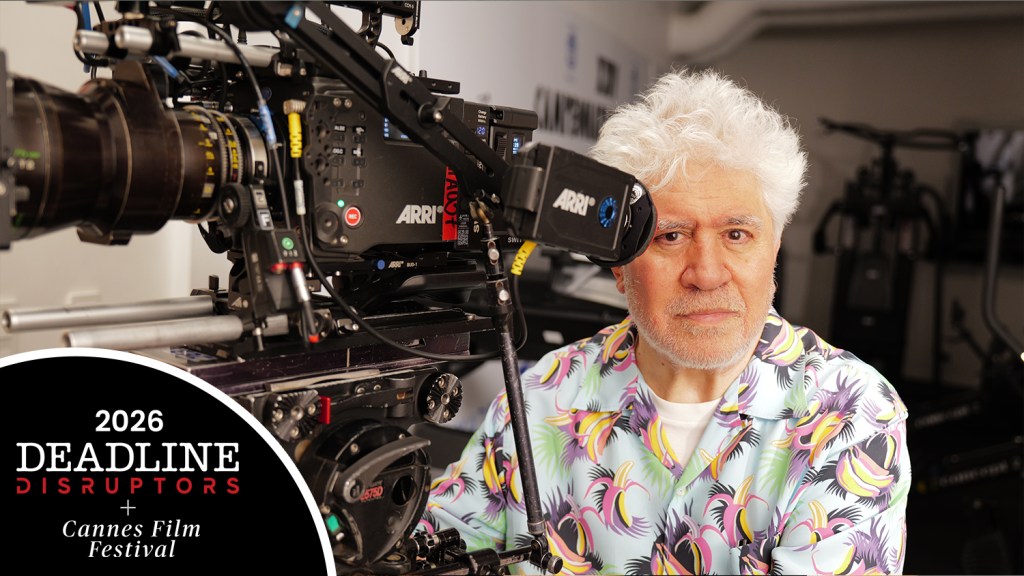
Pedro Almodóvar is known for mining his own personal experience, but Bitter Christmas (Amarga Navidad) explores this on a whole new level.
His viewpoint is reflected in the film in two interwoven protagonists — director Raul (Leonardo Sbaraglia), and Elsa (Bárbara Lennie), the cult filmmaker at the center of Raul’s screenplay. As Raul grapples with telling the story of Elsa’s life — she is wracked by panic attacks and migraines — he’s confronted by the murkiness of borrowing from real people for the purposes of fiction. Meanwhile, Elsa’s boyfriend Beau (Patrick Criado), a fireman who moonlights as a stripper, brings classic Almodóvar-esque humor, while Raul’s assistant Monica (Aitana Sánchez-Gijón) serves as the voice of reason.
DEADLINE: How long have you been thinking about this film? It feels like the culmination of so much personal experience.
PEDRO ALMODÓVAR: It’s been about four years that I’ve been working on the script intermittently while I was also working on some other projects. So it’s been brewing for about four years, which is not one of the longest periods of time for me to write a script.
DEADLINE: A hallmark of your films is the complexity and twists and turns of your plotting. How much do you plan in advance before you begin writing?
ALMODÓVAR: It sounds a little bit paranormal, but I really do feel like something else takes a hold of me during the writing process, and there comes a point at which it’s the story that’s dictating what’s happening. I was surprised by the ending myself when I got to the end of the story. This is actually the adaptation of a short story that I wrote many, many years ago, that told the story of Elsa with her boyfriend, the firefighter/stripper, and her friend Patricia (Victoria Luengo), and the trip that they take to Lanzarote. It was a complete surprise to me that Monica, the character that appears in the last half-hour of the film, is the one who’s challenging the author. She was not part of the story previously. She came to me.

L-R: Pedro Almodóvar on set with Leonardo Sbaraglia and Quim Gutiérrez
Sony Pictures Classics
DEADLINE: Speaking of that character, I wonder if that, for you, is the internal antagonist who asks those questions of yourself?
ALMODÓVAR: You’re right. Monica’s character is a reflection of the ways in which I may question myself. I’m always very aware and wary of not wanting to become complacent, and I particularly didn’t want to become complacent vis-à-vis the figure of the director, which is a reflection of myself in the film. And as Monica is challenging him, yes, she’s challenging me as a director. And I found the experience of displaying that both liberating and amusing because it did become a process of criticizing myself. Sometimes a writer doesn’t think of the way precisely that they’re going to hurt the people around them, because at the end of the day, they don’t think about the hurt, they think about the idea, and that becomes a dangerous thing. And so at a certain level, my screenwriter is kind of also the villain in the film.
One of the things that I was the most interested in that really became quite organic in this film — perhaps in a way that hadn’t been in some of my other films, although it is a topic that I have covered in other films — is the relationship between reality and fiction. I’m endlessly fascinated by that relationship, as I am fascinated by the origin of creativity. It is very mysterious to me where creativity comes from. And so that really becomes the principle theme in this film.
I have touched upon this in films like Bad Education or Broken Embraces, but I do feel like I have done this so definitively in this particular film that I may never again come back to that topic.
DEADLINE: Have you ever had a situation — as Raul does with Monica — where someone has confronted you about your work in such a personal way?
ALMODÓVAR: No, fortunately not. Because, as I said, the writer is someone who can be dangerous for loved ones, because you are always inspired, more or less, by someone that is close to you. I mean, I write with absolute freedom. So when I’m writing, I don’t think about other people, or I only think about the story itself and do exactly what the story demands me to do.
But after that, there is a debate about what are the limits of autofiction because there are no legal limits, but it’s an ethical issue. I’ve always made it a point to not hurt the people who are being reflected in my films. For that reason, I haven’t had anybody be upset at me, so I’ve never had a confrontation like the confrontation that you see in this film. And in fact, if I was ever grabbed by a story about someone who then asked me not to have their likeness be represented in the film, I might just not do the film at all.
DEADLINE: There’s a great scene with Beau set to the music of Grace Jones. Can you tell me about building that scene and about casting Patrick Criado?
ALMODÓVAR: I was very lucky with the actor. He’s very young, and I was amazed that he could be so versatile. And the key of that sequence is not only that he’s very hot, but also the response of the girls — the reactions that he’s getting from the women and the chemistry between them — is key to that scene. I had a lot of fun directing that scene. That scene is also very important to establish that Elsa is there not for erotic purposes, she’s there because she wants to cast him. And so she’s interested in his physical appearance in so far as his ass and his crotch, but not necessarily for erotic reasons.
DEADLINE: I laughed out loud in the scene where Elsa explains what it means to be a cult director. That feels so real. Is that a conversation you’ve had in your own life?
ALMODÓVAR: No, no, no. I just invented it. But it’s curious because it’s one of the favorite sequences of many people. I think there is a lot of fun explaining what a cult movie means. I mean, a cult movie means more things than that. And you have the doctor in the scene, as played by Carmen Machi, a very well-known actress, and she really lends that comedic aspect to that particular scene. The audience in Spain really laughs a lot during that sequence.
DEADLINE: I loved seeing Lanzarote in this film. I’ve been there and it’s unlike anywhere else in the world. It’s like going to the moon.
ALMODÓVAR: Yes, it’s a landscape that doesn’t seem real. It’s also almost like a mental landscape. And given Lanzarote’s volcanic, dark characteristics, it’s also the perfect place for someone to either go hide themselves or mourn, as is the case of Elsa as well. And so these particular characteristics make the island almost a character in itself.
Read the digital edition of Deadline’s Disruptors/Cannes magazine here.
DEADLINE: Do you feel you’ll ever return to English-language films?
ALMODÓVAR: First of all, with The Room Next Door, it really taught me that yes, I could direct in English. I could direct the actresses, they could understand what I was saying, I could understand what they were saying to me. And so, I knew that I could overcome that challenge. I realized that I can shoot a movie in English, but of course, not just any movie. The Room Next Door is ultimately an extension of many of my films. It’s a film about two women of a particular age, in a particular situation. And I was blessed with having these two marvelous actresses who carried the film on their shoulders — Tilda Swinton and Julianne Moore. I did that because I discovered the novel of Sigrid Nunez called What Are You Going Through. I felt like I was [working] in my own themes. So that’s why I said that I could do that movie, because I felt it was close to my interests. I’m not talking about the American culture, I don’t know it enough. I’m just talking about these two female characters. If it’s a comedy, you can invent something, but I don’t know so much the language and the country.
So, it depends, but I’m reading [English-language material] because I would like to keep on working with those actors. With Ethan Hawke I made a short film called Strange Way of Life. I would like to work again with Tilda and Julianne. And I really am looking to find something that I could manage and that could make an adaptation. So, perhaps in the future there will be another movie in English.