



The Church of Scotland has issued a formal apology for its historical role in slavery.
The apology was adopted at its General Assembly in Edinburgh on Saturday.
Before the abolition of slavery in the British Empire in the 1830s, some Kirk members offered a theological justification for chattel slavery.
It has also recognised that historically some of its members would have benefited from direct and indirect participation in the slave trade.
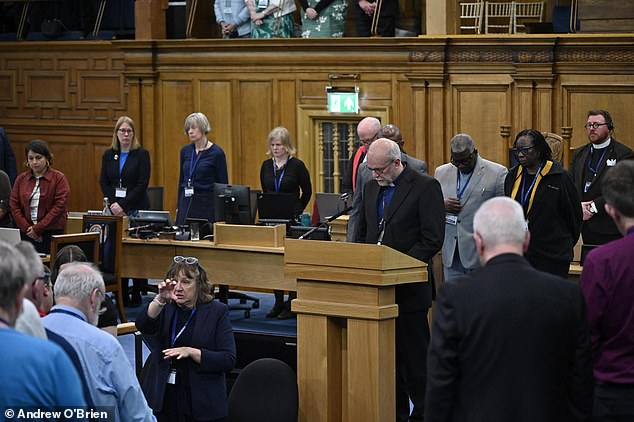
The Very Rev Sally Foster-Fulton presented the apology to the General Assembly.
‘The legacy of slavery stretches like a shadow over our local, national and global landscape,’ she said.
‘Naming that is not about blame, but about faithfulness – about recognising that healing begins where truth is spoken.’
The apology says that the Kirk is ‘grieved beyond telling by the extraordinary suffering we have inflicted – through our actions and our inaction – on our brothers and sisters’.
It adds: ‘We repent, committing ourselves to changing course and bearing fruit worthy of repentance.’
Rose Wedderburn, general secretary of the United Church in Jamaica and the Cayman Islands, praised the apology.
She said: ‘While the process has understandably evoked deep emotions, the effort invested in truth-telling and honest engagement is worthwhile.’
A report before the General Assembly detailed how the Kirk financially benefited from the slave trade.

Rev Sally Foster Fulton delivers the Kirk’s slavery report followed by The Moderator reading out the apology to the General Assembly of the Church of Scotland

Several overseas delegates from Africa and the Caribbean were present at the Assembly and responded to the apology and report saying the Kirk was moving ‘in the right direction’
It stated that, although British merchants were ‘involved in the enslavement and trafficking of people from Africa from the 1550s, the Church of Scotland did not take a public stand on slavery until the end of the 18th century’.
Ministers and moderators were ‘directly engaged in chattel slavery – yet as far as our research has shown us, no disciplinary action was taken by the Church’.
The report added: ‘Some clergy owned enslaved people themselves and continued to do so even after Scottish courts had ruled slavery morally and legally indefensible.
‘Others defended policies that delayed emancipation well beyond the abolition of the slave trade.’ A number of institutions in Scotland have issued apologies for historical links with slavery, including Edinburgh and Glasgow councils which did so in 2022.
Last year an examination of the University of Edinburgh’s ties to the British Empire found it received the equivalent of £845million from the slave trade, and that the profits of colonialism ‘continue to financially benefit’ the institution.
And just months earlier, bosses at the University of St Andrews were told 24 of its active endowment funds had direct links to the slave trade or imperialism.
It said more than £4million of its funds derive from the historical human trade.
The University of Aberdeen revealed it had received up to £166million of bursaries and endowments linked to slavery in 2025.
And in 2019, the University of Glasgow said it would pay £20million in reparations to atone for its historical links to the slave trade.