

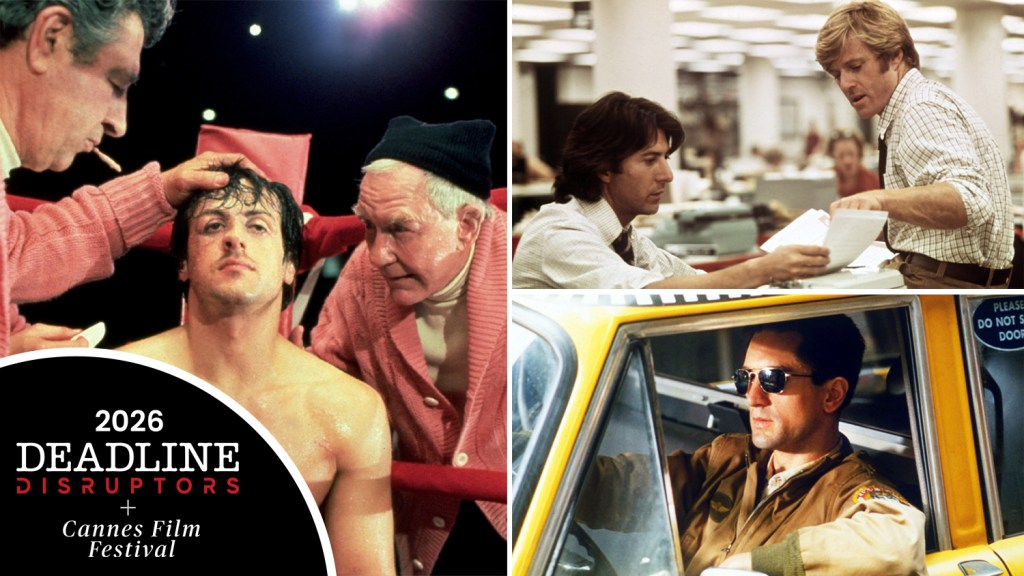
In a special three-part series — including All the Presidents’ Men, Taxi Driver and Rocky — Deadline is looking back a half-century to 1976, an incredible year for movies.
“We saw this movie as something that had a different level to it. It was monumental,” says All the President’s Men’s associate producer Michael Britton. “Most movies are movies — they’re entertainment — but this felt important.”
Fifty years on, All the President’s Men remains monumental: a testament to essential filmmaking, a cautionary tale about the corruption of power, and an example of filmmakers at the top of their game channeling the excavation of political scandal into an intelligent and satisfying thriller. The film is often cited as the gold standard of movies about journalism.
Alan J. Pakula’s 1976 drama starred Robert Redford and Dustin Hoffman as the intrepid Washington Post journalists Bob Woodward and Carl Bernstein who helped expose the Watergate scandal that led to the downfall of President Richard Nixon. The film meticulously recreated their steps in linking the Watergate break-in and Republican ‘dirty tricks’ campaign to the highest echelons of power in America. Based on Woodward and Bernstein’s book of the same name, the William Goldman-scripted film would go on to score eight Oscar nominations, winning four, and taking a hefty $70 million at the box office off an estimated $5-8 million budget.

Robert Redford and Dustin Hoffman in ‘All the President’s Men.’
[Robert Redford] never accepted things as they were and was always looking for what was under the surface.
Ann Hornaday
For many, the film’s snapshot of the scandal would go on to encapsulate the entire affair, which in reality lasted years. Ann Hornaday, The Washington Post’s longtime film critic who is now writing a book on the movie, has called it a metonym for Watergate “that from the moment it opened seemed to fuse seamlessly with private memory and collective myth.”
Jake Tapper, CNN’s lead Washington anchor, says: “I was raised in a political household, where the dirty politicians of my Philly youth were often discussed, and the Watergate hearings were watched live on the family black-and-white TV in the living room. All the President’s Men distilled this dynamic to one that was easy to understand.”
Making All the President’s Men accessible was in large part down to Redford, the driving force behind the project.
Says Hornaday, “Bob is the ultimate disruptor, and he was a disruptor almost from the very beginning of his career. The minute he started to achieve any kind of success or celebrity he leveraged it to do independent work and his own independent productions, which often were critiques of American society. Anybody who knew him, or interviewed him, knew the same thing, which is that he was always going against the grain. He never accepted things as they were and was always looking for what was under the surface.”
Britton, an employee at Redford’s production company Wildwood Enterprises and one of the last surviving crew members who worked on the film from start to finish, remembers a sense of jeopardy.
Hoffman and Redford with director Alan J. Pakula and cinematographer Gordon Willis on set.
Warner Bros./Everett Collection
“There was always the element that there are folks out there who do not necessarily want this story continued. Even up until the time we did the film’s premiere. We took the big, heavy cans to the Kennedy Center, but I actually had a backup copy that I kept in my room at the Watergate just in case somebody sabotaged it.”
Redford had first become inspired to tell the story after talking to Washington journalists during the promotion of 1972 movie The Candidate. The actor splashed out on the rights to Woodward and Bernstein’s book — getting there before co-star Hoffman — recognizing the potential in a film about journalists methodically pursuing a dangerous but vital truth. Paramount turned the project down, but Warner Bros. stepped up.
“I never worked on a picture that so much thought went into,” Redford said at the time. “A lot of it was preventive thought, not so much ‘do this’ as ‘don’t do that’ — don’t make it a movie about Nixon or Watergate. Don’t take a partisan position. Don’t set out to celebrate the press. Don’t be too impressed with the history involved. Don’t be careless with facts. Don’t fall in love with The Washington Post. Do make a movie about the press, about two reporters who did a difficult job of reporting and did it well.”
It was tense at times, because Bob liked to go in fresh with the scene. Dustin wanted to try every different way to do a scene.
Michael Britton
The journalists’ process was at the heart of Redford’s vision. Leading CNN anchor Dana Bash, who later worked with Bernstein, says of the duo: “They have distinctive styles and approaches to their work, yet are sympatico in what matters — the relentless pursuit of the truth. That is true for any investigative journalist, but they obviously broke the mold.”
Also, Redford saw a dramatic opportunity in their differences, noting, “When I read an article about them, I realized one was a Jew and one was a WASP, one guy was a Republican, the other was a radical; one guy was a very good writer, the other wasn’t so good… They didn’t like each other, but they had to work together.”
Redford and Hoffman learned each other’s lines to create synergy and spontaneity, but their differences could lead to an element of friction, says Britton. “It was tense at times, because Bob liked to go in fresh with the scene. Dustin wanted to try every different way to do a scene. So, they had very different styles. As a producer, [Redford] also had to be attuned to the amount of time things were taking.”
In the mid ’70s, Redford was perhaps at the peak of his powers as a leading man, and his stardust was evident, says Alan Shayne, the film’s casting director and former WB TV President, who is now 100 years old.
Redford and Hoffman
Everett Collection
“When Redford was on the set it was like there was a spotlight on him all the time; not a real one but an imagined one. He was just a big star. Light kind of followed him everywhere he went.” Hoffman, he recalls, was “brilliant” and “a genius” but could be difficult in how exacting he was.
Ultimately, it was Jason Robards, who portrayed the paper’s revered editor Ben Bradlee, who took home the film’s sole acting Oscar. According to film lore, dozens of A-list actors — from Burt Lancaster to Robert Mitchum — were considered for the part. Shayne, who had worked with Robarts before, has a different recollection. “Everybody in Hollywood makes lists. I never made a list. I met Bradlee and thought, ‘My god, it’s Jason.’ They had the same kind of voice, same kind of look. It was amazing. I remember going back to Hollywood and everyone on the picture was very excited. They said, ‘Who’s going to play Bradlee?’ I said, ‘Jason Robards’. My friend John Calley [the legendary longtime WB executive], who was head of production at the time, said, ‘We don’t want Robards, he’s washed up’. I said ‘John, that’s who it is.’ Later on, Bob [Redford] claimed he was responsible for casting Jason due to their friendship. Who knows.”
The film’s authenticity is often lauded as a major part of its success. “Pakula and Redford were constantly calling Woodward and Bernstein during the production,” says Hornaday. “They were taking scenes wholesale from the book, they looked at Bob and Carl’s notes, they interviewed them for hours.”
And Shayne saw it first-hand, saying, “With the help of the brilliant George Jenkins [who won the Oscar for Production Design], Alan recreated the whole newsroom of the Post. The wastepaper baskets were filled with real scraps of newspaper. He even wanted the extras to be real actors, which wasn’t an easy thing to pull off. There was the constant feeling of a live newsroom. Jason [Robards] would work from the newsroom office even when the cameras weren’t rolling.”
The film’s subtle yet propulsive score was the work of Oscar-winning composer David Shire, who two years earlier had composed the score for Francis Ford Coppola’s The Conversation. Shire recalls: “I went to see the movie in post-production, and then I almost talked myself out of doing it, because I said to Alan, ‘You know, it’s a fabulous movie, but it has such a documentary feel. Music may even hurt it.’” Shire initially struggled and Pakula rejected multiple themes. “After a time, Pakula explained to me, ‘The movie isn’t a documentary — it’s a story about two men whose hearts are beating faster and faster as they go toward their quest.’ That turned the light on for me; when I thought about a heart beating faster and faster, that pulse came to me, and the theme grew from there. Suddenly, it wasn’t a documentary anymore in my mind. That was one of the most contained and crucial notes I got from a director.”
The resonance of All the President’s Men remains as strong as ever now, even if many Deadline spoke to view Donald Trump’s presidency as being corrupt on an entirely different level to Nixon’s.
“I’ve interviewed a fair number of Watergate figures for my book, many of them Republicans,” says Hornaday. “They’re gobsmacked at what’s happening today in America.” The ‘dirty tricks’ of Republican leaders at that time have “metastasized into something profoundly anti-democratic and dangerous,” she says.
Read the digital edition of Deadline’s Disruptors/Cannes magazine here.
Actor Mark Ruffalo recently wrote about the film through the lens of Paramount’s impending deal for Warner Bros: “As we watch Hollywood barrel towards a Paramount — Warner Bros. merger, All the President’s Men should remind us of what may be lost. This movie would not have been made in a Paramount-Warner Bros.-CNN -Trump era.”
Bash notes: “The film is a reminder that the answers don’t always come quickly, and pushing for truth in the face of resistance from powerful people is scary. Having an organization that has your back is everything.”
For Tapper, “All the President’s Men is about a moment in time, because — as we’ve seen — Presidents engaged in deception or corruption in the modern era have a Praetorian guard in partisan and ideological ‘news’ media, to say nothing of influential social media trolls. That said, the film’s message of the need for journalists, and their editors and publishers, to stand firm with those with facts on their side, even if they stand alone, is just as resonant today.” —Andreas Wiseman