

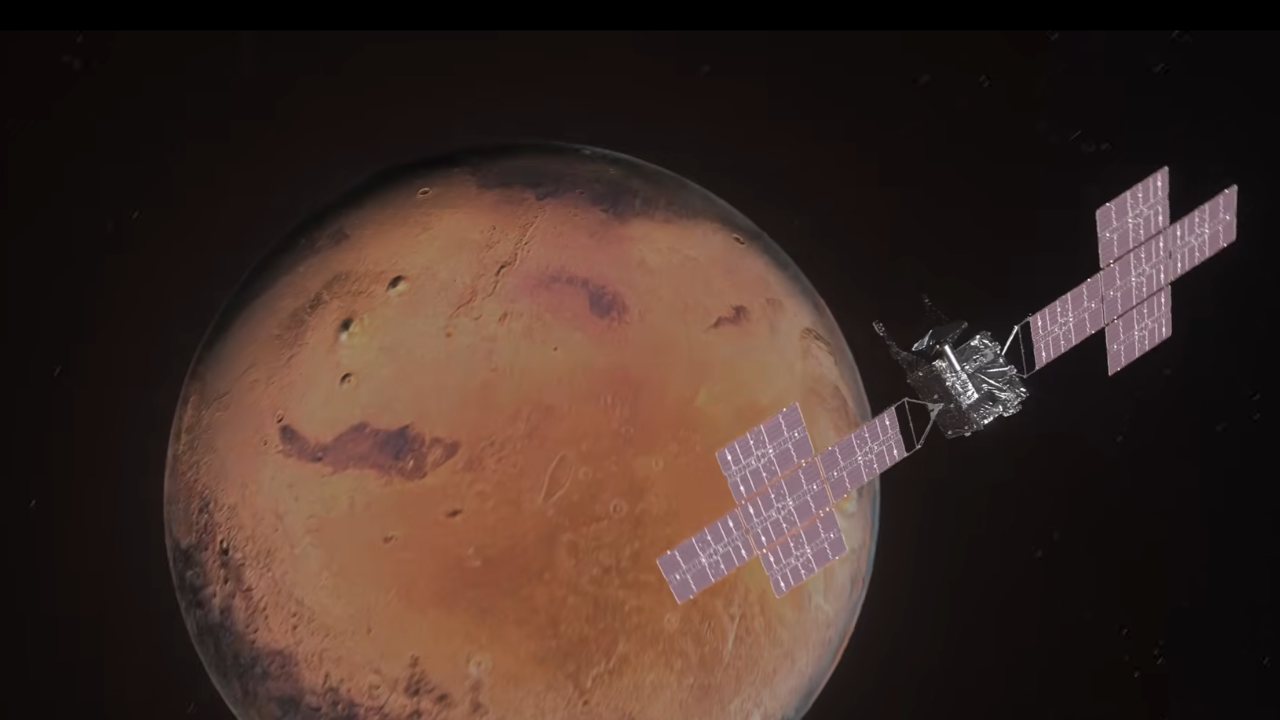
NASA’s Psyche spacecraft flew by Mars on Friday (May 15), diving closer to the Red Planet than either of its tiny moons. But the precisely timed maneuver was not designed to study Mars,
On Friday, Psyche hurtled past the planet at roughly 12,333 mph (19,848 kph), according to NASA. The flyby boosted Psyche’s speed and, more importantly, shifted its trajectory toward its destination, the asteroid 16 Psyche, which orbits the sun between Mars and Jupiter.
Scientists believe the 173-mile-wide (280 km) space rock may be the exposed metallic core of a shattered protoplanet — a primordial building block of the rocky worlds whose outer crust and mantle were likely stripped away in catastrophic collisions billions of years ago. If so, the mission could offer humanity its first direct glimpse of material normally buried deep inside planets like Earth.
A Mars assist
Friday’s flyby marked one of the mission’s most important milestones, conserving precious fuel while placing the spacecraft on course to reach the asteroid in 2029.
The maneuver was an example of one of the most important techniques in modern spaceflight known as the gravity assist. By carefully flying past a moving planet, spacecraft can gain speed, alter direction and conserve propellant, allowing missions to travel farther and faster than rockets alone would permit.
The concept can seem almost counterintuitive, as though spacecraft are somehow getting energy for free. A spacecraft accelerates as it falls toward a planet, then slows again while climbing back out of the planet’s gravity well. Intuitively, those gains and losses should cancel each other out.
What makes the maneuver possible, however, is not simply the planet’s gravity, but the planet’s own motion around the sun.
Mars is hurtling through space carrying enormous momentum as it orbits the sun. By approaching the planet at a carefully calculated angle and departing in another, Psyche effectively stole a tiny fraction of that orbital energy.
The exchange follows Newton’s Third Law — every action has an equal and opposite reaction — as the spacecraft gains momentum by borrowing an infinitesimally small amount from Mars, a transfer imperceptible to the planet but transformative for the mission.

“It’s smart, it’s cheap, and it’s phenomenally clever … it’s a bit like interplanetary billiards,” Shadan Ardalan, a NASA scientist who was involved with the agency’s Juno mission to Jupiter, previously told Space.com.
Gravity assists have long been used to explore humanity’s cosmic backyard. The technique dates back to the dawn of the Space Age in 1959, when the Soviet spacecraft Luna 3 used the moon’s gravity to swing behind it and photograph the lunar far side for the first time.
Many of humanity’s most ambitious robotic missions would also have been impossible without such maneuvers. NASA’s Voyager probes famously used a once-every-176-years alignment of the outer planets in the late 1970s to slingshot from Jupiter to Saturn, with Voyager 2 continuing onward to Uranus and Neptune in a historic grand tour of the outer solar system. Cassini relied on gravity assists with Earth, Venus and Jupiter to build up the speed needed to reach Saturn, while New Horizons swung past Jupiter to shave a few years off its journey to Pluto.
Most recently, NASA’s historic Artemis 2 mission adopted a similar principle, following a “free-return” trajectory that used the moon’s gravity to arc the crew of four back toward Earth without requiring major engine burns after looping around the lunar far side.
On to the asteroid belt
On Friday, the Mars encounter gave Psyche the equivalent of roughly a 2-kilometer-per-second change in velocity relative to the sun, according to a paper published in October detailing the maneuver.
Psyche uses solar-electric propulsion, relying on its solar panels to convert sunlight into electricity and slowly push the spacecraft forward by releasing charged xenon gas. The system is highly efficient, but it generates only a small amount of thrust over long periods of time.
Achieving the same boost in speed and shift in trajectory using propulsion alone would have been extraordinarily expensive and likely impractical, requiring enormous amounts of propellant — more than the spacecraft could realistically carry — while also adding weight and dramatically increasing launch costs.
The Mars flyby allowed the spacecraft to use the planet’s gravity to do much of the work instead, saving fuel for the rest of the journey.
Like a baseball launched off a bat, Psyche now leaves Mars carrying new momentum and a reshaped trajectory, bound for a metallic world that may reveal what lies hidden inside planets themselves. It should arrive at asteroid 16 Psyche in July 2029.