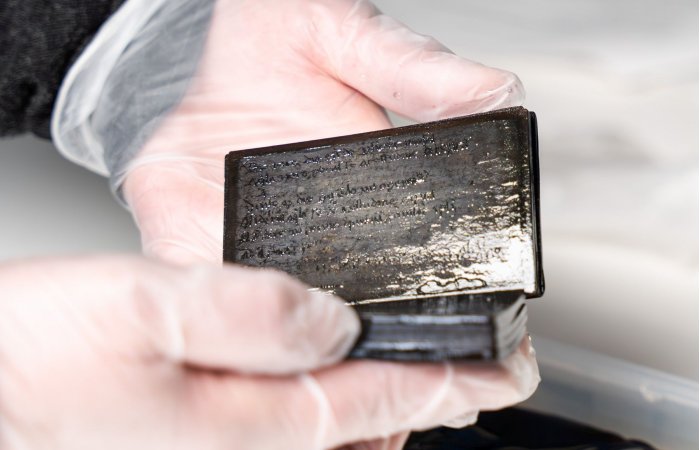
Jan Bartek – AncientPages.com – Archaeologists in Paderborn, Germany, in collaboration with the Westphalia-Lippe Regional Association (LWL), have discovered a well-preserved notebook from the 13th or 14th century in a medieval latrine during construction of the new city administration building. Composed of leather, wood, and wax, the notebook is currently being restored at the LWL in Münster. Once restoration is complete, experts will attempt to decipher its contents.
Credit: LWL-Archäologie für Westfalen/E. Daood
Dr. Barbara Rüschoff-Parzinger, LWL’s Head of Cultural Affairs and an archaeologist, explained: “This is the only such find in all of North Rhine-Westphalia. It sounds strange, but for us archaeologists, latrines are almost always a treasure trove. Comparable medieval artifacts are also known from Lübeck and Lüneburg. There, a similarly damp soil environment preserved the finds. However, in no other case has the entire book been preserved as an archaeological find, as was the case here.”
The document, estimated to be 700 to 800 years old (leather binding: 10 x 7.5 cm; wood: 8.6 x 5.5 cm), is notable for its exceptional preservation. Rüschoff-Parzinger anticipates it will provide valuable insights into daily life in medieval Westphalia: “After careful restoration by the LWL experts, it may be possible to make the difficult-to-decipher text fully legible again using high-tech methods.” The team is consulting with manuscript and materials experts from across North Rhine-Westphalia.
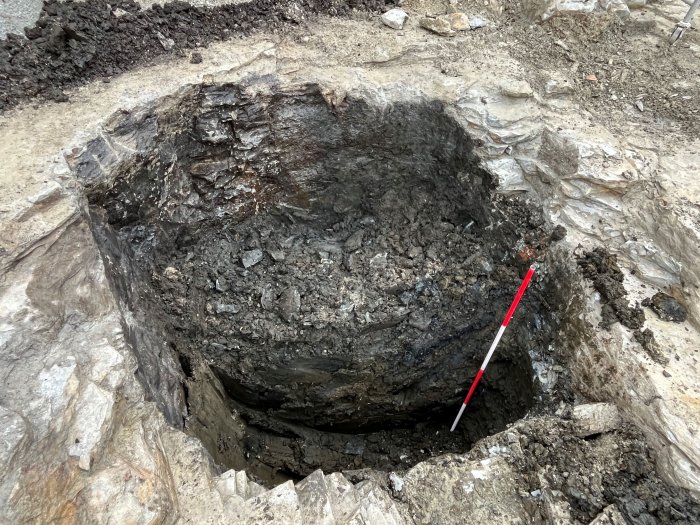
The latrine where the notebook was found. Credit: Denkmal3d, Heike Tausendfreund
Dr. Sveva Gai, LWL city archaeologist in Paderborn, also hopes the text will reveal information about its author. “Who wrote the book and what purpose did it serve?” she asks. Initial evidence suggests a Paderborn merchant may have written the notebook, possibly to record business transactions and personal notes. “Merchants were educated people: unlike most people, they could both read and write.” The reason the notebook ended up in the latrine remains unclear. “It could have fallen in there by accident,” she suggests.
Notebook As Waxtablet
The medieval notebook consists of ten pages: eight are double-sided, while the first and last are waxed on one side only. It is bound and stored in a small leather case with a lid. LWL conservator Susanne Bretzel was the first to examine the notebook after centuries underground. She noted, “Packed in a wet clod of earth—and initially quite inconspicuous—the object only became clear during cleaning in our restoration workshop in Münster. And indeed, even after so many centuries in the ground, the latrine find still had a rather unpleasant odor.”
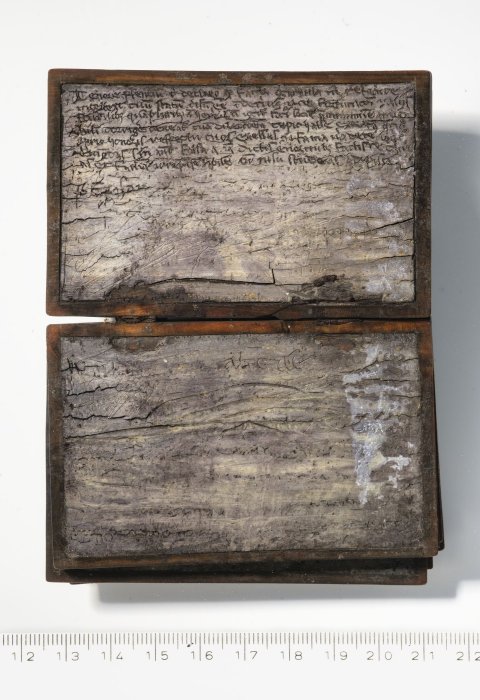
The damp, airtight Paderborn soil was crucial for preserving the notebook. These conditions allowed the wax text, written with a stylus made of metal, bone, or ivory, to remain intact for 700 to 800 years, according to Bretzel. She stated, “I only had to clean the outside of the book, as the inner pages were so tightly bound that there was no dirt on them. The wood also hadn’t warped, so the wax is still intact and the writing itself is easily legible.”
The text is written in two directions, depending on how the book was held, yet it appears to be the work of a single author. This indicates spontaneous use as a notebook.
Credit: LWL/ S. Brentführer
Regarding the writing implement, Bretzel explains: “The stylus, a slender tool used in writing on wax tablets, is pointed at one end to scratch the letters into the wax. The other end of the stylus was flat or spatula-shaped. This allowed the wax to be smoothed and the writing erased, making the tablet reusable.”
The leather binding remains intact, though the threads have loosened. Gai notes, “The surface of the leather binding is decorated with an embossed pattern, meaning a raised design created by pressing or stamping: small, regular rows of lilies covering the entire surface. Perhaps we can deduce something about the origin of the piece from this in the future, or even identify its place of manufacture.” The distinctive lily motif suggests the book was highly valued. As Peternek explains, the lily symbolized purity, royal power, and divine favor in the Middle Ages.
Not Easy To Decipher
The wax still covers all the inner surfaces of the tablets and is largely inscribed with cursive script. Gai: “The Latin language—also an indication of an upper-class owner—and the characteristics of the cursive script date this book to the period between the 13th and the end of the 14th century. The wax, however, doesn’t just show the most recently written pages. The rubbing of an older script is still clearly legible.”
Advanced methods may be used in the future to separate and decipher the different layers of superimposed writing. The city archaeologist states that a transcription, converting the handwriting into legible script, has already been commissioned.
Rüschoff-Parzinger: “The text is difficult to decipher, even for experts. Some words are recognizable, but the transcription will require time because certain words may have been altered by incorrect spellings.” The text will be translated from Latin into German once the transcription is complete.
Preserving The Medieval Notebook For Future Generations
The LWL archaeology team is now working to conserve the find. Peternek says, “Our first priority is analyzing the materials used. Wood and wax, in particular, must be examined using scientific methods: What wax or resin mixture is the wax made of? (A resin is a sticky substance that can preserve objects.) Were pigments (coloring agents used for decoration or identification) added? What is its melting point? (The melting point is the temperature at which a solid becomes a liquid.) What type of wood is it?” All this information is essential for conservation.
Transitioning from the scientific analysis, LWL Cultural Affairs Director Rüschoff-Parzinger adds, “The work has been carried out in constant consultation between the project management team from the city of Paderborn and the excavation company.”
This partnership has been especially important. Thanks to this close cooperation, there were no construction delays. The archaeologists carefully documented the find, quickly moved it to the LWL Archaeology Restoration Workshop in Münster, and provided expert treatment and on-site storage. These steps have helped preserve this fragile object.
Looking ahead, as part of these preservation efforts, the team is using different conservation methods for each material. Bretzel says, “Until we have all the test results, the leather and wood will remain in distilled water, which we will change regularly. The entire conservation process could then take up to a year.” Afterward, the plan is to display the medieval notebook at the LWL Museum in the Imperial Palace in Paderborn.
Silk As Toiletpaper
The major construction project for the new city administration building in Paderborn has involved extensive archaeological excavations. The site is in a historically sensitive area of the city. It borders the immunity wall of Abdinghof Abbey and is bounded by Marienplatz to the south and Abdinghofstraße to the west. Work has been underway since December 2024. The first phase of construction is complete; it involved excavating the deep building pit. During further excavation for the construction pit, archaeologists discovered five latrines. These proved to be sealed, airtight chambers beneath early modern buildings. They extended into the limestone soil of the former 11th-century quarry.
Archaeologists recovered the medieval wax tablet from one of these latrines. LWL archaeologist Gai said, “The find was located together with other medieval objects. These included numerous stave vessels (barrels), a knife, fabric remnants, complete proto-stoneware vessels (a type of medieval pottery), and basketry remnants. These accompanying finds confirm the dating of the book.”
According to Gai, the upper classes lived in the center of Paderborn. This was not necessarily the nobility, but the upper middle class. This makes a closer look at the other finds worthwhile. Conservator Bretzel explains: “The silk fabric remnants from the latrine were partially torn into rectangular pieces. Some were extremely finely woven and decorated. Perhaps this was toilet paper after the once-elegant fabric was discarded.”
Silk as toilet paper also suggests an elevated status, says Gai. “As soon as this latrine can be assigned to a specific plot of land, archival research could help identify the residents. Then, in the best-case scenario, it would be possible to link the wax tablet to a specific person by name.”
Source: Landschaftsverband Westfalen-Lippe (LWL)
Written by Jan Bartek – AncientPages.com Staff Writer