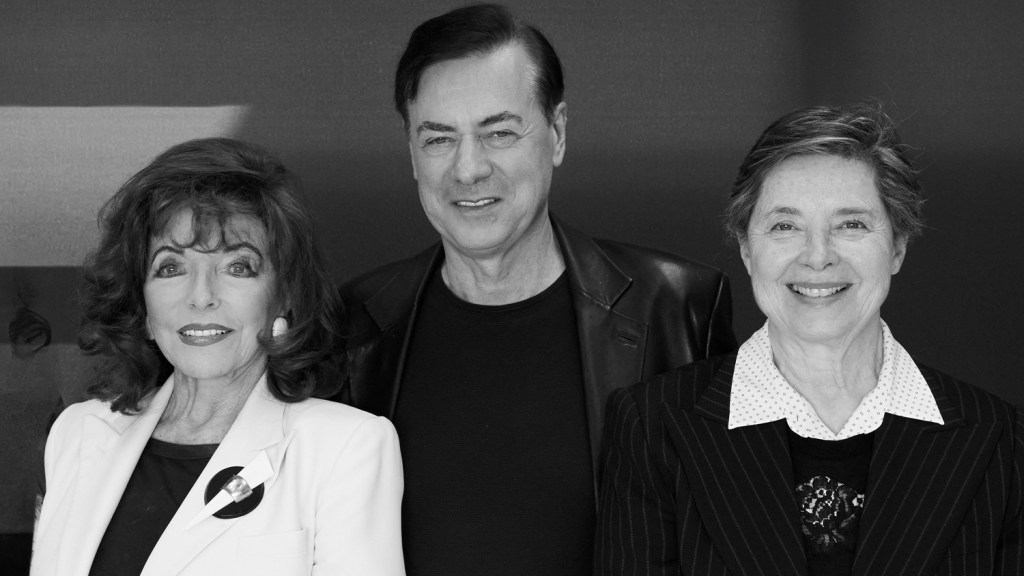
EXCLUSIVE: John Gore the Broadway maven turned fledgling movie mogul is making his first foray into the Cannes market today with a new film about Wallis Simpson, the woman for whom a king gave up his throne, and he was determined that the grand royal title of Duchess “had better be in its title.”
One early runner was The Bitter End but Gore dismissed it, because he felt that the film starring Dame Joan Collins and Isabella Rossellini should feature a royal salutation in its name.
What’s in a name is important, and certain movie titles “get so much penetration,” Gore attests.
Eventually, after tiring of The Duchess & I, The Duchess & Me and other similar names, the filmmakers decided to go with My Duchess. “Obviously at the back of my mind, I’m always thinking about the other Duchesses,” says Gore referring to Sarah Ferguson, who was stripped of her Duchess of York banner, and Megan, the Duchess of Sussex.
“I thought, ‘We have to have Duchess in the title so people can make all those kind of connections,’ even though you can’t really say them in the movie, but people need to think of it in that way,” says Gore.
He adds that a perfect title would’ve been “The Last Duchess of Windsor, because we know there won’t be another one, but I thought we’ll just get in too much trouble.”
Edward VIII abdicated his throne in 1936 and was named Duke of Windsor the following year before marrying Ms. Simpson, who became the Duchess of Windsor.

Isabella Rossellini, left, and and Joan Collins in ‘My Duchess’
Rory Mulvey/John Gore Studios
To this day, however, the Royal Family has steered well clear of the Windsor titles which have not been used since the death of the Duke in 1972 and his wife 14 years later.
Gore also overruled those who hadn’t wanted him to cast Charles Dance to portray Lord Mountbatten. “They were saying , ‘Oh, we can’t use him, he’s been in The Crown,’” Gore notes.
Joan Collins
Baz Bamigboye/Deadline
Dance appeared in five episodes of The Crown as Mountbatten. However, the My Duchess production had Dance for a day and a half of filming and Gore says he argued that the film required an actor “that has to be able to land 100 per cent. You just go, ‘It’s Lord Mountbatten.’ Even Joan was resistant,” he said, with the naysayers worrying that about repeating themselves.
However, Gore was adamant, pointing out that Dance’s interpretation here is quite different than the scenes he played in The Crown. He suggests that when My Duchess “creeps up on Netflix in 20 years’ time, everyone will probably see it as part of [The Crown],” and think it’s a deliberate plan, “but it really was that he was the best guy to land it.”
Gore, as head of John Gore Gore Studios, will meet with market buyers today and host a luncheon with Dame Joan and Rossellini, who portrays the Duchess’ lawyer Suzanne Blum.
Later, this evening the dame will be on the red carpet for the opening ceremony.
Gore was impressed, he says, by the research Dame Joan had done on the Duchess’ final years and how she was ill-treated by her lawyer.
“All the stories she’d told me kept going around in my mind,” but then he happened to be tuned in when Dame Joan attended the 2024 Emmy Awards, presenting the award for Outstanding Limited or Anthology Series alongside Taraji P. Henson. “I just saw the audience go crazy over her. She’s not forgotten and she seems as beloved, if not more so,” Gore says of the star who was then 90.
He felt then that audiences might be up for seeing her “do something very different.”
Gore admits that he’s always been “fascinated” by her performances, having over the decades made a point of watching her earliest 1950s movies. ”Obviously, she was a big movie star. She was above Richard Burton in an in early movie Sea Wife. He was a supporting player and clearly she was in this huge trajectory and then ended up having kids and doing a load of TV,” he says.
But Gore argues that in her day “the TV she did was definitive. The most famous episode of Star Trek, one of the most famous characters in Batman,” he says referring to her appearance in in Star Trek in 1967, and her arc as Lorelei Circe, known as the “Siren,” in two 1960s episodes of Batman.
“She did a Mission Impossible where it’s really the Joan Collins show. So you can see all these iconic things. If you ever talk to anyone who works on Star Trek, they say they all aspire in one way or another to remake the episode she did, which is a sort of time travel thing and Captain Kirk falls in love with her.”
Joan Collins and William Shatner in an episode of ‘Star Trek’. Getty
Gore says that over the years he watched dozens of Dame Joan’s television performances. “Dynasty, of course, as Alexis. So I just felt seeing how different she was and seeing her now and seeing that she would still do it,” he says.
By the time he wanted to push ahead and make the movie with Dame Joan, the bonus was signing Rossellini following her success in Conclave. “I really thought with Joan, we should get on with it. But Isabella signing up meant that I knew we were going to hit a different level.”
Gore also became fascinated by what he read and was told by his star of the Duchess of Windsor’s last years. He toyed with the idea of adding a coda at the end about how Mohammad Al Fayed owned the villa where the Windsors had resided, and it’s where his son Dodi Fayed visited before he and Diana died in that car crash in Paris.
“Clearly, they were showing off to her at the villa,” he surmises.
But, perhaps that’s a tale for another movie or television drama.
Not wishing to harp on about Dame Joan’s age, but were there any problems with insurance bonds for the film?
“We had to go through all that process,” says Gore, “and actually she checked out amazingly. It was great. I was prepared to do it without the bond. I was prepared to go, ‘Okay, if we can get on and get it done, let’s go ahead without it.’ But they were able to pull it off. I thought going into it from the first moment it came up, that we’re never going to get insurance for this.”
He says that he made it clear from the earliest discussions with Dame Joan about the project, that “we were going to see her properly [without make-up]. I was not at first base until we knew she was really going to go for it, and actually she did it full on in final scenes without going, ‘I need to be pretty.’ So we didn’t cross swords on that front because she did go with it,” he adds.
The film is the first production out of his John Gore Studios, which has a pedigree. “The bottom line is I bought Hammer Films out of bankruptcy,” says Gore.
During his introduction to film buyers, Gore will show some footage from his studio’s titles which include John Madden’s film Onward and Sideways starring Laura Linney and Rhys Ifans. He’s also involved with producer Liza Marshall’s The Return of Stanley Atwell starring Nicholas Galitzine.
Gore has clear views about the leap he has made from live theater to the screen.
For him “TV is certainly product and film is art. I’ve no doubt on that now. Whereas TV…you can have great TV, but it is sort of structural formula. Whereas film, you are chipping away like chipping away in a statue till you get into it. The process, the editing is as fascinating as the shooting, frankly. Things emerge,” he says.
With theater shows, things can he altered, refined or totally overhauled, whereas with film, “I’m not wild about the fact we have to make permanent decisions,” he says, laughing as he notes how many times Cameron Mackintosh has had new material introduced into Les Miserables.
“Cameron might own up to you. Les Miz is on version 20, “ he says chuckling.
“So not being able to do that, and everyone’s always going, ‘Picture lock, picture lock,’ a lot. I go and say, ‘I’ll say when it’s picture lock,’ because I just can’t stand that moment of going, ‘We’re done.’”
He says that he’s in the film business for the long haul but theater is where his bread and butter is; his Broadway Across America circuit has control of over fifty theaters in the U.S. and Canada.
Gore believes that for a show to enjoy a long run on Broadway and the road it has to “please the 48-year-old female. She has to come and she has to want to bring her daughters or her mother…That’s the demographic. And from there, everything builds. And I did all sorts of crazy things and I’ve had to learn, unless you’re pleasing that customer, you’re not going to get to something that hits the mother load…It’s fundamental.”
But if you want to be a solid Broadway hit, one factor to keep in mind, Gore claims, is that a Best Musical win at the Tony Awards “It’s a hundred million dollar prize, literally…If you win a Best Picture Oscar, it doesn’t move the needle at all really in that sort of scale.”
Has he discovered a similar measurement for the movies — What’s the 48 year-old female equivalent?
“It’s a bit too early,” he says while noting that some films on his slate are “certainly skewing older,” at least until the Nicholas Galitzine film The Return of Stanley Atwell.
“The reality is,” he adds, ”you have to have the promotion and then be streaming pretty quick because for so many people, as soon as they see it’s out there, they’re just going, ‘When can I see it online?’ Trying to get them into the cinemas is hard work for these more smaller pictures,” he maintains.
Joan Collins as the Duchess of Windsor in ‘My Duchess’
Rory Mulvey/John Gore Studios
Gore says that most of the major streamers and cable channels have seen My Duchess, even Ted Sarandos from Netflix. He says that he and the Netflix boss have known each other each other for a long time.
How did they meet? “It was on Sean Connery’s sofa in the Bahamas,” he says.
Both Gore and Sarandos have connections with the Bahamas, where the 007 James Bond star lived until his death six years ago.
When they first met, the man from Netflix asked Gore if he was from the UK.
“He said, ‘You’re British. I’m doing this thing called House of Cards. Do you know what it is?’ I said, ‘House of Cards. I loved it.’ That’s how far I go back with those guys.”