



Ambulance crew and the Coastguard stood waiting for firefighters as the tide came in and submerged a woman whose head was stuck in the rocks on a Suffolk beach, an inquest has heard.
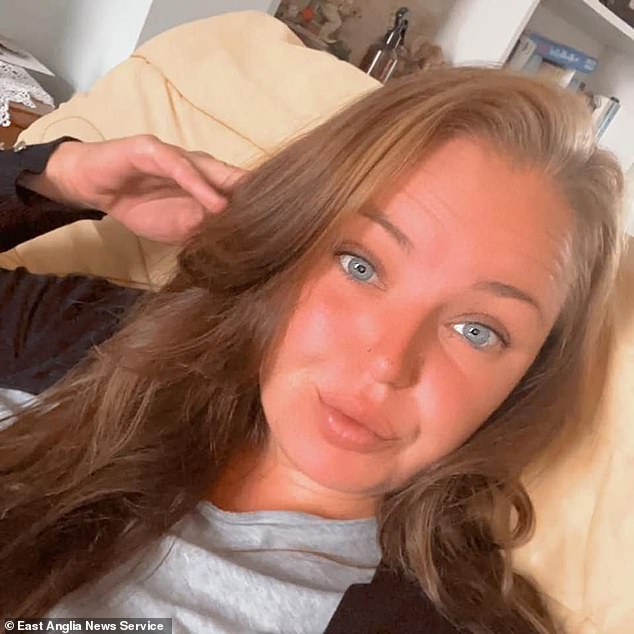
Saffron Cole-Nottage, 32, died on February 2, 2025, after falling head-first while walking her dog with her daughter on The Esplanade in Lowestoft, Suffolk.
Richard Lark, a watch manager at Suffolk Fire and Rescue Service, told the inquest at Suffolk Coroner’s Court that he had asked ambulance crews if they had been down to assess the mother.
‘I asked the ambulance service if they had been down to her, and they said ‘No’ because of PPE. I asked who had been down to assess her, and they said they did not know,’ he said.
Two members of the Coastguard were also sent to the scene in overalls with no PPE, the firefighter said, adding that no cordon was in place, and emergency services had not been with Ms Cole-Nottage, and no attempt had been made to rescue her.
‘I asked the Coastguard what was happening and they stated they did not know,’ he told the inquest. ‘I looked over the wall and saw two non-uniformed police officers.’
Ms Cole-Nottage had been conscious and talking for at least ten minutes before Mr Lark arrived with his colleague.
And upon feeling her leg, which was still warm, he believed that ‘there was a high chance she could be in a gap in the rocks allowing her to breathe,’ he told the inquest.
Mr Lark, Mr Herrod and Mr Wright decided to rescue the mother, which took between 30 to 60 seconds. After she was pulled from the rocks at approximately 8.30pm, they performed CPR – and also required assistance.

Saffron Cole-Nottage, 32, drowned after falling in a gap between rocks on February 2, 2025

Ambulance crew and the Coastguard stood waiting for firefighters as the tide came in and submerged a woman to the scene on Lowestoft seafront, Suffolk
‘The ambulance crew did not come to the lower sea wall to assess Saffron,’ the watch manager added.
Jason Wilkins, also a firefighter, said they could not rescue Ms Cole-Nottage because they ‘had no equipment with them and it would go against their policy to go down without equipment’.
‘The Coastguard informed me he believed this was Recognition of Life Extinct,’ he added.
Meanwhile, fellow firefighter Ben Whale told Suffolk Coroner’s Court that given the cold conditions, Ms Cole-Nottage could have been saved after being underwater for 30 minutes.
Recalling the incident, Mr Whale said ‘it did not feel quite right’ as a police officer said they believed it was a body recovery but would not give any further information.
In total, four fire crews and 12 firefighters were on the scene, as well as a specialist team, equipped to handle water rescue. They all agreed with Mr Whale that they should try and save Ms Cole-Nottage, the inquest was told.
‘That’s all the trigger I need to say we’re going for the rescue,’ Mr Whale said. ‘It just did not feel right.’
Two firefighters in protective gear held on to Saffron, and the two firefighters – not in protective gear – were down on the rocks holding onto them.
‘It was quite a simple manual manipulation,’ Mr Whale said. ‘A small push for a large pull.’
Mr Whale told the inquest that even the two firefighters in protective gear could have managed to free Saffron on their own.
The firefighter had to compose himself twice during his evidence, during which Ms Cole-Nottage’s partner, Michael, quietly wept.
A statement was read out at the inquest on behalf of Michael, who thanked The Suffolk Fire and Rescue Service for trying to save Saffron.
Ben Whale told the inquest that six years ago he had helped rescue someone trapped in the rocks in a similar situation on Lowestoft seafront, and that person survived.
The Fire Service was also delayed in arriving at the scene because the ambulance call handler didn’t make it clear that fire crews were needed, the inquest heard.
Firefighter Sebastian Herrod explained his crew arrived at the scene at 8.22pm and rescued the mother eight minutes later before starting CPR.
The ambulance staff were reluctant to go over the lower sea wall at the casualty’s level. They were on the upper promenade,’ he told the inquest.
‘The fire service carried her up on a scoop. Paramedics worked on her in the ambulance.’
Volunteer Coastguard Matthew Knight told the inquest police and paramedics had already declared the casualty was Recognition of Life Extinct [ROLE].
‘I continued to travel to the scene but as the casualty was ROLE, I drove in a calmer manner,’ he said.
‘The firefighters made the decision she could still be saved and proceeded to pull her out.
‘I do not believe that the firefighters were aware that the ambulance crew had previously declared the casualty ROLE.
‘The ambulance crew looked very shocked at what was going on. The casualty was put on a scoop and carried up to the ambulance.
‘The firefighters were asking what had just happened. [They were trying to] confirm why nothing was actually being done for the casualty.’
Meanwhile, Megan Dunkley a call handler for Suffolk Fire and Rescue Service, notified them of somebody ‘trapped in some rocks’ but did not make a direct request for their attendance.
‘The ambulance made no direct request for our attendance,’ said Ms Dunkley. ‘Therefore, it was not clear if we were needed or requested by another agency.’
To confuse matters more, this was happening at a time when it was becoming routine for the ambulance service to call the fire brigade about jobs they were going to, even if the fire service wasn’t needed, the court was told.
Ms Dunkley said: ‘This was happening at a time when there was a practice at the ambulance control to notify the fire service even if they were not needed.
‘It seemed as though the Coastguard was the leading agency. Fire services do not go into the sea for rescues.’

Ms Cole-Nottage was described as a ‘loving mother who was completely devoted to her children’
Elizabeth Pardon, a crew commander for the Cambridgeshire and Suffolk combined control room for the Fire and Rescue Service, who supervised the call also said it was ‘not clear whether our agency was being requested or not’.
‘”I wonder if you would like to come along”. That is not the direct request we would expect,’ she told the inquest.
She said: ‘With it being a sea incident, the fire service would not attend incidents at sea.
‘We did not have the clarity. I made the decision to ask another operator to call the Coastguard. I decided they would be a lead agency.’
The fire service called the Coastguard at 8.09pm, and they confirmed that the fire service was needed because Saffron was trapped.
Ms Cole-Nottage’s partner thanked the fire service in a statement read out to the coroner’s court.
‘Thank you to you and all of your colleagues for your brave and quick efforts when you arrived to bring Saffron out and tried to save her life and in particular for treating Saffron as a rescue and not as a casualty,’ it read.
‘Even when you brought her out, performing CPR, it means a lot to us.’
The inquest continues.