


These days, our modern pocket computers all look roughly indistinguishable from one another. Unless you’re touting around a new-age folding phone, the smartphone on your person is most likely a glass slab with rounded corners, metal side rails, and a punch-hole or oblong selfie camera.
This wasn’t always the case — for most of the mobile phone’s storied post, tech companies were notorious for experimenting with unique form factors and innovative-if-extravagant selling points. Here are eight examples of downright strange handsets from the past, that, by today’s standards, look straight out of an alternative universe.
Nokia N-Gage (2003)
The Game Boy Advance one

The Nokia N-Gage has gone down in infamy as the cellphone that tried to also be a Game Boy Advance. It featured a handheld video game console-esque wide body, complete with a d-pad on its left-hand side. The N-Gage even had its own MultiMediaCard-based cartridge slot for inserting titles, as well as access to N-Gage Arena, which was Nokia’s online games service at the time. While perfectly serviceable as a device for sending and receiving phone calls, the N-Gage never managed to dethrone Nintendo’s position in the portable gaming scene.
Motorola Rokr E1 (2005)
The iTunes one

Before there was the iPhone, there was the Rokr E1. This ill-fated candy-bar style handset was notable for shipping with native support for iTunes, having been conceived of in collaboration between Motorola and Apple. Despite launching with stereo speakers and a built-in iPod-style music player interface, the Rokr E1 failed to capture the public’s attention, ultimately fizzling into irrelevancy not long after its initial release to market.
Samsung Juke (2007)
The swiveling one

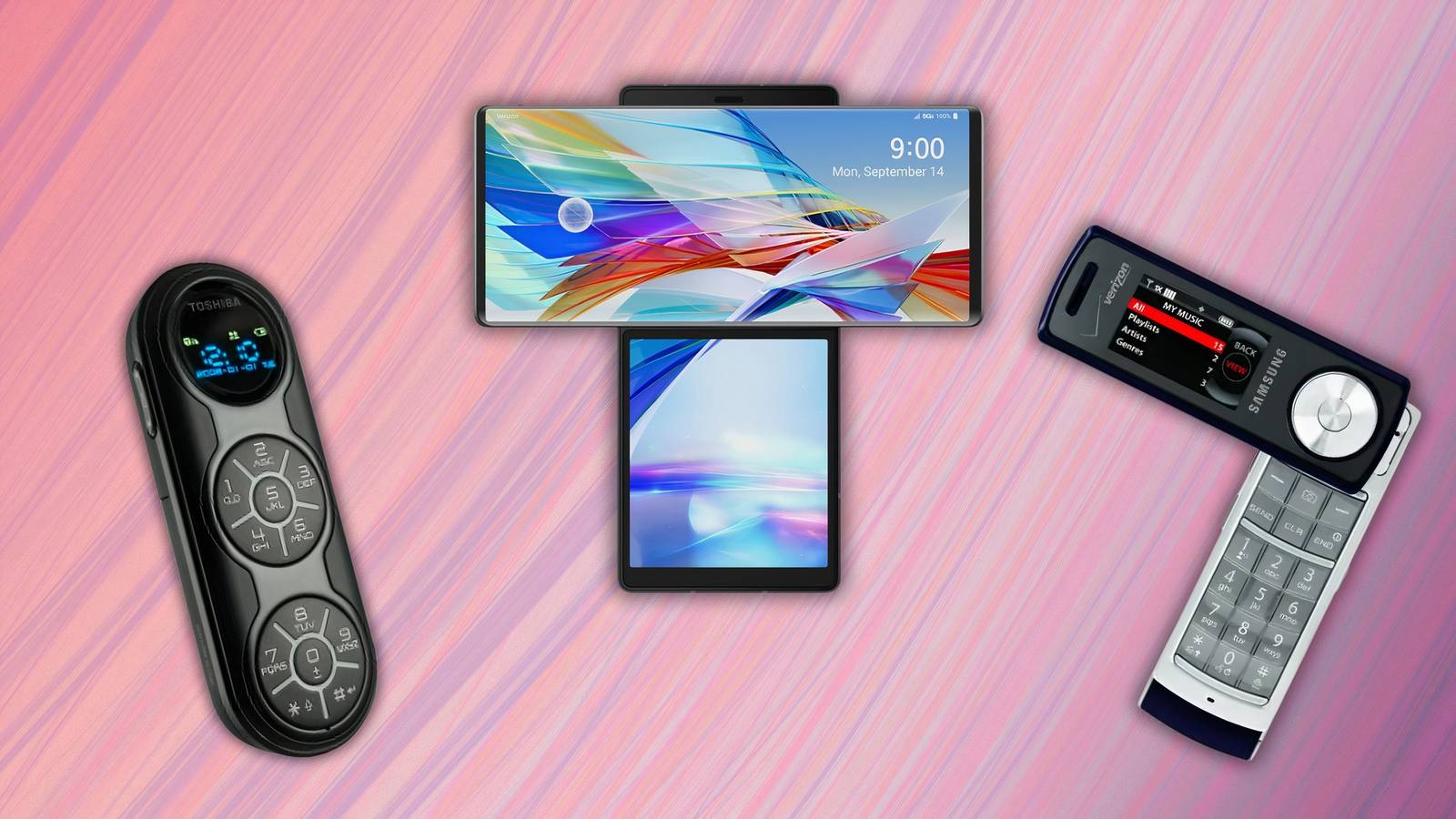
The Samsung Juke, also known as the SCH-u470 or the Verizon Wireless Juke in the US, was a quirky mobile phone notable for its egregiously elongated form factor. The device’s main gimmick was its ability to be swiveled open for use as a cellular handset, and then swiveled closed for use as a music player. In addition to its telephony prowess, the Juke featured robust audio support with a built-in equalizer, 3D sound, and broader-than-average support for audio codecs and file formats.
Toshiba G450 (2008)
The USB stick one

Toshiba’s G450 was certainly an oddball. Physically speaking, the device resembled an oversized lozenge more than a handset (Pocket-lint Managing Editor Amanda Kondolojy affectionately refers to it as the massage chair remote phone). The G450’s circular display was certainly a choice, as was its split, sperical number pad configuration. At the time, Toshiba marketed the G450 as a “four-in-one” product, encompassing a mobile phone, an MP3 player, a USB thumb drive, and, rather uniquely, an HSDPA USB modem.
Microsoft Kin ONE (2010)
The social one

From the moment it was clear the iPhone would be a smashing success, Microsoft began attempting to break into the modern smartphone space. Before we had Windows Phone-clad Lumia devices and dual-screened Surface handsets, we had Kin. Running its own Windows CE-based KIN OS operating system, the first Kin ONE resembled the Palm Pre with its landscape physical keyboard. The Kin ONE was quirky, to say the least, thanks in part to its focus on social networking and its ‘Loop’ home screen, which curated content from Facebook, X (née Twitter), MySpace, and more.
Sony Ericsson Xperia Play (2011)
The PlayStation Vita one

In the early 2010s, there was a growing fear that the mobile games industry would swallow traditional handheld gaming whole. To combat this, Sony devised a two-tier plan: create the PlayStation Vita (a handheld console with smartphone features), and create the Xperia Play (a smartphone with handheld console features). While the Vita was a middling success at best, the Xperia Play simply never took off. It’s PSP Go-style slide-out gamepad was certainly unique, but it lacked the software compatibility needed to take advantage of its physical control scheme.
HTC ChaCha (2011)
The other social one

Microsoft wasn’t the only company attempting to create a social media phone in the early 2010s. In collaboration with Facebook, HTC built both the ChaCha and the Salsa. These marketing names alone are enough to warrant inclusion on this list, but the ChaCha takes the cake with its BlackBerry-esque physical keyboard layout, which looks uncanny when paired with HTC’s distinct design language. The dedicated Facebook button near the bottom of the unit is a vestige from the past that, quite frankly, I’m glad never caught on in the end.
LG Wing (2020)
The aviation one

LG was always rather experimental with its smartphone hardware, and, nearing the end of its stint in the mobile market, it unleashed the Wing onto the world. A seemingly normal candybar-style phone on the surface, the Wing could be unsheathed into a strange, weird, over-the-top T-shaped configuration. When in this state, the bottom section of the device served as a navigation pad, while the top display allowed for landscape content consumption. Innovative, to be sure, and strange, to be even more sure.