


Hungary‘s media sector and Hollywood producers seeking its juicy tax incentive are readying for a new future after Péter Magyar’s Tisza party ended the 16-year rule of Viktor Orbán’s far-right rival Fidesz. These high hopes for reform are tempered, however, by the scale of change deemed necessary.
Under Fidesz, which led the country between 2010 and 2026, the country’s TV and film sector turned into a nightmare for many independent producers, especially those critical of the leadership.
The EU and other critics routinely called Hungary’s public broadcasting system for failing to protect journalists and acting as propaganda vehicle for the leadership, often playing Orbán speeches on loop, and projects that glorified Hungary’s military past and Fidesz’s Christian nationalist cause were favored by government-friendly bodies. There has also been widespread consternation about how around 80% of local media was concentrated within structures Orbán’s party controlled.
The pro-EU Tisza’s win has therefore led to a palpable release of emotion, with one independent producer telling us, “It’s a massive celebration here.” Changes are happening quickly, with Magyar appearing on state-run radio yesterday and vowing to suspend state media broadcasts, as he accused news anchors of kowtowing to Orbán and giving little voice to opposition.
“Every Hungarian deserves a public service media that broadcasts the truth,” he said, per Reuters. “We will need a little time to pass a new media law, a new media authority and setting up the professional conditions for state media to actually do what it is meant to do.”
His decisive election victory overnight on Sunday also delivered a blow to President Donald Trump’s MAGA movement, which many say has used Orbán’s Christian-led nationalism as a blueprint. Vice President J.D. Vance even made the voyage to Budapest last week to campaign for the autocratic Orbán, who also had the backing of Trump via Truth Social. The visit was futile, and some even suggested Vance’s presence was detrimental to the incumbent party’s election hopes, though two sources we’ve spoken to say his profile is so small in Hungary as to be irrelevant to voters.
The victory is primarily being put down to Magyar’s brand of personal politics that saw him campaign relentlessly in small villages and towns, appealing people who had become disillusioned with Orbán and offering an alternative to younger voters, who ultimately turned out in droves. The center-right Tisza will take 137 of the 199 seats in the Hungarian parliament, with Fidesz gaining just 56 – a supermajority that gives Magyar an extensive mandate to enact change. “Hungarians said yes to Europe today. They said yes to a free Hungary,” Magyar told supporters, as he waved the country’s flag in front of supporters by the River Danube earlier this week.
Fidesz will officially leave power next month following a handover period, at which point structural reform will begin. The media could be among the most visible short-term changes. Sources working within state-backed organizations spoke to us about future restructuring anonymously, as they cautiously await news and how they will be impacted.
“With this extremely high turnout for the election, almost 80% and a two-thirds win for the opposition party, it will mean a lot of changes for the country – the leader will push for this,” said a source within Hungary’s content financing system.

Peter Magyar waves a Hungarian flag to supporters after voting closes
Janos Kummer/Getty Images
Producers are now hoping Tisza’s victory will change the scope of local productions.
“Orban and his cronies put up propaganda – revisionist stuff with incredibly expensive budgets,” said one senior Hungarian TV producer speaking on grounds of anonymity. “There will be a new directive to commission films and series much more rooted in our present issues, problems and conflicts, and not this stale, revisionist propaganda. There is every reason to hope for that.”
Tisza’s supermajority victory is such that Magyar will be able to repeal much of the hardest legislation brought in during the Orbán era. He has said he will tackle cronyism and that government control of state services and media is “over,” while vowing to replace presidents of the competition and media authorities.
Prior to the election, Tisza said several bodies with leaders elected by Orbán’s government, including the National Media and Infocommunications Authority and the Media Council, “cannot be considered independent and do not fulfil their roles.” It added that the public broadcaster, Duna Média, will no longer be “a party mouthpiece,” noting, “We will mandate real editorial independence, balanced reporting, and transparent content standards, with civil oversight.”
One industry veteran said “the pubcaster leadership will change very quickly,” while an independent producer added Hungary needs to follow the example of the “Czech Republic and others who have these high-quality public TV programs.”
There’s no guarantee reform will lead to a complete cultural change, of course. Neighboring Poland voted in pro-European government in 2023, which made similar changes to undo legislation of the previous leadership, but its public broadcaster, TVP, is now trailing behind right-wing news network Republika, which has emerged from nowhere to lead the ratings, and sentiment appears to be shifting back towards populism.
Hungarian funding bodies and screen organizations will see senior management changes, and yesterday it was announced government film commissioner Csaba Káel will leave his role at the National Film Institute (NFI). “If the right people are appointed to the film institute, it will be a good balance of arthouse, more sophisticated productions and commercial ones,” said our distribution source.
Though Hungary has seen a boom in production since the NFI was created in 2020, with estimates of fivefold growth and revenues exceeding 300 billion forints ($940M) annually, Káel has come under sharp criticism for perceptions he favors Fidesz-friendly projects. Just days ago, veteran producer Gábor Kovács and filmmaker Attila Janisch both calling for him to step down and allow new management to reform the body. They’ve now got their wish, with financial commitments suspended until the changing of the guard.
We’ve reached out to the NFI and Duna Média for comment.
Party atmosphere
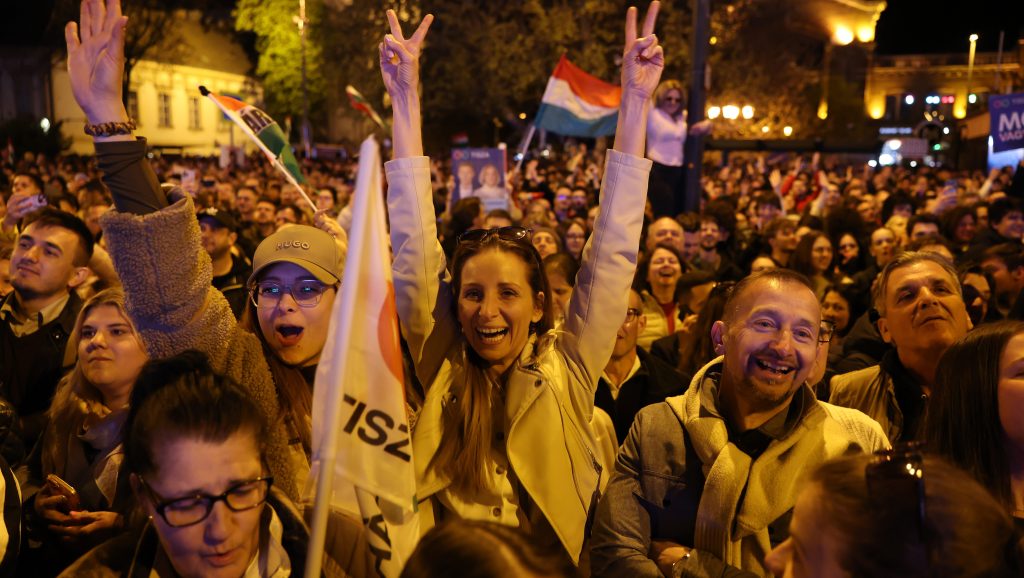
It has been a party mood in Hungary this week, with thousands turning out in the streets in celebration. Magyar, who posted AI videos to promote himself to younger voters and hit out at Fidesz, was seen swinging a Hungarian flag on a stage near the River Danube on Sunday night, but was overshadowed by fellow politician Zsolt Hegedűs, whose dance moves went viral after being picked up by cameras.
One senior TV producer told us they had postponed a meeting after celebrating slightly too hard with the masses who congregated in the country’s capital, Budapest, last night. “Everyone is hungover, it’s a huge celebration,” they said Monday morning, as images of happy Tisza supporters landed on the wires.
Once the party ends and the hard work resumes, the production sector will be eyeing potential changes under Magyar. While he is fiscally right-wing (and a former Fidesz member, no less), the new Prime Minister is considered by many to be sympathetic to Hungary’s cultural sector, co-operation with the EU and an independent media sector.
“It’s very hard to predict what will happen next, but Magyar has surrounded himself with very liberal cultural people,” said Gabor Krigler, the former HBO Europe exec who now runs production house Joyrider Television. “There is going to be a definite change.”
Among key plans for the industry, Tisza wants to re-energize the country’s lucrative 30% tax rebate, which Hungary’s film commission has claimed attracts more than 100 Hollywood productions a year. Having first launched back in 2004, the system has in recent years welcomed the likes of Alien: Romulus, The Brutalist and Dune: Prophecy. However, a decision to temporarily freeze new registrations has led to administrative bottleneck, especially with other European countries offering lucrative alternatives, and Tisza believes could Hungary’s broader position as a cultural exporter and international production hub was facing increasing peril under Fidesz.
According to Tisza, this has put under pressure the production industry’s annual revenues, which are between estimated to be between 250 billion-300 billion forints. “For economic reasons, they will have to rethink the system, but it has been contributing significantly to GDP,” said Krigler, whose company has focused on international co-productions with counterparts from the likes of the UK and the Czech Republic instead of local projects in recent years.
Magyar’s focus on the economy means reform of Hungary’s draconian anti-LGBTQ+ laws, which currently includes the banning of Pride marches and fines for promoting homosexuality in schools, may not be a priority. Magyar, who was once an ally of Orbán before breaking with Fidesz, has said his government will protect the right of assembly, but has fielded criticism for a perceived unwillingness to address the subject.
When Orbán’s legislation was fast-tracked in 2024, questions were posed around whether Hollywood would take a stand against discrimination and draw back from the country’s production incentives, but sources we’ve spoken to say this hasn’t happened. “Capitalism is capitalism,” was how one Hungarian producer described it, choosing to remain anonymous.
Tisza’s manifesto has included plans to retain and strengthen the 20,000-30,000 people who work in the production sector. “They want it to be very transparent and clear, and they want these people to stay and for the industry to grow,” said the content financing source. Hungary is considered one of the most skilled production communities in Europe, with HBO Europe’s productions from the country considered to have helped a creative boom in the earlier part of the 20th century.
The big question is whether Tisza can afford to make culture a priority, with the economic situation by far the most pressing issue for most Hungarians.
“Hungary has developed strong production capacity in recent years, and there is still room for growth,” said Emese Acs, Co-Managing Director at Fremantle-owned UFA Produkció. “A lot of that capacity is currently underutilized, so there’s a general expectation that the sector could regain momentum. That said, the industry is closely tied to the broader economic environment. If conditions improve, that will directly impact broadcasters’ spending power and ultimately lead to more commissions for producers.”
Maygar will have much to consider when he takes office next month, but what’s clear already is the country’s producers and filmmakers are ready for the reset. “This is a game-changer for me,” said Joyrider boss Krigler. “We can now return, come back and produce here again. It’s very energizing.”