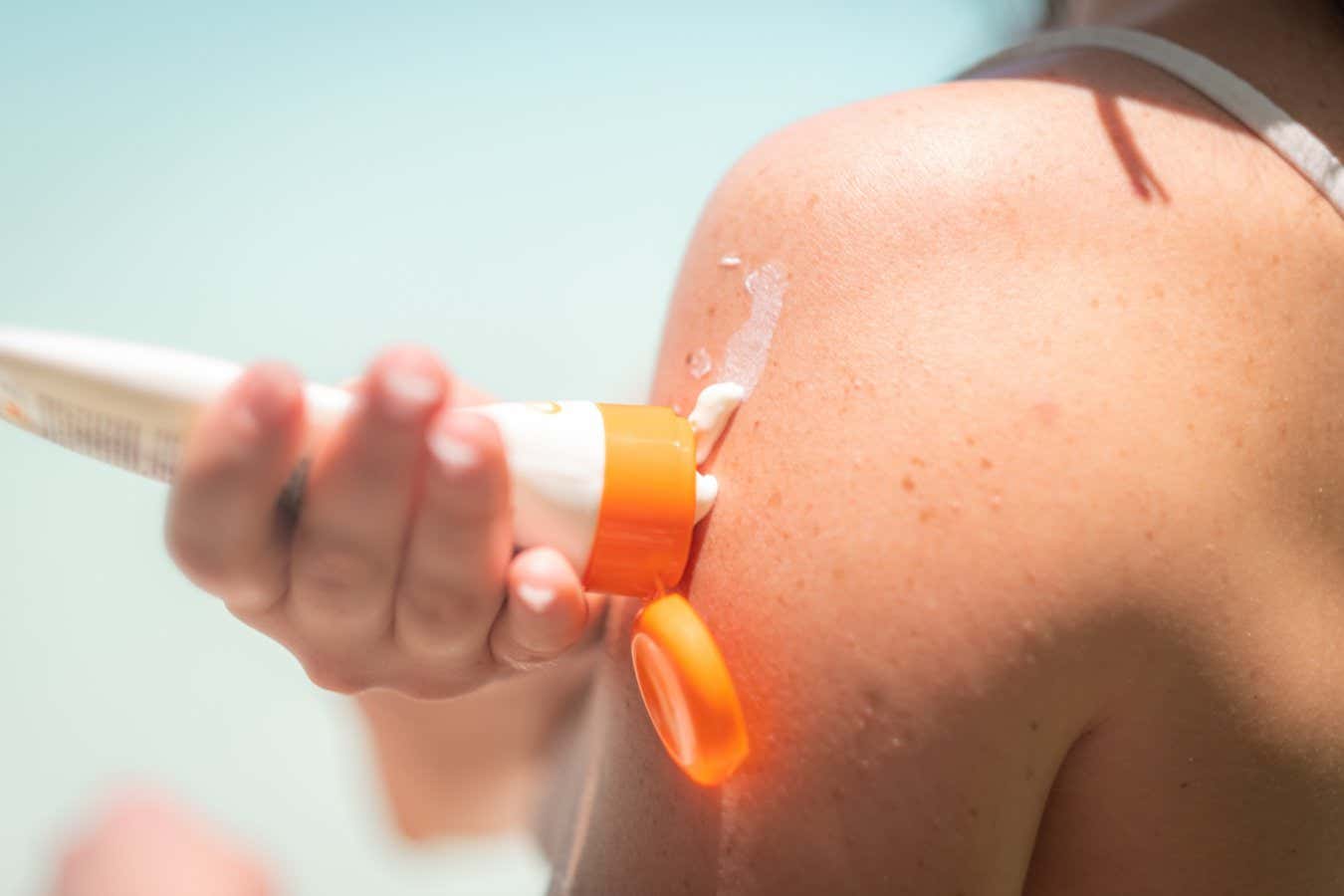

Sunscreen protects your skin, but just how much do you need?
Shutterstock
When the sun is out, many of us reach for sunscreen, but myths and misinformation have left some people confused about when and how to use it, and how to ensure we still get enough vitamin D. Rachel Neale, a skin cancer expert at QIMR Berghofer Medical Research Institute in Australia, has led clinical trials looking at the link between sun exposure and skin cancer, and sunscreen use and vitamin D. She also recently led the development of a new position statement that considers how to balance the risks and benefits of sun exposure. Here, she lists five things that everyone should know about sunscreen.
Sunscreen should be used as a last line of defence
Many people think it’s OK to lie on the beach all day in a tiny bikini as long as they rub sunscreen all over their exposed skin and reapply it every 2 hours. They think sunscreen makes them bulletproof. But even if you apply the best sunscreen perfectly, it still lets some ultraviolet (UV) radiation through. If you’re out in the sun for hours, that gradually adds up to a dose that is big enough to cause skin damage. At that point, it doesn’t matter if you apply more sunscreen; the damage is already done.
People often assume that if they reapply sunscreen every 2 hours, they’re sort of starting the protection again, but that’s not how it works. You also need to protect yourself with a hat, sunglasses, rash shirt or other protective clothing, and stay in the shade in the middle of the day. Sunscreen should be considered a last line of defence for the parts of your skin that you can’t easily cover while you’re outdoors, like your hands and neck.
There is good evidence that sunscreen protects against skin cancer and wrinkles
The largest, longest-running study of sunscreen was conducted in the Australian town of Nambour. In 1992, 1600 people in the town were randomised to apply daily sunscreen or continue with their normal sunscreen use, which tended to be minimal. It found that those who applied the daily sunscreen were half as likely to develop melanoma years down the track.
The researchers also created moulds of the backs of the study participants’ hands to look at damage to the surface of the skin. Those in the daily sunscreen group had lower rates of skin ageing compared with those who didn’t. When they were followed up on in 2014, they also had slightly fewer deaths from any cause.
The sunscreen to choose is the one you like wearing
It’s no good having sunscreen that sits in your cupboard and doesn’t end up on your skin because you don’t like the feel of it. If you’re going on a hike and you’re going to be out all day, it’s better to wear sunscreen with a high sun protection factor (SPF) of 50+. But it’s harder to get a high-SPF sunscreen that feels really nice, so if you’ll be popping out for only short periods throughout the day, you can choose an SPF 15 or 30 sunscreen. Tinted sunscreens can offer the same protection as normal sunscreens, but only if you apply them thickly. But because these often make the skin look overly tinted, people tend to apply them too thinly. One option is to first put on a thick layer of normal sunscreen, then apply the tinted sunscreen on top of it.
Chemical sunscreens, meaning those that contain organic ingredients such as octocrylene and avobenzone, work by absorbing UV radiation from the sun and converting it to harmless heat. Inorganic sunscreens, also known as mineral or physical sunscreens, contain zinc oxide or titanium dioxide particles. They are often reported to work by reflecting or scattering UV radiation, but they actually absorb UV radiation, too, like chemical sunscreens.
Wearing two layers of sunscreen helps to achieve adequate coverage
You get the SPF listed on the bottle only if you apply 2 milligrams of sunscreen per square centimetre of skin, which is around 7 teaspoons for full-body coverage in an average adult. But it’s really hard to apply this amount of sunscreen in one go. One day, I decided to measure it out exactly, and I couldn’t rub it all on; it was too much. So now, I apply one layer, let it sink in while I brush my teeth and do other things, and then a second layer, so I can apply the full recommended amount.
I was born in Armidale, Australia, in the late 1960s and didn’t wear sunscreen as a child, despite my pale skin. I’ve since had three skin cancers removed, the first of which appeared when I was just 29. So now, I am careful to protect my skin.
If you’re diligent with sunscreen, you might need to take a vitamin D supplement
We recently conducted a trial called the Sun-D Study to see whether applying SPF 50+ sunscreen every day affects people’s vitamin D levels. We randomly assigned 639 people to apply SPF 50+ sunscreen as part of their daily morning routine on days when the UV index was forecast to reach 3 or higher, or to use it at their own discretion. After about a year, a higher proportion of participants in the daily sunscreen group were vitamin D-deficient – about 46 per cent compared with 37 per cent in the control group. If you wear sunscreen every day, I would advise taking a vitamin D supplement so that you don’t become deficient, especially in winter. I take one myself – they are cheap, safe and effective.
People with dark-coloured skin are at greater risk of developing a vitamin D deficiency. I recently led the development of a new position statement that looked at how to balance the various risks and benefits of sun exposure. It brought together experts from many Australian universities and medical organisations, and it concluded that people with dark-coloured skin need to put on sunscreen only if they plan to spend more than 2 hours outdoors on days with high UV radiation levels. This is in recognition of the fact that melanoma incidence is 30 times lower in people with dark-coloured skin than in those with light-coloured skin, and that vitamin D deficiency poses a greater risk.
Topics: